
If you’ve seen the ads promising Rocket Money will “cancel your forgotten subscriptions” and “negotiate your bills for you,” your first instinct is probably a healthy one: is Rocket Money legit, or is this too good to be true? You’re handing a budgeting app access to your bank accounts, so the skepticism is warranted.

Rocket Money spots the subscriptions you forgot you were paying for and can negotiate your bills down, and you only pay a fee if it actually lowers one. Your data stays protected with bank-grade AES-256 encryption and read-only account connections. Test out Premium free for a week, cancel whenever you like.
- View all your accounts and finances in one dashboard
- Identify subscriptions free, then cancel them hands-free with Premium
- Set up budgets and put savings on autopilot with Premium
- Add net worth tracking and credit reports with Premium
Here’s the short version: Rocket Money is a legitimate, real company, not a scam. It’s owned by Rocket Companies, the publicly traded parent of Rocket Mortgage that files audited annual reports with the SEC, and it carries an A+ rating with the Better Business Bureau. More than 10 million people use it to track spending and kill unwanted subscriptions.
But “legit” and “perfect” are not the same thing. The real complaints about Rocket Money aren’t about fraud or stolen data. They’re about the trial-to-paid flow, the bill-negotiation fee, and how hard some users find it to cancel. This guide breaks down exactly what’s legitimate, what to watch out for, and whether it deserves your trust in 2026.
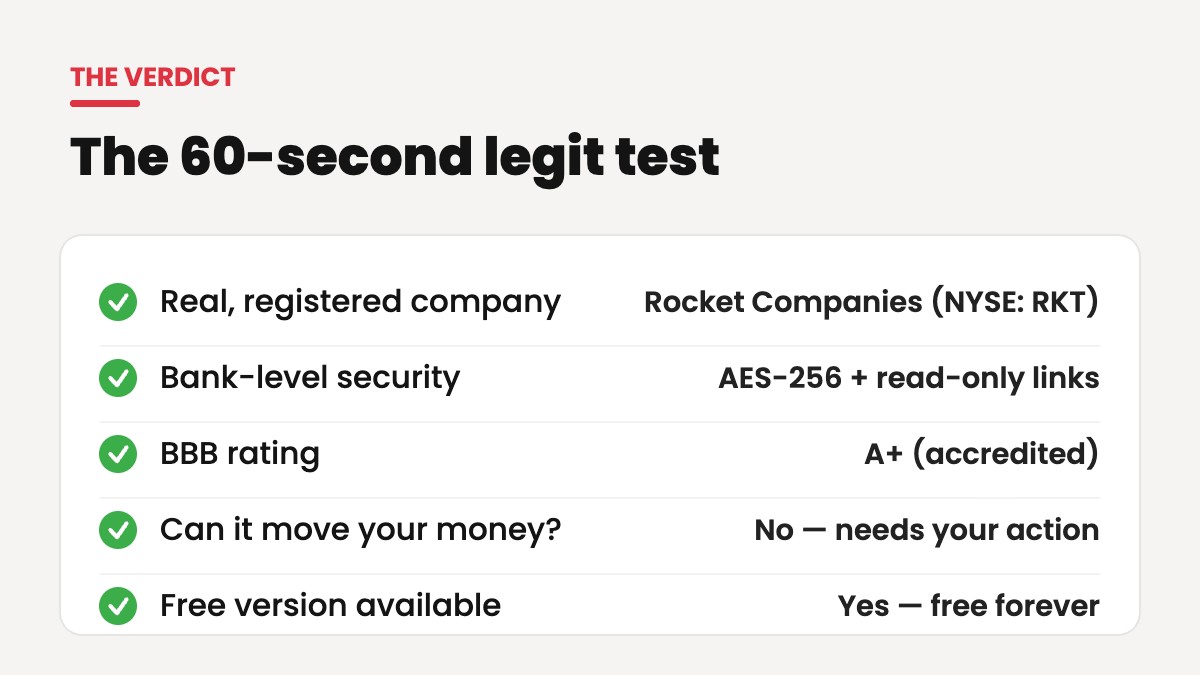
| The Legit Test | 🚀 Rocket Money |
|---|---|
| Real, registered company? | ✅ Yes, owned by Rocket Companies (NYSE: RKT) |
| Bank-level security? | ✅ AES-256 encryption + read-only bank links |
| BBB rating | ✅ A+ (accredited) |
| Can it move your money? | ❌ No, not without your explicit action |
| Free version available? | ✅ Yes (Premium is optional) |
| The catch | ⚠️ Bill-negotiation fee + easy-to-miss trial renewal |
Is Rocket Money Legit? Who Owns It and How It Makes Money
Yes, Rocket Money is legit. It is a real, U.S.-based financial technology company with millions of active users, a physical corporate presence, and a publicly traded parent company that files audited financial statements with the SEC. When a company is owned by a business that trades on the New York Stock Exchange, it operates under a level of regulatory scrutiny that no fly-by-night scam app could survive.
The confusion usually comes from two places. First, the app asks to connect to your bank accounts, which understandably makes people nervous. Second, a lot of the online reviews are angry, but when you actually read them, they’re overwhelmingly about billing surprises, not security breaches or theft. That’s an important distinction, and we’ll dig into it below.
Who Owns Rocket Money? (And Why It Matters)
Understanding who’s behind an app is the fastest way to judge whether it’s legit. Here’s the Rocket Money timeline:
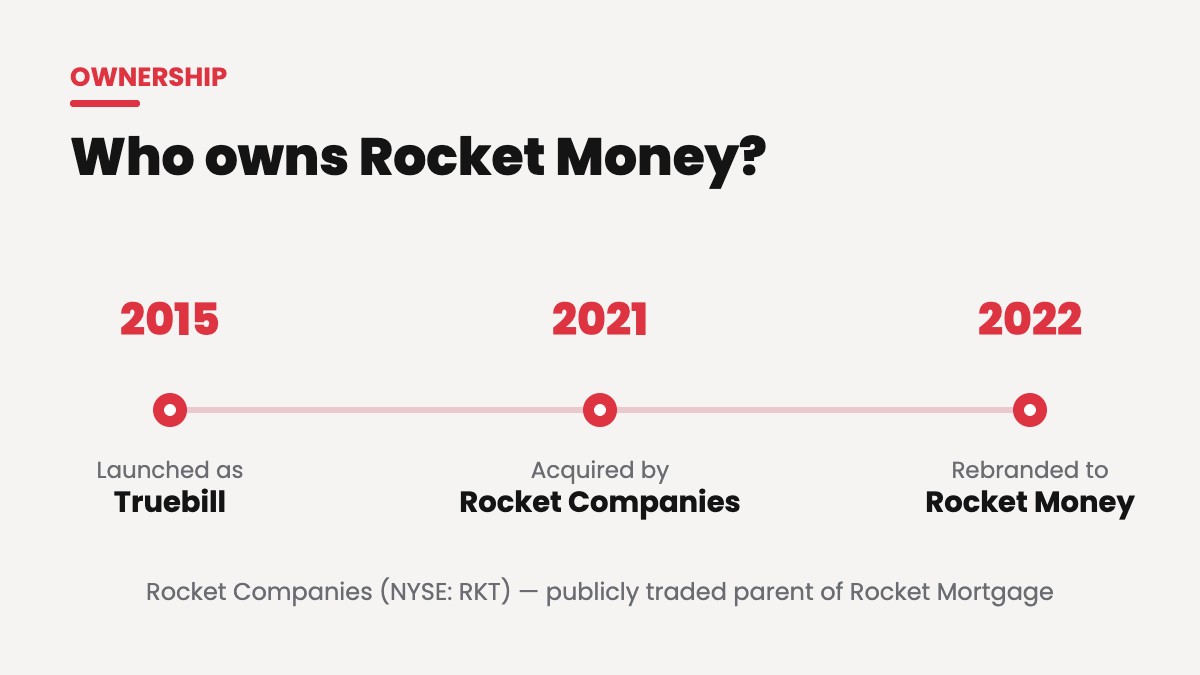
- 2015: Launched as Truebill. The app was founded as Truebill, a subscription-tracking and bill-management tool, and quickly built a reputation for helping people cancel forgotten subscriptions.
- 2021: Acquired by Rocket Companies. Rocket Companies (NYSE: RKT), the publicly traded parent of Rocket Mortgage, bought Truebill for roughly $1.3 billion.
- 2022: Rebranded to Rocket Money. Truebill became “Rocket Money” to fold it into the broader Rocket ecosystem of financial products.
Why does this matter? Because a scam app is anonymous, offshore, and hard to hold accountable. Rocket Money is the opposite: it’s a named subsidiary of a Fortune 500-scale, SEC-reporting company. If it behaved fraudulently, it would face regulators, class-action lawyers, and shareholders, not exactly the profile of a scheme trying to disappear with your data.
The trade-off worth noting: because Rocket Money sits inside a larger financial-services company, it may market you other Rocket products (like mortgages or loans). That’s a normal cross-sell, not a scam, but it’s worth knowing your data lives inside a bigger ecosystem.
Is Rocket Money Safe? Security & Encryption
Legitimacy and security are related but separate questions. A company can be 100% real and still be careless with your data, so let’s look at how Rocket Money actually protects your information.
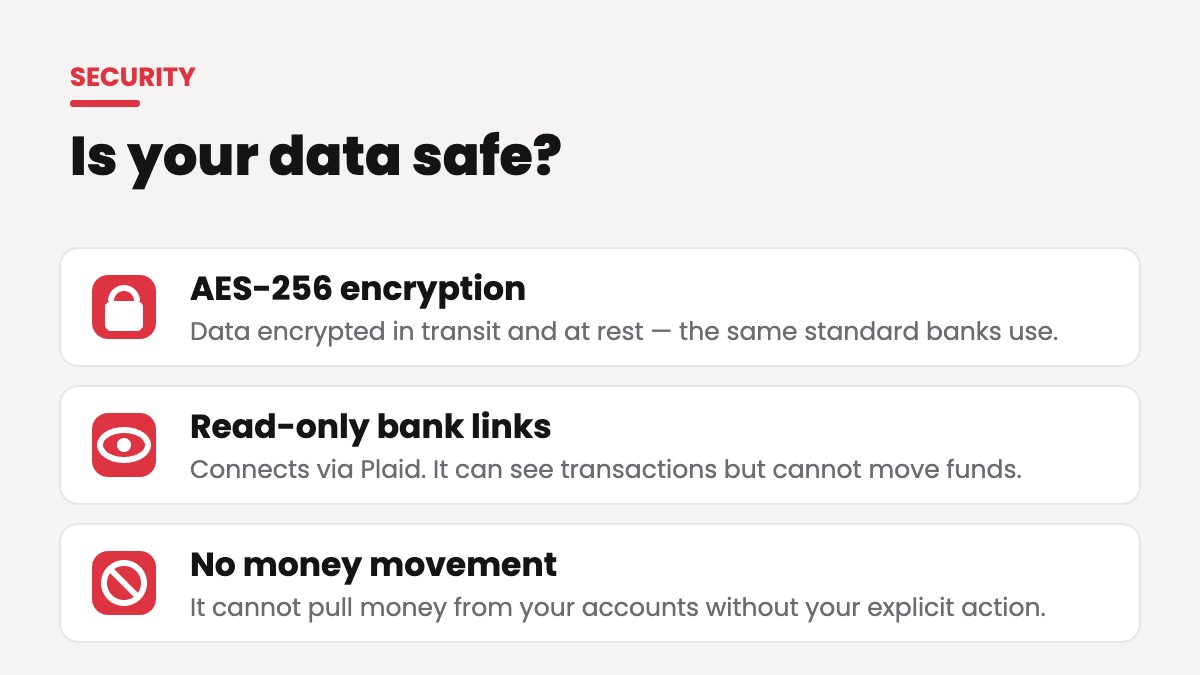
- AES-256 encryption. Rocket Money encrypts your data both in transit and at rest using AES-256, the same encryption standard used by banks and government agencies.
- Read-only bank connections. Rocket Money links to your accounts through secure third-party aggregators (like Plaid). These connections are typically read-only, meaning the app can see your transactions but cannot move money out of your accounts.
- No permission to transfer funds. Rocket Money cannot pull money from your linked bank accounts without your explicit action (like setting up an autosave or paying for Premium).
- No major reported breaches. As of 2026, there are no widely reported major data breaches tied to Rocket Money.
- FDIC-insured savings. Rocket Money itself is a financial technology company, not a bank. If you use its Financial Goals / Smart Savings feature, your funds are held at nbkc bank, Member FDIC, insured up to $250,000 per depositor, per institution, the standard federal limit that applies to traditional bank accounts.
The single most important thing you can do on your end is enable multi-factor authentication (MFA) and use a strong, unique password. The biggest realistic risk with any budgeting app isn’t the company getting hacked. It’s your own login getting compromised because you reused a password.
Is Rocket Money Free, or Does It Cost Money?
This is where a lot of the “is Rocket Money a scam?” frustration actually comes from, not because it’s dishonest, but because people don’t realize where the free plan ends and the paid plan begins.
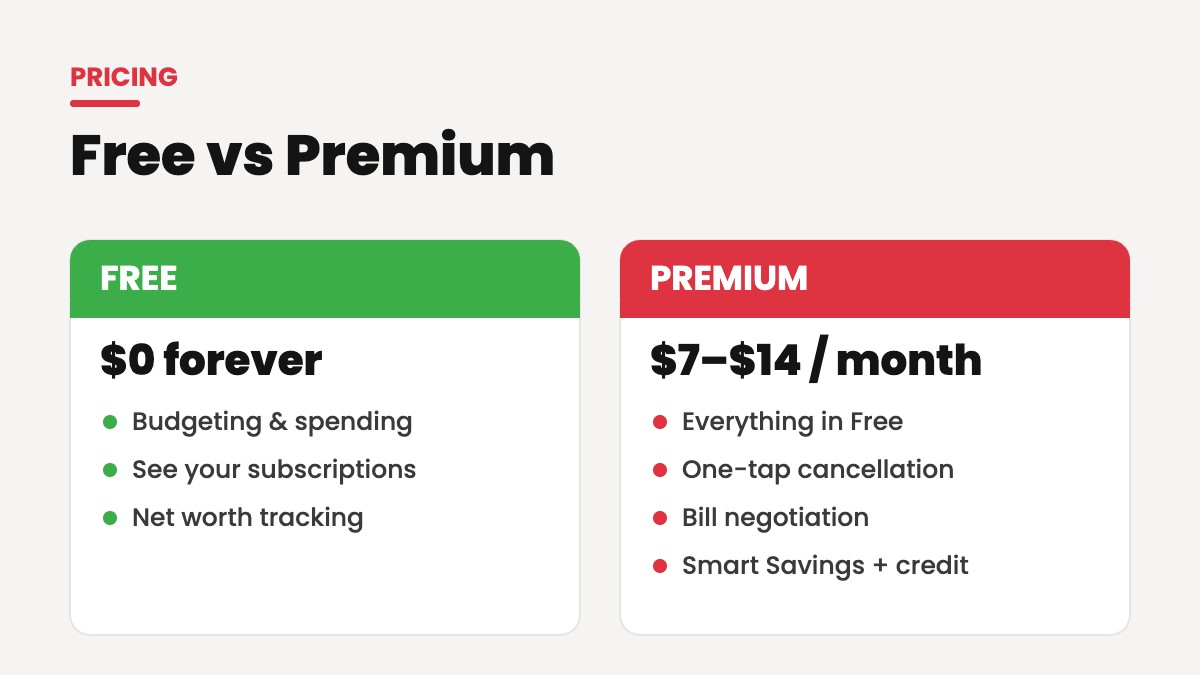
| Feature | Free Plan | Premium ($7–$14/mo) and Premium+ ($15/mo) |
|---|---|---|
| Budgeting & spending tracking | ✅ | ✅ |
| See your subscriptions | ✅ | ✅ |
| Net worth tracking | ✅ | ✅ |
| One-tap subscription cancellation | ❌ | ✅ |
| Bill negotiation | ✅ (success fee applies) | ✅ (success fee applies) |
| Smart Savings / autosave | ❌ | ✅ |
| Premium credit monitoring | ❌ | ✅ |
The free plan is useful and costs nothing. You can track spending and see every subscription you’re paying for without spending a dime. Premium uses a “pay what you think is fair” model from $7 to $14 per month and comes with a 7-day free trial. A third tier, Premium+, costs $15 per month and adds Rowan, an AI assistant you text, plus bill negotiation with no success fee. The catch on the trial: it takes a card up front, and if you don’t cancel before it ends you start paying the monthly amount you picked. That first charge is the source of most of the “surprise charge” complaints.
How Does Rocket Money Make Money If It’s Free?
It’s a fair question to ask of any “free” financial app. Rocket Money makes money in three ways, none of which involve selling your data.
- Premium subscriptions. The “pay what you think is fair” model ($7–$14/month), plus a flat-rate Premium+ tier at $15/month, is the core revenue driver. Users voluntarily choose a price within that range for the full feature set.
- Bill-negotiation success fees. When Rocket Money successfully lowers a bill, it keeps 35%–60% of the first year’s savings. If negotiation fails, there’s no charge.
- Cross-promotion within the Rocket ecosystem. Because Rocket Money is owned by Rocket Companies, it may surface other Rocket products (mortgages, loans) to users. This is standard cross-selling, not a hidden cost to you.
None of these revenue sources require Rocket Money to sell or share your personal financial data with advertisers, which is a meaningfully different business model than free apps that monetize purely through data sales.
The Real Complaints (What “Not Legit” Reviews Actually Mean)
Rocket Money holds an A+ BBB rating, yet its customer review scores are much lower, around 3.3 to 3.5 stars on Trustpilot and notably lower on BBB’s own customer-review section. That gap is the most honest picture of the app. Here’s what’s actually behind the negative reviews:
1. The bill-negotiation fee surprises people
When Rocket Money negotiates a bill down for you, it charges 35% to 60% of your first-year savings as a success fee, and only if it actually lowers the bill. If it saves you $300 over a year, the fee could be up to $180. It’s disclosed, but a lot of users don’t register how large the fee can be until it hits their account. Worth knowing: bill negotiation itself is open to everyone, including free users, so you can try it without a Premium subscription (as of 2026-08-20).
2. The trial-to-paid renewal catches people off guard
The 7-day free trial auto-converts to a paid monthly membership if you don’t cancel. That’s standard SaaS practice, but combined with the “pay what you want” screen, some users do not register that the trial took a card at all. You can cancel any time, and there is no annual commitment.
3. Some “savings” turn out to be one-time credits
A recurring Trustpilot/BBB theme: Rocket Money claims a monthly saving that turns out to be a one-time credit, so the promised reduction doesn’t show up on the next bill. Regulators have noticed the friction too. In December 2022, the Electronic Privacy Information Center (EPIC) filed a CFPB complaint over what it called deceptive practices. None of this makes Rocket Money a scam, but it’s fair to go in with clear eyes.
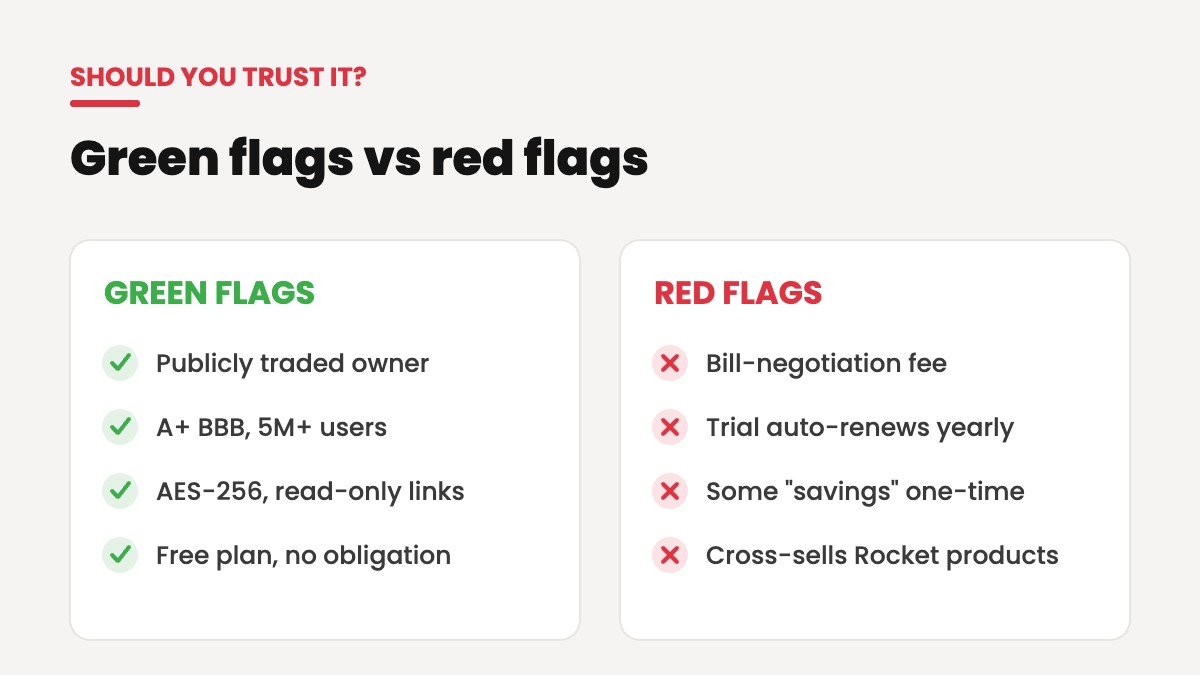
Rocket Money: Green Flags vs. Red Flags
| ✅ Green Flags (Legit) | ⚠️ Red Flags (Watch Out) |
|---|---|
| Owned by publicly traded Rocket Companies | Bill-negotiation fee can be large (35% to 60% of year one) |
| A+ BBB rating, 10M+ users | 7-day trial auto-renews to a paid monthly plan |
| AES-256 encryption, read-only bank links | Some “savings” are one-time credits |
| Free plan with no obligation to upgrade | Cross-marketing of other Rocket products |
Rocket Money vs. Other Budgeting Apps
Legitimacy questions aside, Rocket Money’s pricing structure is different from most of its paid competitors. Here’s how it stacks up as of 2026:
| App | Free Plan? | Paid Price | Free Trial |
|---|---|---|---|
| Rocket Money | ✅ Yes, permanently | $7–$14/mo (you choose), $15/mo Premium+ | 7 days |
| YNAB | ❌ No | $14.99/mo or $109/yr | 34 days, no card required |
| Monarch Money | ❌ No | $14.99/mo or $99.99/yr | 7 days, card required |
Pricing verified directly from each provider’s site, August 2026. Subject to change, so confirm current rates before signing up.
The takeaway: Rocket Money is the only one of the three with a permanent free tier, and its “name your own price” Premium floor ($7/mo) undercuts both competitors’ fixed monthly rates.
So, Should You Trust Rocket Money?
Here’s the balanced verdict. Rocket Money is legit, secure, and safe to link to your bank. The company is real, the encryption is bank-grade, and it can’t move your money without permission. For a free spending tracker and subscription finder, it’s one of the easiest wins in personal finance: link your accounts and you’ll usually spot forgotten charges within a day.
The place to be careful is Premium. If you upgrade, set a calendar reminder before the trial ends, read the bill-negotiation fee terms before you approve a negotiation, and confirm any promised savings are recurring rather than one-time. Do that, and the “scam” complaints simply don’t apply to you.
Who Rocket Money Is Best For
- Good fit: People with forgotten subscriptions across several accounts who want a single dashboard for spending, plus the option to have someone else negotiate a bill.
- Good fit: Anyone who wants a free budgeting tool and doesn’t need every premium feature on day one.
- Possibly not a fit: Detail-oriented DIY budgeters who already track spending manually and negotiate their own bills. The premium features solve a problem they may not have.
Frequently Asked Questions
Yes. Rocket Money is a legitimate financial app owned by Rocket Companies (NYSE: RKT), the publicly traded parent of Rocket Mortgage. It has an A+ Better Business Bureau rating and more than 10 million users. It launched as Truebill in 2015 and rebranded to Rocket Money in 2022.
Yes. Rocket Money uses AES-256 encryption and connects to your bank through secure, read-only aggregators like Plaid. It can see your transactions but cannot move money out of your accounts without your explicit action. Enabling multi-factor authentication adds another layer of protection.
No, Rocket Money is not a scam. Most negative reviews relate to billing surprises, such as the bill-negotiation success fee, the auto-renewing free trial, or savings that turned out to be one-time credits, rather than fraud, theft, or data breaches.
The low review scores are almost entirely about the paid Premium experience: the bill-negotiation fee (35%–60% of first-year savings), the 7-day trial converting to a paid monthly plan, and confusion over one-time vs. recurring savings. These are avoidable if you read the terms and set a reminder before the trial ends.
Yes, Rocket Money has a free plan that includes budgeting, spending tracking, subscription visibility, and net worth tracking. Bill negotiation is available on the free plan too. Other Premium features, like one-tap cancellation and automated savings, cost $7–$14 per month on a “pay what you want” model with a 7-day free trial.
Rocket Money charges 35% to 60% of your first-year savings as a success fee for bill negotiation. For example, if it saves you $300 over a year, the fee could be up to $180. You only pay if Rocket Money actually lowers your bill.
Rocket Money is owned by Rocket Companies (NYSE: RKT), the publicly traded parent company of Rocket Mortgage. Rocket Companies acquired the app, then called Truebill, in 2021 and rebranded it to Rocket Money in 2022.
Rocket Money itself is not a bank, so it isn’t FDIC insured as a company. However, funds you save through its Financial Goals / Smart Savings feature are held at nbkc bank, Member FDIC, and insured up to $250,000 per depositor, per institution, the same standard protection as a traditional bank account.