Experienced workers have a job search lasting about 43 days, and fresh graduates can expect a longer wait. Your search will be much harder if you make one of the following very common mistakes. Avoiding all 5 will not promise an interview, but hitting any might mean you are missing out.

Errors In Your Application

crumpled resume

When you are applying for a job, you should be triple-checking everything you want to send to your potential employer. Every job posting gets over 250 applications, and every hiring manager is looking for the fastest, easiest way to chop down that pile into something manageable. If you have typos in your resume, or misspell the manager’s name in your introduction or cover letter, chances are you will never get a call back.

Even earnest job applicants fall into this trap. If you are applying to many jobs, and making tweaks to your resume for each one (as we recommend), it is easy for a typo or two to slip in the cracks.

How To Avoid It

Your secret weapon is checklists. Surgeons use checklists to make sure they never skip steps, and you should too. You may want to customize the checklist for your own job search, but you can find a good template below.

  1. Does my resume and cover letter include everything I want it to?
  2. I have at least 2 keywords in my resume.
  3. I have at least 3 keywords in my cover letter.
  4. My resume has no spelling errors.
  5. I have the correct company name, job title, and hiring manager name (if applicable) in my cover letter.
  6. My cover letter is free of grammar errors
  7. My cover letter has no spelling errors
  8. I have included the correct attachments on the email I’m sending to the hiring manager

Applying for jobs you are not qualified for

tossed application
Another way to get rejected, and blocked from applying again

This mistake will come up more often the longer your job search drags out. As your savings start to run low, you may try to stretch your qualifications and apply for more jobs outside of your element – this can cripple your chances of getting an interview (and an offer).

The problem arises from what are called “Blacklists”. These are lists of applicants that a hiring manager was hit with such a bad impression that they basically strike the applicant from consideration at any other posts in their company.

If you are on a blacklist, that means that the hiring manager felt that you wasted their time, and so your name is removed from consideration from all jobs at that company. The most common reason to be blacklisted is applying for jobs that you are not qualified for. If the hiring manager thinks you are stretching your qualifications to the limit, or not meeting their baseline application requirements, you are risking the blacklist for that company, so not only will you not get a call back for this post, but probably any others too.

How To Avoid It

This is a tricky one to avoid. Hiring managers usually put far more “essential requirements” for a job than are really needed. You can usually safely apply to a job where you meet 50% of the required qualifications because of that. The real trick is finding out which of the qualifications you can ignore, and the ones that can get you blacklisted if you ignore.

Required education (bachelor’s degree, associates degree, MBA) are usually strict requirements. If you do not meet the education requirement, you better have quite a lot of experience to make up for it.

Certifications can be trickier. If a position requires a certification that you do not have, read about that certification before applying. If it is something that requires sponsorship from your employer, then you can usually apply so long as you express your intention on obtaining it as soon as you start. Having a pre-certification, like our Series 7 Course, is also a great way to get your foot in the door.

Being able to use specific software or have a specific skill is more lenient. These are usually more of a “wish list”, so having a couple of these will help, but you can confidently apply even if you just have one or two (if you have none, that is a red flag). Always use your head – if you are applying for a Graphic Designer position but you do not have the required proficiency in Photoshop, that can be just as bad as missing the Education requirement.

Cutting your job search short

confident business student
Just got his first call back

If you have been searching for a position for more than a couple weeks, there is no bigger relief than a call back or an invitation to an interview. Searching for positions to apply for, writing new cover letters, and constantly tweaking your resume can be an exhausting process, and getting that call back seems like a light at the end of the tunnel.

The only problem is when you decide to put new applications on hold while you wait to see how your interview goes. Before you know it, 2 weeks have passed, you finally send an email to ask how the interview went only to find out they went with another applicant. Now you are 3 weeks behind on your job search, with nothing to show for it.

How To Avoid It

To avoid this one, first you should understand the “Hiring Funnel“, as John Sullivan puts it. You were one of the 200 or so people who applied for this job, and the hiring manager picked out probably around 20-25 for a first-round interview. If you are one of these, you have passed the 90% mark, but you still only have about a 10% chance of getting the job.

If you are called back for a second round interview, then you know it is serious, but the hiring manager probably called another 4 or 5 people, so you are still only looking at a 20-30% chance of getting this job. Even if you hit the final interview stage, you are still competing with 2 or 3 other people. Until you actually have a job offer in-hand, probability says that you likely will not get this be their first pick, but there will probably be between 2 and 4 weeks between when you first get a call for an interview and when the final decision is made.

If you are called back for a second or third round interview, you can safely put your search for new jobs to apply for on hold for a couple days to make sure you are fully prepared. The most important thing to remember is that your job search “isn’t over until its over”.

Applying for too many jobs

Exhausted job seeker

This pitfall is the opposite of the previous – you are so concerned with getting an interview that you tried to cast a very wide net and make sure you always have applications sent out. This is a common problem because it is also a productive habit. Maybe you set a goal for yourself to find and apply for one new job every day, or spend 8 hours searching for a job every week.

The problem does not usually come up until a couple weeks of trying to meet your “quota”. As you move farther into your job search, the grind of constantly finding and applying to jobs will begin to wear on you, and quickly. This means you are much more likely to start cutting corners (not properly optimizing your resume for keywords and the job you’re applying for), make mistakes (more typos, less likely to follow your checklists), and apply for jobs for which you are not fully qualified.

How to avoid it

This might be the hardest one to avoid, if you are a dedicated job seeker. Setting goals for yourself is one of the most important ways to stay motivated and keep your job search running. It is equally important, though, to recognize when the grind is getting to you, and take a break.
If you have been at your job search for more than two weeks, ask yourself the following questions before you start to apply for a new job:

  1. Am I applying to this just to say I’ve applied today?
  2. If I saw this posting last week, would I have skipped it?
  3. If I got this job, would I probably quit within the first year?

If you answer “yes” to any of these, it may be a good idea to skip this posting and take a break from applications for a day or two, and come back with fresh eyes later.

Starting Too Late

out of time

As we said in the intro, the job search process will last around 43 days for experienced workers, longer for fresh graduates. This application time is going to be stressful – probably a lot more stressful than any job you secure, so you should count your job search time as work.

A very common problem with graduating students or people who are looking to leave their current position is that they do not start their job search before graduating/quitting. This is done for a variety of reasons, but some of the most common are wanting a “clean break” (some space between school and work, or between jobs) and underestimating the competition in the job market.

If you start your job search too late, the total time you will spend unemployed will go up, but you also increase the chances of making any of the mistakes above. If you get call backs for interviews right away, you will probably underestimate the competition and think that your break was justified. If you don’t get calls for interviews right away, you may begin to panic and apply for too many too quickly, without giving yourself adequate time to customize your application for each job you apply to. Either way, you will always wish you started the job search sooner.

How To Avoid It

A question we get all the time is “when should I start looking for a job”? The answer is always right now. Even if you will not graduate for another 3 years, start looking for jobs right away. You may not start applying, but you will get to know the job market, and the skills that employers are looking for in the jobs that you want. This will give you an opportunity to cater your educational path towards the skills employers want.

If you are graduating within the next year, searching for jobs now can help you find what certifications you can start working towards right away to get you a leg up over the competition.
If you are graduating at the end of this semester, you should be searching and applying for jobs or internships as soon as possible. Companies generally hire entry level positions in cycles, so try to get any interviews you can lined up before you graduate.

Applying while you are still in school, getting ready to graduate, is also a great way to show initiative to potential employers. You can get started with our job search tool, which posts listings from all over the world in one easy place.


Pop Quiz

[mlw_quizmaster quiz=70]

The internship season is upon us. It might be better to say that it never ended.

Some estimates put the total number of internships in the United States a bit over 1.5 million positions per year, and with new spots opening with every school term, students with an eye for work experience are usually keeping tabs for interesting posts opening in their area.

In fact, internships have become such a standard part of the college experience that your university might require it for your major, or assume that most students will partake on their own initiative.

What should you, the intrepid business student, be looking for when you start applying for internships?

The Value of the Internship

The most valuable benefit of an internship is, of course, getting some work experience under your belt, which is why so many students are keen to have one or two added to their resume before they graduate.

Internships are also seen as a great way to get recruited and have a job waiting after you graduate – making a great impression on a company you want to work for during your internship can help skip the line when they start hiring fresh graduates. Getting an internship after you graduate is also a tried and true method of getting your foot in the door.

We digress – these are the benefits you have heard about from every angle by now. What you might not know is how much the circumstances surrounding your internship will play out for your job prospects after you graduate.

Paid Versus Unpaid

Everyone would prefer an unpaid internship, of course, but you might be surprised at how big a difference it comes to whether you are paid for your work. The conventional wisdom over the last few years has been that the experience of the internship is the most valuable part of the experience, but paid internships offer a lot more than a bit of extra cash.

You get what you’re paid for

Paid internships are always better than unpaid

Every year, the National Association of Colleges and Employers surveys internship participants about their experiences. For students who undertook paid internships, all the common knowledge of internships applied: students graduated with job offers nearly twice the rate of students with no internships (63% vs 35%), earned far more in their first jobs ($51,200 vs $37,000), and generally benefited in every way that was expected.

Students who went with unpaid internships had a very different story. On the whole, they were barely better off in terms of job offers than their peers with no internship at all (37% vs 35%), and worse, they started at even lower salary points ($35,700 vs $37,000).

Why The Discrepancy?

fetching coffee
Should not be a major part of your internship experience

There are a few factors at play when it comes to unpaid internships. The first is that companies who tend towards hiring lots of unpaid interns are generally more strapped for cash than those who pay for student labor. This means when it comes to hiring, they are less likely to have many openings to offer even the best interns.

Another factor at play is that when a company hires an unpaid intern, they are making a much smaller investment in that student, so there is less incentive to make that intern be fully productive. This translates to less training, less important tasks assigned, and (most importantly) less incentive to keep them around after the internship expires.

This means that the job experience you get with an unpaid internship is likely much less valuable than a paid internship.

Are unpaid internships worth it?

Not worth the effort

Lower starting wages, barely better chances of getting a job, less interesting work while on the internship, why would students offer to work for free at all?

At the end of the day, the solution is not quite as simple. Taking an unpaid internship in finance is not the same as taking an unpaid internship in social services, for example. If you intend to enter a field where you simply do not see many (if any) paid internships advertised, the field itself may require unpaid internships as a proving ground. This is especially the case in industries like fashion and writing.

The truth of the matter is, though, that even in these industries where unpaid internships are the norm, you will probably struggle to find work after graduating because the industries themselves are so competitive.

Internships are only valuable if you gain work experience that will help you later in your career. If you cannot find a spot at a company that you want to work with, you may be better off sticking with the classroom and try to build up your resume through certifications or other training programs.

How To Land A Great Internship

Dress to impress

When you apply for an internship, all of the standard rules for job seekers apply. Have a great resume. Write a killer cover letter. Be ready to crush your competition with a great interview.

There are some extra tips and tricks to keep in mind though. Companies generally hire interns in cycles, but the recruitment process to fill each internship starts an average to 6 to 8 months ahead. If you want to get an internship before you graduate, you need to start right now (click here to go to our internship search page).

Internships are also extremely competitive, moreso now than ever. Companies expect to hire fewer interns in 2016 than they did in 2015, so your pool of competition is getting fiercer. Be ready to apply early and often, and be ready for rejection (as with any job hunt).

What if I miss out?

If you try and fail to land an internship, it is not the end of the world. Per the most recent survey data, you have some things to take solace in:

  • You’re probably going to earn more after you graduate than someone who took an average unpaid internship out of desperation to have “something”.
  • Just because you get an internship doesn’t mean you have a secured job. After 1 year, workers who had no internship had more secure jobs than people who took an internship, but were hired by a different company after graduation
  • After 5 years, workers who had no internship at all had the most secure jobs (64.2% were still with the first employer they worked with after graduation).

Where To Find Internships

You can use our Job and Internship Search Tool – we pull in listings from several different job and internship databases around the country, so it is a great place to start!

Pop Quiz

[mlw_quizmaster quiz=71]

Stock market games are an awesome way to introduce your students to investing, but keeping them on the right track can be tricky. Some students want to dive into day trading penny stocks, while others will want to pick out a mutual fund and stay out of the action. Striking a balance can be tricky, which is why our new Diversification Rule is here to help!

How It Works

When you next set up your HTMW class, you now have 2 settings to make sure your students are building a diversified portfolio.

Position Limit

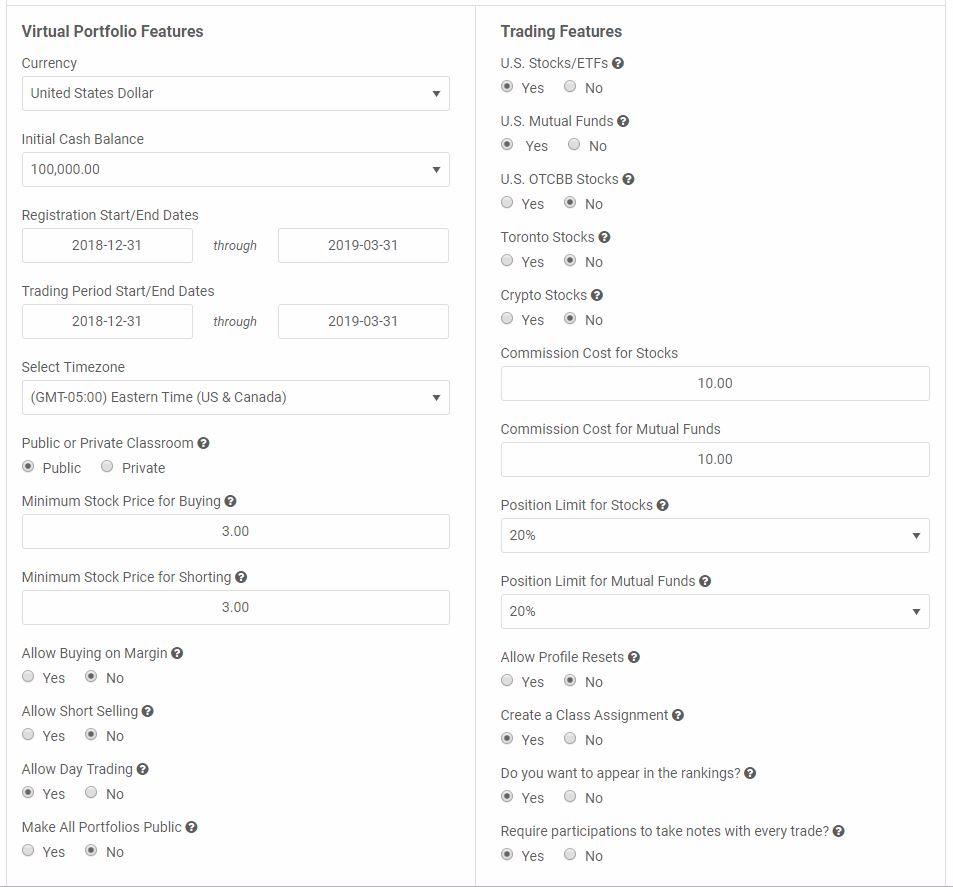
Position Limits have been part of HTMW for some time, but they are now more important than ever! Setting a “Position Limit” puts a cap on how much a students can invest in a single security. For example, if your students have $100,000 portfolios and a 25% position limit, they can only invest up to $25,000 in AAPL stock.

Diversification Limit

Diversification Limits are new for 2019 – this is a brand-new setting that determines how much your students can invest in an entire security type. For example, if your students have a $100,000 portfolio and a 50% Diversification limit on Stocks, they can only invest $50,000 in stocks as a whole – the remaining $50,000 must be invested in Mutual Funds or held as cash.

Try to mix and match your Position Limits and Diversification Rules to make sure students get their feet wet in a variety of different securities – and make this the most exciting stock game yet!

If you haven’t already, make sure your create your class for this Spring by Clicking Here.

When trading penny stocks, traders should remember that penny stocks are companies whose shares trade for under $1. They are known to be often risky investments, and are usually trading for such little money because the company is in a state of financial disaster, with an uncertain future that could go either way.


When searching for good sites  to purchase penny stocks, traders be on the lookout for brokers that do not charge additional fees on top of original stock prices. This is a major  factor that the investor can control and should not be overlooked.


When looking for a good site, make sure there are:

No additional charges for low-prices stocks: Some sites will advertise their supposedly good transaction fees as part of their effort, but avoid telling traders that there are a number of added costs. Some brokers charge a percentage of the total trade value, whilst others might a fee per share purchased. Either way, the trader will be getting charged more than they would for a normal blue-chip stock trade, and most certainly if the broker charges a fee per share as penny stocks are often traded in vast quantities.


No unreasonable volume restrictions: Timothy Sykes saysIf a trader were to find a stock that they would like to purchase for 1 cent, and are planning to invest $1000 – this would mean that they would be buying 100,000 shares. Any broker that charges either for large trades, or requires that the trader splits up  their order into multiple smaller orders is not sensible to use for investing in penny stocks. A reasonable number to look for would be 1 million shares, that is, sites that allow investors to purchase up to 1 million shares (or invest $10,000 in stocks at 1 cent for the case of this example) and still avoid being charged extra.”


No Costly Add-Ons: due to the harsh nature of penny stock investment, some sites could require that you upgrade to products like premium accounts – these tend to be filled with additional usage fees and upped minimum balances. Some also may require that you place orders via telephone to a person, meaning high unforeseen service charges.

Remember: if you are looking to enter penny stock trading, you should ensure that you are whilst minimising any possible additional costs and difficulties.


A Low Minimum Account Balance: Often, people that are trying to invest in penny stocks do not have a large amount of capital that they are happy to or able to risk. This means in response, that it is important for a good penny stock site to have a low/non-existent account minimum balance. Because of the unpredictable nature of investing in penny stocks, it is not common for penny stock traders to see their original investment reduce at a fast rate, because of which a low minimum balance requirement should be constant and not merely a sign-up perk. This will cover the trader should an investment go badly wrong.


Finding a good investment:

A lot of the companies that trade with share prices of less than a dollar have small market shares. When looking to invest in penny stocks, it is important for the trader to take note of the strength of the company’s fundamentals – if or not the company is profitable, and if or not if it will be able to enter profit with its current business structure, and whether the company is reliant on issuance of new shares to generate capital. If a trader learns about an organisation, potential it may have, and its current place, there are countless investment opportunities to be had.

Trading, investing, and saving requires skills. There is no doubt that the complexity of the financial markets warrants an in-depth understanding of the interrelatedness between multiple variables. Consider inflation, employment, and interest rates as cases in point. These macroeconomic elements have a substantial impact on stocks, bonds, mutual funds, ETFs, currencies, commodities, and indices trading. Even with a tertiary education in economics and strategic management, it’s no mean feat to dabble in the financial markets and stay afloat.

Stocks are inherently volatile. They are associated with peaks and troughs, cycles and patterns. Traders and investors are best served by conducting in-depth analysis of these securities before putting hard-earned money into a company’s stock. The performance of stocks is affected by a myriad of factors, notably consumer confidence, business confidence, the dollar index, the inflation rate, interest rate, fiscal policy, and company performance, et al. But that’s only one side of the equation; multiple other elements impact stock prices and company performance, most of them in a non-linear fashion.

For example, one might expect that an interest-rate hike would encourage foreign investors to acquire more USD. This would naturally boost the strength of the USD which would make US exports relatively more expensive on the global stage, thereby having a negative impact on company sales, performance, and earnings. This should decrease stock prices. From another perspective, interest rates should also lower stock prices by dint of their effect on the cost of borrowed funds. When companies finance their activities through bank loans, the cost of borrowed capital increases. This means that profits are lower and consumers will ultimately be forced to pay for this in the form of higher prices. However, the performance of the US stock markets does not in any way reflect such behavior. Stocks are running rampant.


A classic example is bank stocks. Bank of America (BAC), Wells Fargo, (WFC) and Citibank (CITI) have largely underperformed, even in the face of a booming economy, deregulation of the banking industry, and rising interest rates. This is largely unexpected. However, there are many underlying reasons why bank stocks are underperforming, including management giving away billions of dollars in stock buybacks, weaker products, and weaker fundamentals in the broader market. There is also the issue of the Federal Reserve bank slowing money growth, and the costs of raw materials rapidly rising.

Of course, the everyday investor is not expected to know this information. Many of us chase soundbites when making trading decisions or long-term investment decisions. If the interest rates are rising, surely bank stocks will appreciate? As you can tell, there are simply too many unanswered questions and investors want things simplified.


How to Avoid Poor Investment Choices with Sophisticated Tools & Resources

Nowadays, traders and investors have many powerful tools and resources available to them. The leading trading platforms provide their clients with expert insights, auto invest options, charts, graphs, technical and fundamental analysis. The advent of augmented reality and artificial intelligence systems has created an entirely new investment framework.


Experts at leading trading brokerages have reviewed many of the available resources on the market, and found that one of the most useful tools on the market is a robo-advisor. We put multiple brokerages to the test and ended up shortlisting a handful of trading platforms. By reading this WealthSimple review reveals that this trading brokerage is best suited to using advanced trading tools and resources. It offers cutting-edge innovative features such as automatic portfolio rebalancing and multiple tiers of accounts geared towards investor preferences.


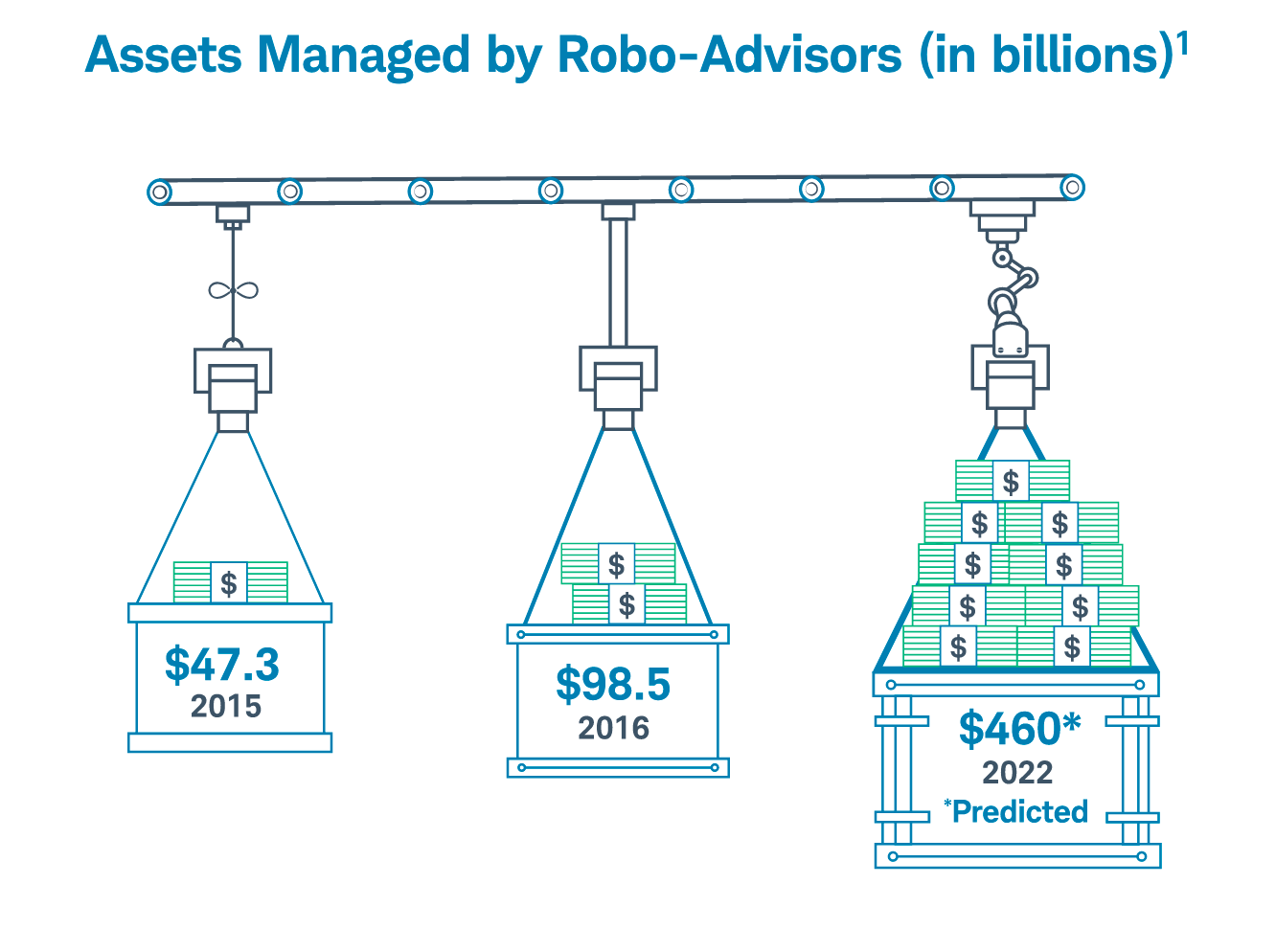
Robo-advisors are algorithmically-based systems which assist investors with their financial portfolios. They are automated platforms which help with savings and investments. You don’t need a human advisor – you can defer to an algorithm. Over the years, significantly more assets have been invested in the financial markets with robo-advisors, including the following past and future projections:

2015 – $47.3 billion

2016 – $98.5 billion

2022 – $460 billion (anticipated)

Assets Under Investment

Source: Charles Schwab & Co

Robo-advisors are designed to help achieve your strategic investment objectives. They do this by delivering a cost-effective solution to clients. Among the many benefits of using a robo-advisor are the following:


  • Tax loss harvesting
  • Diversified investments
  • Zero-emotion investing
  • Optimization of asset allocation
  • Automatic portfolio rebalancing
  • Lower fees (0.25% – 0.5% of the financial portfolio)


The fact that robo-advisors are such a sophisticated tool has led many to question their efficacy for first-time investors. Opinions are divided on the topic of whether a novice investor should employ the services of robo-advisors, or not. Truth be told, a robo-advisor is not capable of offering holistic financial planning for investors. Many important issues such as saving requirements for retirement objectives, defining strategic objectives, and selecting the best types of accounts are not within the general purview of robo-advisors.


There is scant evidence to support the notion that a robo-advisor would be well-suited to calming investor fears if the market collapses. For example, would an algorithm maintain market stability by preventing a mass sell-off of stocks as happened in 2008, or not? On the flip side, they’re accessible at any time – no appointment necessary.


How to get started with a Robo-Advisor?

There are scores of robo-advisors populating the trading and investment arena. Regardless, the steps required to get started are similar:


  • Fill out a questionnaire to evaluate your investment requirements
  • The robo-advisor suggests a diversified portfolio of ETFs
  • The portfolio will be rebalanced by financial experts via an algorithm
  • Certain robo-advisors may allow access to financial planners
  • Clients can easily track their portfolio progress online


One of the problems that many investors face in the financial markets is that of selling when markets are too low, and buying when markets are too high. This happens when panic sets in and emotional investment decisions are made. The human element cannot truly ever be removed from an investment decision, given that people need assurances about different asset categories, classes, and types. A hybrid system is the most likely solution where a robo-advisor operates in tandem with an investment specialist (when required).


Robo-advisors may well see many investors placing their finances in the bond market if we see interest rates of 5%. This will have an adverse effect on overall client wealth since wealth is largely created in the stock market. The best financial portfolios are the ones which bring multiple asset classes into play. If your financial predicament is relatively simple to gauge, a robo-advisor could be a useful resource.


Wrapping it up with a Robo-Advisor

Overall, there are many different robo-advisor options available, with greater support options available via hybrid systems. Certain companies offering these algorithmic investment resources require minimum account balances of $100,000 + and a 0.4% annual fee for hybrid robo-advisor services. Other robo-advisors allow you to invest as little as $500 or less in your portfolio, and they typically offer between 5 – 10 different ETF options. Besides exchange traded funds, there are also index funds which mirror the performance of an index such as the S&P 500 index, the NASDAQ composite index, and the like.


Most companies offering robo-advisors charge between 0.25% – 0.89% in annual management fees, although the majority of them hover around 0.5%. Fortunately, there aren’t any transaction fees with these services, which is substantially cheaper than investing on your own with companies like Fidelity. If you’re looking to save money on professional investment management services, it is a good idea to consider a robo-advisor which runs on an algorithm designed by investment experts. It is continually monitored according to performance criteria and rebalanced accordingly. Since investors are allowing the algorithm to plough funds into ETFs and not individual stocks, risk is mitigated and performance is broad-based.

Keeping the employees safe and healthy should be a priority for all businesses, especially for the ones that have their staff working in a warehouse. Warehouses can become extremely dangerous places, because of moving vehicles, high shelves, human workforce, and heavy items stocked on racks. If the management does not promote and follow proper health and safety procedures, disaster can wait around the corner. Studies show that the main causes of accidents in warehouses are the vehicles that run in and around the space, the falling objects, the moving objects, the manual handling of goods, the work at heights and the slips and trips.

Safety regulations require all companies to have occupational health and safety programs. Its purpose is to prevent diseases in the workplace, and work-related injuries. All business owners and employers have the responsibility to ensure their staff a safe workplace, no matter if they are working in a warehouse or office. Depending on the size and area of the business, the scope of the health and safety program can differ.

Health and safety should not be forgotten once the legal obligations of the company are satisfied. The working environment is in a continuous change and companies should asses the risk, and adapt the health and safety policy to the present needs of the market.  Warehouse operators should focus their attention on some specific aspects that require improvements.

Heavy equipment

If the warehouse works on a regular basis with heavy equipment, then it is something natural for the staff to use the devices. In terms of productivity, this is an advantage for the company, but it can become a disadvantage for the employees because they forget the danger these machines are representing.

The role of the warehouse manager is to keep the employees aware of the potential danger they face themselves when they are using heavy equipment. All the machinery should be evaluated regularly, cared and repaired.

Workplace transport

All warehouses should feature designated traffic routes that keep the employees safe. Both internal and external routes should feature clear signage to inform the staff about the places where the delivery drivers park the vehicles, where the forklifts operate and what areas are safe for the public.

Spills and hazardous objects

The warehouse is a fast moving environment, where items and packages are transported, stored and moved, and it is easy an item or substance to get left behind and workers to run into it because they do not expect that item to be there. If the warehouse stores liquids, it is something common spills of various types to fall on the floor and to create a slippery surface. Safety signs can prevent accidents from happening. It is advisable to use them to inform the workers when a surface is wet or mopped, to keep them safe.

All the objects that can lead to tripping should be removed from the floor, especially in poorly lit areas. An important improvement brought to the storage space is the anti-slip tape that is installed on the floor and improves the grip the staff experience.

Working at height

All warehouses count on the usage of mobile elevating work platforms and ladders. The persons who control the activities performed at heights should properly plan the operations, supervise and train the employees. Only competent staff should be allowed to operate at height. A great improvement would be to use robotic arms to work at height and protect the human workforce from injuries.

Stock and equipment transport

The warehouses are located at various levels from the warehouse entrance, and it is important to improve the operations by creating a yard ramp, or even more, depending on the size of the warehouse. The yard ramp has the role to facilitate the transition from the road to the warehouse level. It is not advisable the employees to navigate the steps when they are carrying heavy items, because they are exposed to accidents. All businesses have to be prudent when it comes to the health and safety of their employees.

Harmful substances

Depending on the specific of the warehouse, there are serious concerns businesses should focus on, if they store harmful materials or substances. If the employees are not working in proper conditions, the warehouse can be the target of an inspection.

Ergonomics

Alongside creating a safe workplace, the company should also make sure that the employees take good care of themselves and stay in good shape. It is important for the employees to learn how to lift the items in a proper way, and not to injure themselves, because the company can be at risk of liability.

Why is crucial for companies that manage warehouses to improve the health and safety conditions?

Retain employees

The best way to remain competitive in the market is to have happy employees. Happy employees are motivated to work harder and complete their tasks successfully. The working conditions have a great impact on the loyalty of employees. Companies can build and maintain employee loyalty through a safe and healthy environment.

Avoid potential compensation suits and claims

If the employees get injured while working in the warehouse, they can file compensation claims and suits. Compensation claims often prove to be deadly for companies, especially if the company has neglected to offer their workers the training required by the law. Workplace injury, because of hazards and exposure to risk factors is a growing statistic. Personal injury attorneys state that the number of persons who are injured due to their employer’s poor safety procedures is in continuous growth. All workplaces come with an element of risk, but the role of the warehouse manager is to lower the hazards. Personal injury attorneys are specialised in helping the persons who suffer a personal injury and their rate of success in case of a claim or suit is close to 100%. Companies should not expose themselves to this risk.

Save costs

Apart from the costs of a potential compensation claim or cost, employee injury, compensation payment, and litigation costs, the companies that have their employees injured while working in the warehouse also have to pay for the hospital, rehabilitation, medication and doctors’ fee. Often, the companies that have their employees injured at the workplace, also experience increased insurance premiums. Health and safety improvements are the simplest way to reduce these costs.

The collective opinion of investors all around the world is that a diverse investment portfolio is better than a linear one. Diversification is perceived as easy and straightforward by many investors, but truth be told, there is plenty of misleading information out there that might damage numerous of investment portfolios. Of course, you can’t “put all your eggs in one basket” but this is wrongly interpreted by investors. Below we have some additional information that will certainly come in handy when it comes to building a strong and resilient portfolio.


Different Types of Risks Lowe Portfolio Vulnerability

When investing, venture capitalists face two main types of vulnerabilities: undiversifiable and diversifiable.

  • Non-diversifiable risks are those that are associated with all companies and all investors. These are commonly known as market risks or systematic risks. In this category fall inflation rates, exchange rates, war, political instability and interest rates. These are things that cannot be changed by the investor themselves and should be accepted as they are.
  • Diversifiable risks are also known as unsystematic risks and these don’t depend on political or economic instability. They can be influenced and minimized through diversification and they are specific to companies, markets and industry.

Why Should You Start Diversifying Your Portfolio?

Let’s take a hypothetical situation where an investor only has airline stock investments in their portfolio. The pilots and staff of said airline announce that they will be on an indefinite strike and all stock prices are dropping. Your portfolio will lose its value in an instant.

But if you also have stocks in other industries, let’s say railway stocks, only one part of your investments will suffer. But experts recommend not to stop your diversification at two types of stocks. In case of war or economic instability, both airline and railway stocks might suffer. Diversify your investment portfolio furthermore to gain resilience in face of unfortunate economic or social disasters. From different companies to different industries, investors should seek new diversification opportunities to gain uncorrelated stocks.

Asset class diversification is also important. Different asset classes react differently to various market events. This type of diversification will keep investors protected against market swings. As a general rule, equity markets and bonds move in opposite directions. So, if unfortunate events emerge in one asset class, the other will experience growth and a positive trend.

Experienced investors can try to diversify their portfolio with synthetic investment products. However, these are complex and require plenty of experience. Small investors and beginners should avoid such investments due to their difficulty level.

How to Find the Finances for Portfolio Diversification?

Diversifying your portfolio means more money invested in different types of assets. If you’re unwilling to swap one asset for another, you can find various types of loans that will offer you just enough financial means for your future investments. Business loans seem to be the most desired when it comes to reliable and accessible financing options for most investors (Source: Nocredit.se). When investors want to reach new diversification rates in their portfolios, these types of loans are the first on investors’ list.

How to Diversify Your Investment Portfolio

To diversify your investment portfolio, it’s mandatory to consider different asset classes. This depends, however, on your capital and risk tolerance.

  • Stocks are the most common investment option but they also are the most volatile asset class. Instead of investing in stock in a single enterprise, it’s advisable to invest in different enterprises in different industries. Diversity can be achieved easily when it comes to these types of assets, but it’s important not to limit your portfolio at these.
  • Real Estate is another asset in which you want to invest for a diversified portfolio. The real estate market and stock market influence each other (see the 2008 recession) but don’t show such a close relationship. When stocks or bonds drop, there is a long interval necessary for real estate to follow. But also, when stock rates experience a positive trend, the housing market needs a while to improve and also follow. When it comes to real estate assets, it’s important to remember that location-specific factors play a huge role in prices to boom or plummet. In this case, you should think of these factors as independent ones from the overall economic context. Expensive markets, for instance, tend to perform better than stock markets in many circumstances.
  • Bonds are yet another great type of asset for investors looking forward to diversifying their portfolios. Bonds are issued by government and corporations when they look forward to raising money. Investors can lend money to the government or a company that needs money. The loan is issued for a fixed amount of time and it is also charging interests (variable or fixed). Of course, the borrower will have to repay the entire amount borrowed and interest as well when the bond expires. While this isn’t a permanent type of investment, it’s a great opportunity to diversify one’s portfolio. They perform opposite to stocks in face of various market events, which makes them perfect. Plus, in this case, portfolios are not exposed to market volatility. The amount borrowed will be recovered by its maturity date. Bonds are a great way to counterbalance market volatility and are more stable than stocks and real estate investments are. While the returns are certainly less generous than in other assets’ case, they are a secure investment for sure.

Other Reliable Ways to Diversify a Portfolio

While the options presented above surely are great tools to diversify an investment portfolio, there are other reliable ways to do so. For instance, you can invest in whatever type of asset you think that will accumulate value over time. Vintage cars, art and jewelry are only some of the asset classes that investors believer that will preserve if not boost their value over time. Low-risk short-term investments are other solutions when it comes to portfolio diversification. You could invest in foreign and domestic stocks at the same time to minimize your portfolio’s volatility in face of certain politic and economic events.

If you try to fly too fast in the trading business of Forex, there will not be a good performance. This is because the volatility in this market is very high compared to any kind of financial markets. The traders will have to maintain their performance to the most efficient level possible. As there can be a change in price trends at any particular moment, your trading process must be protective. Even the change can come at the time when there is trade running. For this kind of situations, the traders will have to design their business to handle the trades. There are some tools known as stop-loss and take-profit. They are very good with proper closing of the trades with a limit set based on pips. Traders will have to set them based on their profit targets. Like those, there will be a lot of good trading system in this business. All you will need to do is concentrate on the effective trading process. For that, traders will definitely have to remain down to earth.

Focus on your money management skills

Forex market does not need any kind of clever traders to make money from it. That does not mean that you can be overconfident about a proper performance. It is very hard for making a good trade and manage a proper risk to reward ratio. For that, the traders will have to learn about proper position sizing of the trades. Most importantly, proper market analysis needed for finding the right signals. Even the closing of the trades will have to get some protections. The tools we mentioned in the introduction are known as stop-loss and take-profit and will help trades with that. For all of these, the traders will have to select the right profit margin targets, first. It is like the traders are going to think about a decent risk to profit margins even before opening a trade. This system helps traders to maintain a consistent performance in the business.

Learn from the experienced traders

Being new to the retail trading industry, you have a lot to learn from the experienced trader. If you start using the copy trading mt4 service, you will understand how the pro-Aussie traders are making a consistent profit. Try to analyze their trades and develop a unique trading system. Use the demo account offered by Rakuten broker and build your confidence. Always remember, trading is nothing but a business where knowledge is the most powerful ingredient needed for you to become a successful trader.

Start your career in the demo trading account

Now all of the novice traders may have a basic idea of proper management of trades. But it is not so easy to learn about all of the process and strategies. If you think about learning them in the live trading account, there will be losses. This is because improper planning will make you lose the trades. From there, the traders will have the chances of refining their edge. From time to time, traders can reach a superior level of trading. But that must not make you lose a lot of money from the account. For that, the traders will have to select the demo trading process to learn about things. It is a system in which traders will not have to worry about losing their money. Because the investment in this sector of currency trading is fake. So, the losses will not affect the trader’s performance. You can learn about every single necessary process very easily and properly.

Learn properly about the right risk management

One thing has been forgotten in this article which is necessary for a better performance. We are talking about risk management. It is necessary for the traders to remain consistent in the performance for a trade. Basically, it reduces the tension of losing capital from the trades. You must maintain it all the time.

We are actually talking about the proper risk to profit margin ration. It is the one which is used for analyzing the trades. On one side, you will see the risk and the other side will define your return from the trades. That can be good for the traders to maintain some proper income. There can be another use of that feature. The trading system can get help from the right ratio. You will just have to target the amount of profit and fix the risk per trade for that. Basically, all of the traders will have to be with their own version of the risk to profit margin. As the volatile markets will not let anyone know about any certain signal, there will have to be some proper strategy which depends on the target. The traders will have to use that in the business of Forex for some proper income from it. In this article, we are going to talk about the proper working process on the basis of your own risk to profit margin ratio.

You can fulfill your targets from long term trades

The traders must know that way to maintain their business so that the proper income is possible. All of the traders will have to do the right things with their trades. If there is no good performance available for the traders, no income will come. But the marketplace will be a sweetheart for the traders to not let them lose money if the system is right. Or even a decent trading edge will have a proper income from the business. All you will have to do is choose the right timeframe for trading with. The bigger you can think of the timeframe, the proper it will be for good income. From the methods of trading into currency markets, the swing trading and the position trading process will be very good for the traders. They will help the traders to work with key swings in the process of the market analysis. Proper pips are also available on big time trades.

Avoid using indicators and EAs

Those who are relatively new to the investment industry might think the successful traders in Hong Kong are using an automated trading system. But in reality indicators and EAs has no place in the Forex market. You need to analyze the market sentiment to find profitable trades in favor of the market trend. Start working hard so that you can easily develop a balanced way to place trades with low-risk exposure.

The right position sizing will require proper targets

If you will not be able to make proper trades with right position sizing, the system will not let your money. This is because the trading business in Forex is all about managing the right signals for trades. Even when there is a huge lot for trading with, the volatility will not let the trades to bring back some proper income for you. In fact, the proper risk management will fail to make you right for trading and doing the right kind of performance for the income. That is why the traders will have to think about the right profit targets and work with it for proper position sizing. When there will be proper ones for your trades, there will be good income to make your smile for the business.

Risks management is a must for any kind of trader

Without the proper position sizing of the trades, there will have to be right risk management. Because the system will not let the traders be humble in the process. If you have tensions about losing your investment or random planning will come to you like overtrading or micromanagement. The right trading process will go in hell and take the trading account with it. So make the right choice for your money management plans and reduce the chance and tensions caused by the possibility of losing your capital.

If you are still new to cryptocurrencies, it can be difficult to tell the difference between the different coins out there. But once you start digging in, you’ll start realizing how different cryptocurrencies can be in their implementation and objectives. Two of the most well-known cryptocurrencies are Bitcoin and Ethereum. And while both do share some similarities, they are also vastly different at their core. Let’s take a look at both cryptocurrencies, what differentiates them, and some predictions for the future.

What Bitcoin Is

Bitcoin was created to provide people with an alternative to fiat currency and the banking system. It uses cryptography and a new technology known as the blockchain to authenticate transactions. The blockchain is a system of distributed ledgers that broadcast transactions in real time to independent miners who have to solve complex logarithmic equations in order to provide “blocks” where authenticated transactions will be stored and strung together in chronological order. This allows everyone in the network to access a record of every transaction made on the blockchain, which makes it more secure and less prone to tampering.

What Ethereum Is

While Ethereum also uses the blockchain, this is pretty much where all similarities stop. Contrary to Bitcoin, Ethereum, or should we say Ether, was not created solely to make transactions. Ethereum is a sort of decentralized, blockchain-based operating system with its own coding language allowing developers to create decentralized apps and borrow the Ethereum network. Ether is supposed to be used as “fuel” to power these applications. While Ether is sold on the open market and is subject to speculation, its ultimate goal is to supply developers with an established network where they can build smart contracts, monetize work, and even launch their own cryptocurrencies.

What Does the Future Hold for Ethereum?

One of the main issues that have been raised with Ethereum was its scalability. And some of these issues were exposed when one of the first massively popular dapps, crypto kitties, nearly crashed the network when it was launched. In the beginning, the relatively small number of transactions the Ethereum network could handle wasn’t a problem, but now that it’s become popular, it is probably its biggest problem.

The future of Ethereum will largely depend on how they tackle these issues. One of the solutions proposed was sharding, which allows them to compress larger blocks and make them easier to process and store. Vitalik Buterin, Ethereum’s founder, also launched plasma protocol in order to simplify transactions and reduce the amount of unnecessary data being processed by adding a second layer to their blockchain.

But even with all its problems, many observers are still bullish about Ethereum, and people like Nigel Green of the Devere Group predicted that the value of Ether could hit the $2,500 by the end of the year. Those who wish to invest in Ethereum, however, should focus on getting the latest crypto news from reputable sources and take any predictions with a grain of salt.

What About Bitcoin?

Bitcoin also has to deal with scalability issues. As more people use the coin, more and more people have to wait in line for miners to authenticate their transactions. This not only slows down transaction speeds, but users now have to pay more to move in front of the line and get their transactions authenticated faster.

Many solutions have been proposed to deal with the issue, with the most popular being the lightning network. The lightning network is a separate network that allows people to conduct a number of off-chain transactions by opening payment channels between parties. This would put less of a strain on the network and allow it to run more smoothly.

As far as prices go, it’s really difficult to know which way Bitcoin will go in 2019. Most conservative forecasts predict that it should reach the $4,000 and gain more traction by the end of the year as ETFs and more regulation is being introduced. How high Bitcoin will go will also depend on how successful the lightning network is and if we start seeing more adoption from retailers. Transaction volume will also have to go up.

Conclusion

Bitcoin and Ethereum are two completely different projects and before you invest, it would be wise to do your homework and learn everything there is to know about them. Stay informed and only get your information from verifiable sources. Also, don’t be afraid to look at other cryptocurrencies and see what they have to offer as well.

If you have considered web hosting as a way of making money, you are not alone. In addition to some of the big names in web hosting out there, there are a seemingly endless list of smaller web hosting companies that are trying to make a dollar. As of January 1, 2018, there were more than 1.8 billion websites. Whether these websites get one visitor or they get tens of thousands of visitors every single month, they all need web hosting. This means that there is a lot of business to go around.

Is There Money to Be Made As a Web Host?

The short answer is yes. If there was not, then people would not be in the business. Sure, there are some companies that offer free hosting. However, that rarely works out for the companies that put their sites on these servers. They usually end up moving back to a paid host. And it’s always good to remember that with anything on the Internet that’s free, if you are not paying for it, it’s likely that you are actually the product that’s being sold.

In order to make money as a web host, you need is to find a hosting service that is affordable and then resell it at a slightly higher price. As long as you have large enough servers and you have a sufficient amount of bandwidth, you will be able to divide up your server and sell it for a monthly fee. This is an awesome way for you to make money, it’s a great way to gain client loyalty, and you can attract other people who may be interested in purchasing the services and products you have for sale.

Should You Purchase from a Reseller?

Maybe. If you do, we recommend using extreme caution. It is good to do your due diligence and learn as much as you can about hosting companies before spending your money and entrusting your business to them.

You want a reseller that has a variety of price brackets. There should be an uptime guarantee, and the reviews of the company should be stellar. The more automation the hosting company has, for example, when signing up new clients, the more reputable they likely are. Be sure that you do not get pulled in by a cheap price, because you will likely get quality that’s equivalent to what you pay.

Is Web Hosting Lucrative for Big Companies?

Again, the answer is yes, but there are some factors to consider. A hosting company is just like any other company. They determine how many people they can hire, how much marketing they can do, how much new hardware they can purchase, etc. based on their gross profit. For the majority of the bigger hosting companies, 30 percent of their gross profit is dedicated to their servers. That only leaves them with $.70 on the dollar to cover the rest of their expenses.

Some of the more established hosting companies do not need to worry as much about marketing because their names are synonymous with web hosting. Newer companies that are trying to make a name or existing companies that are looking to expand their client base could dedicate up to 10 percent of their gross income to marketing. Now, they are down to $.60 on the dollar that they can use to pay salaries and cover other expenses.

There are a number of web hosting companies that offer their service for around $10 a month or about $120 every year. They attract people to their service by offering 24 hour seven day a week support, along with other goodies. They are able to do this because they are betting that their servers are good enough that their clients are not going to require a lot of support.

Just think, call centers, like the ones you use for your cell phone, your insurance company, or maintenance on products you purchase, can pay their support team members under $40,000 a year. It’s because, in most cases, providing support does not require a software engineer. However, hosting services need system administrators who could cost in excess of $100,000 each year plus any benefits that are offered. By charging $10 a month or $120 a year, a hosting company can only hire one software engineer for every 1,400 customers.

This does not even take into consideration all of the other expenses a large hosting company is going to have, including staff, rent, etc. Hosting services that offer their product for $20 a month or $50 a month have a better margin, but still they need a lot of customers in order to cover their expenses.

Regional Differences Comparing US and Canadian Hosting

National dynamics also influence how web hosting revenue is generated. Take a country like the US where the web hosting industry is a mature and extremely profitable business sector. In the early days of US web hosting small resellers morphed into larger hosting companies and bootstrapped revenue, we are now seeing this with a lot of Canadian web hosts. However, in the US market dynamics have evolved to the point where larger conglomerates like EIG (Endurance International Group) have a massive share of the US web hosting market.

How the Economics of Web Hosting Impact Clients

Let’s say that a hosting company offers their clients virtually everything for $10 a month. They know that of the 1.8 billion websites that are on the Internet right now the vast majority of them get little movement. So what their hope is is that the majority of their clients use little to no bandwidth. Successful websites that do use a lot of bandwidth get throttled by the hosting service, they become unhappy with their slowed down service, and so they leave and choose another company or purchase a more expensive plan. Then the hosting service is able to replace those high-bandwidth clients with clients that have little to no bandwidth.

When you understand the economics of web hosting, you to see why it’s not in your best interests to purchase the cheapest hosting out there. Of course, not everyone can afford to pay hundreds of dollars a month for web hosting. However, if you’re only going to spend $10 a month, realize that the support you get will really only be the bare minimum, you’re going to be sharing your server with a lot of other sites, and if your site become successful, you can expect it to be throttled and will eventually need to find another hosting company.

Are you interested in becoming a web hosting reseller? Do you have additional insight on the economics of web hosting? If so, tell us about it in the comments section below.

Recently cryptocurrency trading has taken the market by storm but even seasoned investors have found it difficult to trade in crypto. Trading in cryptocurrency is proving beneficial but not everybody is well equipped to make a profit out of it. There are numerous tokens to choose from and various exchange markets on which to trade.

Cryptocurrency has had a fair amount of criticism since its invention. Despite that it has seen a rapid surge in the market and is being widely used as an acceptable digital currency. Economic experts have predicted a bright future for Bitcoin in particular and it is being said that it might revolutionize the way financial transactions happen all over the world.

Here we enumerate the most fundamental guidelines that an interested investor should follow.

Do your due diligence before diving in

The most basic thing you should keep in mind before investing into crypto trading is to do intensive research so that you have a thorough understanding of the market. There is a lot of information such as crypto-figures, and technical terms which are all too much to process.

Hence research becomes very important, there is a lot of information available on the internet so you can do research from the comfort of your home also. Bitcoin is the only crypto that is widely popular but there are a lot of other cryptocurrencies that are doing well in the market. So if you know the market very well beforehand then you can make smart investments.

Be very cautious about whose advice you take.

The upsurge in the use of cryptocurrency has given an opportunity to so called crypto experts to fill their pockets. They take advantage of the fear, uncertainty, and doubt surrounding crypto in the market and mislead the investors without due regard to their professional ethics.


Make rational choices before trading

Trading in cryptocurrencies can be a stressful task, and it is best to take decisions based on logic and not emotions. Trading decisions that are based upon emotional whims and fancies can be hugely detrimental for one’s assets. For instance, deciding to sell simply because the token is not appreciating fast enough is a characteristically bad trading decision. On a similar note, it is not wise to buy merely because the value of a token is at an all time high level, because you might be putting your funds into a token which is on the brink of a collapse.

In order to maximize your trading profits in the long term, it is essential to understand that markets are volatile and can change at any moment, but one must not take any frenzied trading decisions when such changes take place.

Currently your economic transactions are strictly regulated by national governments and banks. This restricts people’s ability to freely make transactions globally. Cryptocurrency is a mechanism designed to get rid of these stringent system of government manipulation. It’s use in illicit activities have stagnated its growth but the use of blockchain technology will make sure that crypto is free from cyber crimes.

Running a small business often means having a lot of knowledge of your industry, and having some knowledge of accounting, finance, human resources, informational technology and similar.

Finance is one of the crucial parts of business operations. Still, very few entrepreneurs are financial experts by training.

Focusing on the financial side of your company is a must, regardless of your field of expertise. This aspect deserves as much attention as manufacturing, marketing, and distribution are receiving. While there are some major costs and investments to process every now and then, it is also essential to maintain your alertness when it comes to everyday spending. With that in mind, here are some important financial management lessons every small business owner needs to know.

Don’t mix business and personal accounts

A lot of business owners are often tempted to secure their business finances with their personal funds and sometimes even to use business money when they are lacking some in their wallet. Both of these ideas are bad for many reasons. Firstly, there are legal issues, such as accounting, taxes, and personal liability. Secondly, this can turn into a bad habit which can make both your personal and professional finances a train wreck.

To prevent such disasters you should set a personal and a business budget and adhere to them strictly. This includes separate credit cards, loans, and taxes.

Make timely payments

It is easy to lose track of the bills, loans, and credit card fees when you have tons of other things to do and worry about. But everything regarding finances, including utility bills and employees’ paychecks, needs to be managed properly because it will consistently add up to a large sum which can cause you millions of problems.

Paying your bills and loans on time will save you from late fees and giving your employees what they are promised and when they are promised will ensure loyalty and overall good atmosphere in the firm.

The easiest ways to do this is to set up monthly reminders and set aside a budget for these sorts of things for each month.

Don’t forget to pay yourself

Being your own boss means that you are an employee too, which consequently means you deserve compensation too. Many small business owners invest everything they have in day-to-day operations and growth, and they overlook their own role in the company. If you neglect to pay yourself your personal finances will not be in good shape and your business will suffer as a result.

Seek out growth opportunities

In addition to compensating for all the hard work you are doing, you need to keep your eyes open for the chance of growth opportunities. In order to remain vital, every small business needs to continue to innovate, attract new employees and partners, come up with new ideas, and grow. For that, you need to invest. Some of the small business growth strategies you need to consider are market penetration, market expansion, product expansion, diversification strategy, and acquisition strategies.

Have a solid billing strategy

If there is anything that can hurt your business that is poor cash flow. If there is anything that can hurt your cash flow that is poor billing strategy. Clients that are late on their invoices and payments can harm your business operations, which can lead to business failure.

If you have problems with late-paying customers, and badgering them with reminders and repeated invoices doesn’t work, you should try a different approach. You can give them discounts when they pay on time and fines when they are late.

Plan for the future

The world of business is full of surprises, and many of them are unpleasant. However, based on your previous expenses and earnings for a few months back, you can learn just how much money you need to set aside each month. Besides the regular items on your monthly budget, there is also a need for dedicating money for the unforeseen expenses, which can include everything from lawsuits to natural disasters.

Some business find that getting a loan can ease cash flow issues. One popular option loan option for smaller businesses is from the US Small Business Administration (SBA). The SBA Express Loan can be a good option if you need access to cash quickly as the review process usually takes under 36 hours. However, while the review process is extremely fast, keep in mind that it takes over 30 days still to actually receive the cash. So before applying for an SBA loan make sure to plan ahead.

Have a strong budget

Speaking of… Keeping your budget accurate is one of the best things you can do for your firm. All expenses and incomes need to be recorded and tracked as they arrive. To succeed in that, you will need to hire an accountant, outsource this part of the job to an accounting company, or, for the time being, download a budgeting smartphone app.

Establish healthy financial habits

In the end, it all comes down to setting up good financial habits. This includes internal financial protocols (e.g., setting time to review and update financial information), controlling where and when your money goes and becoming more frugal.

If you fail to do these things you will leave your business vulnerable to fraud, theft, and legal problems. As for the frugality, there is no need to turn yourself and your employees into extreme “coupon collectors”. However, you can be alert for rebate offers, negotiate with vendors for better deals, and refrain from unnecessary costs.

The more you comprehend the financial side of your business, the better equipped you will be to make smart money management decisions. The lessons above will help you get started, but you should always be hands-on it and proactive when it comes to managing your finances, regardless of the scale of the challenge ahead.

So you want to be successful with trading forex? Then there are a number of ways you can learn about forex trading. From reading books, to trading articles to forex related websites and forums and videos, there is no shortage to information that you can access on the internet.

Most beginner traders tend to make the mistake of starting to trade with real money even before they can take some time to understand how the forex markets work.

This is one of the biggest reasons why many forex traders fail. Starting with a demo trading account for at least a few months can help you to hone your forex trading skills.

In this article, we take a look at how you can learn about forex trading.

Forex trading books

The best place to start if you want to learn about forex trading are books. There are many books written by famous traders which can be useful. Starting with one of these books is a good way to understand how the forex markets work.

A good starting place is to either order these books via Amazon. You can also download these books in a PDf format so it is easy to read. These books, especially ones authored by some very famous traders can provide you with a wealth of information.

Forex trading videos

There are numerous trading videos that are available. However, not all of them are knowledgeable. Now a days, anyone can upload a video onto Youtube. Therefore, you need to take some time to check out the publisher.

There are quite a few reputable Youtube video channels that you can check out if you want to learn about forex trading.

For example Trading 212 or Khan Academy are two good channels to begin with. When learning about forex trading, you also need to pay attention to other aspects such as the economy and also understand how the fundamentals work.

Forex trading forums

Forex trading forums are another avenue to learn about forex trading. There are many threads that you can follow to understand the more technical aspects of trading.

It is important to note that you need to be careful about the threads and topics that you follow. This is because forums are made up of different types of traders; from professionals to absolute beginners. Therefore, the information you come across can be incorrect at times.

However, if you spend enough time on a forum, you would be able to easily figure out which threads and traders to follow.

Trading strategies and testing

In order to be able to truly figure out how good you are trading, then you need to put this knowledge to the test. Trading strategies are one way to understand how well you know the markets and the technical indicators.

Most traders make the mistake of purchasing a trading system. In reality, these trading systems can end up losing you money than making any money for you. Therefore, it is always best to build your own trading strategy instead of buying a ready made one.

Forex demo account

A forex demo account is another way to help you with trading forex. A demo account will allow you to trade without any risk. You can also experiment different strategies with a demo account until you are familiar with your trading.

Having a good broker also helps. There are many forex brokers that offer a demo trading account. A good example is JustForex which offers a demo trading account for free so you can practice how to trade forex (JustForex review).

In conclusion, it is important to understand that it will take a lot of time and practice to learn forex trading. The only way you can be successful is by being consistent and patient when learning.

Before we start, this is just a note that this is a guide designed for the absolute beginners in trading. How beginner, you ask? Well, we have sat down with an experienced trader to ask the all important questions about trading to teach us, absolute novices, all about the world of trading.

Where does the beginner start? How much do you have to learn? Well, the answer is, PLENTY. In fact, the learnings never end. Not only do you have to keep yourself constantly researching, but you have to be on top of new strategies and possibilities all the time.

So, keeping this in mind, we asked the trader the basic questions that you would have to know to get into the game and how to actually make a profit out of this tricky world.

Why would you go into trading if you have never done it before?

People go into trading for various reasons. You need to make up your mind what the exact reasons are for you wanting to enter the trading space so that you don’t put yourself in a bad position.

Decide what your reasons are for going into trading in the first place. Are you looking to make some extra money to pay for your children’s education, a dream trip or to put away for retirement? Or is this the start of your new, exciting career? Being a local trader and a once a week trader are totally different animals.

Based on your answer, you can start determining what your timeline is in trading.

Are trading platforms important?

Absolutely! There are hundreds of trading platforms out there for you to choose from, but you do need to do some careful research into it as it is quite cut-throat. There are a lot that simply assume that you will lose and take your trades.

What is great is that a lot of the platforms can be accessed through desktop and mobile, and many allow you to build your own personalized trading hub.

If someone was launching themselves into trading for the first time ever, what would your ultimate piece of advice be?

If you are first starting out, the first thing you need to get sorted is a risk management strategy. You can have the greatest indicators and the best strategy on how to trade, but if your targets and what profits you are taking and stop loss orders are wrong, you can still not make money.

So, basically you have to look at trades and see how they have performed in the past and what their historical movement looks like. If you are capable of doing a statistical study on it, do a stat study on what you need your stop level to be and how much loss you can take. You ultimately need to, going into the trade, know what your profit level needs to be and stick to that as rigorously as possible.
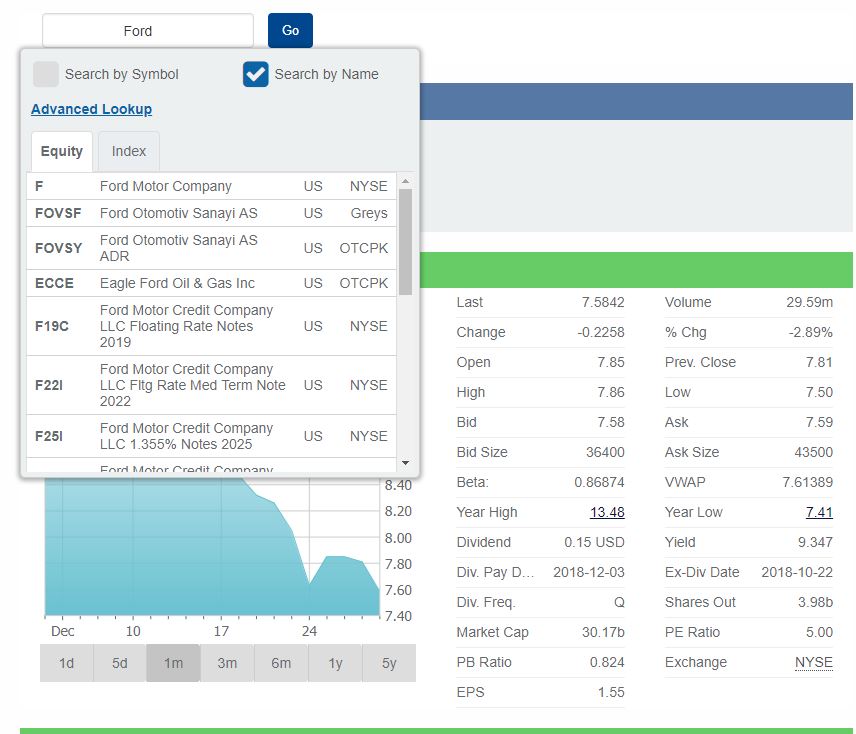
Lets chat more about stop loss orders. What is it and what happens if you don’t implement a stop loss order

When you execute a trade and buy something, the market could possibly go against you. This is when you start losing money, which is absolutely normal when trading. The market goes through peaks and dips and you need to know just how much you can take.

At some point you have to know when to exist the trade for a loss and the loss level cannot be higher than what your take take profits are. You have to have a lot higher success rate than losing, which falls within your strategic planning.  

How do you personally know when to exit? Markets go through peaks and falls, but what is the biggest indicator

This is where it comes to you getting your trading strategy right and then sticking to it. Once a trader gets a trading strategy that works, most stick to them as long as they making a profit.

If you are looking to take ten ticks on the trade then stick to taking ten ticks instead of having a ten tick stop loss or something along those lines. A tick is essentially the change in trading price from trade. The minimum tick size for stocks trading above $1 is 1 cent.

Setting targets depends on the reason why you are doing the trade. If there is a technical reason for it, you have to make sure that you set your timescale and stick to it. What is a reasonable level to make profit from it to is a question you have to be asking yourself too. Setting this limit is important as obviously everyone wants to make hundreds and hundreds of ticks, but it is not always reasonable all the time.

Market conditions are also one of the biggest determinants of when to stay and when to exit a trade. If there are huge events globally, you will need to be taking it into account. So, for example, if there big events like nonfarm payrolls out of the US, there are usually large moves on the markets. So, if you have a trade at that time, you will need to have a larger take profit because you are risking more because of the increased volatility of the market.

Talking about market conditions, how important is it to keep up to date with what is happening globally?

Wake up and read the news. Go to bed reading the news.

Most of the life of a trader is doing research and keeping the research in front of you while trading in order to make good choices and decisions. Everyone is trying to stay as well informed as possible to not get caught out by buying something that happens on the global scale.

There are tons of accurate and up to date news wires that you can subscribe to. But they are usually quite expensive. Market Squawks have all of the major screens like Bloomberg and Reuters which is always updated. They put out daily calendars and research papers to keep you updated with global events and market movements. Twitter is also great for breaking news for you to keep an eye on, although you need to  keep watching the feeds and trends to make sure that it is accurate.

This also depends on what type of time period you are looking at trading over. Locals in the trade arena, which are the regular traders who trade several times a day need to have an in-depth knowledge. Other strategies mean that you only trade a few times a week, and this will mean that you don’t need to be quite as in depth in market movements.

In saying this, it is important to have a proper risk strategy in place as you can land yourself in trouble. Hence why having the risk strategy was the first and foremost most important thing to have before launching your trading career.

To wrap up

In ending, the greatest advice given, is not to follow the pack. Don’t do exactly what everyone else does all the time. Take time to work on your strategy and refine it over time. Take all of the main considerations into mind. Time frames, profit margins, your ultimate risk appetite. Don’t get down when something does not work out and when you see a fall in the market. Keep at it. But also be savvy enough to know when to cut your losses.

In the past few years, more and more people chose trading as their full-time job and main source of income. The reason behind this phenomenon is that nowadays, extraordinary profits are just one-click away! Forex and stock trading are among the most popular types. Both come with advantages and disadvantages which will make you choose the best one for you.

Forex and Stock trading – a brief introduction

Forex trading is more speculative and represents the action of trading fiat currencies. When you trade a currency pair, you either buy a currency at one price and sell it at a higher price; or you sell a currency at one price and buy it at a lower price to make a profit. This market is the largest and most liquid in the entire world, with $5 trillion traded every day. It is open 24 hours a day, 5 days a week for banks, institutions, and individual traders.

On the other hand, the stock trading process consists of you trading the price of a stock or buying partial ownership of a publicly-listed company available on the stock market. You can easily do that through a stock certificate.

This market is also known as the equity market and it allows companies to gain capital, while also giving their investors the opportunity to have partial ownership of their shares. In contrast with the foreign exchange market, the stock market is less flexible, as your investments and trades depend on the activity of the company you chose.

Forex and Stock trading – Pros and Cons

Forex trading comes with its ups and downs, considering that the foreign exchange is such an imposing market. Let’s begin with the pros, because it surely has some! First of all, the size and the high liquidity of this market can be a great advantage for traders, as there are many potential buyers and sellers at any given price-level. Another pro is the flexibility of this market.

As we mentioned, it is open 24/5 and no matter where you’re located, there is always an open trading session in the world where you can buy and sell currencies. Last but not the least; a significant advantage is that forex trading has low transaction costs! You usually have to pay a fee requested by the broker – which is based on the difference between the buying and selling price of the currency pair, also known as the spread.

Given the extremely competitive nature of this market, the spreads of major currency pairs can be as low as 1 pip, meaning that in order to open a position size of $100,000 on the let’s say the EUR/USD pair, you would have to pay only $10!

Forex trading has its share of cons, too! The high liquidity can bring great profits, but it can also be very risky. This market shows greater sensitivity to all kinds of political and economic situations in other countries, especially when they are of an international importance and can change the value of currencies in a split second. Along with many other reasons, without a proper education, forex trading can be dangerously risky! The leverage available for this type of trading can also be profitable, but just as easily it can work against you if you enter a trade that goes the wrong way.

Stock trading has a solid list of pros, too! They are easy to buy and equally easy to sell. You can earn money in two ways: either by taking advantage of short-term trends, or by holding the stock in order for the company’s earnings and stock price to grow over time. Moreover, stocks rely on economy, meaning that when the economy grows, so do the corporate earnings – which is a reason to celebrate for stock traders!

Probably the biggest disadvantage of stock trading is that while investors do have the advantage of owning a part of the profits of the corporation, they can also risk losing the invested money in case stock prices fall due to bad business decisions, a bad economy or worse – if the company goes bankrupt. Also, stock trading is less flexible, and it can require a lot of time.

How to start Forex and Stock Trading

You can become a forex trader or shareholder in just a few minutes. All you need to do is find a professional and trustworthy online broker. TradeFW forex and CFDs broker is a broker chosen by millions of traders and it offers its client the two financial instruments. The process of becoming a forex or stock trader is the same. All you need to do is open the right account for you level of experience, in this case a standard account; fund it and enter a position or buy a share of your favorite company.

Although it sounds easy, and this step it actually is the easiest part – the truth is that successful trades will come with hard work and a lot of knowledge. Before you place a trade or invest in a stock, make sure to inform yourself and develop a strategy, as well as a trading plan with clear objectives. Be patient and learn from your mistakes! One day, the well-deserved profit will also come just in a brief second.

Conclusion

Forex trading, just like stock trading, has pros and cons – but the truth is that each investor knows which one to pick and turn its cons into advantages. Trading can become your career, a profitable one, but it takes time and hard lessons! Just be patient, you will get there, and it will be worth it!

This lesson plan was created by Andy Webb, of Monticello CUSD. The lesson plan includes a PowerPoint and several hand-outs.

I use How the Market Works as a supplement to my Consumer Education class. Most of my students don’t really understand what a stock or a mutual fund is much less how the companies are priced. I have a unit where I ask the students to invest in the stock market using How the Market Works and the competition lasts several months until there is a winner. The winner for the semester gets their name put on the trophy. This is highly coveted! I have attached the powerpoint that I use when I am teaching students about the different types of investing and investment products. We are on block schedule. The powerpoint has a day by day breakdown of what I do in my classes. Furthermore, I have attached all of the different handouts I have created.

Handouts

This project was submitted by Linda Campbell, a professor of business administration and management at Siena Heights University

Project Overview and Goals

The purpose of using Virtual Stock Exchange is to give you a better understanding of trading strategies and portfolio management. You will also learn a variety of financial instruments and their risks and rewards as they apply to asset management

Parts I and II:   Managerial Finance Project– Registration

Registration for How the Market Works is free. Create a login code.   Choose a name I can identify as yours – keep a copy of your sign in name and password.

Instructions to register for our classroom contest:

  1. You are invited to enter the contest, “Managerial Finance”.  The Password for this contest is:  ___________:  Go to the following website: __________________
  2. My Dashboard – Click on  Contests; click on Join; Click on Search (and find our class contest by name: “Managerial Finance”  Our Password for the contest is:
  • Begin Part I of “Managerial Finance”. Complete all Assignments – take quiz – be sure to follow instructions to get credit
  • If Dashboard is not visible, Click on “Choose Assignment” and scroll down to complete additional assignments.

Additional Information:

  • Portfolio Management Constraints:  Cash must not exceed 20% of your portfolio at any time.  We want you invested, not sitting on the sidelines.
  • This is a six-week assignment with a one-week intermission between Parts I and II.
  • Part I is a two-week simulation and is your introduction to HTMW.  You will complete all the assignments and required stock trades. At the end of Part I, your portfolio balance will be reset.
  • Part II is a four-week simulation.  You will use your experience from the Part I to make more knowledgeable investment decisions.
 Managerial Finance –  Part I:  Two-Week Stock Simulation
Week 1


Register and begin assignments – be sure to make at least three stock trades  – Due ___________
Week 2


Complete assignments and be sure to make at least three stock trades.  Due _______________________
Week 3Intermission:


Finish up and evaluate your trading portfolio.  Choose primary stocks you wish to trade during Part II

By Thursday, all balances will be reset and your trading activities from Part I will be erased.  You will have a fresh start.


Now you are ready for Part II.

 Part II:  Managerial Finance Project – All balances have been reset!
Week 4Begin assignments – Two articles and a minimum of three stock trades – Due  __________
Week 5


Complete assignments – Two articles and a minimum of three stock trades. Due _________
Week 6Complete assignments – Two articles and a minimum of three stock trades. Due _________


Week 7Complete assignments-  Two articles and a minimum of three stock trades. Due _________


Part III – Virtual Stock Exchange Debrief Paper – Due ______________

A 2-3 page, double-spaced paper about your Virtual Stock Exchange experience will be due at the end of the semester.  Please address the following:

  • What are the key things you learned from your Virtual Stock Exchange experience?
  • What companies did you invest in?  How did their stock perform?
  • Which transactions exceeded your expectations?  What conditions caused this?
  • Which transactions underperformed for you?  What factors created the performance gap?
  • How will your Virtual Stock Exchange experience influence your personal investing in the future?
  • How did you do in the rankings with your classmates?

This project is the “Core”, which most teachers use as the basis for their HTMW class stock game. The other recommendations in this library usually follow this format (with some variation). This makes it very flexible to work with your classes.

This project usually runs between 4 and 16 weeks. Longer contests tend to work better. This is because students are exposed to more “market news” for a longer time, and is a better introduction to “real” investing outside of the classroom.

Project Overview

The goal of this project is to introduce students to basic investing concepts, and get exposure to the real-world financial markets. Each student will build their own portfolio of stocks and mutual funds, with a set of initial investing goals, and regular investing journal entries. At the end of the session, students will create and present a 5-10 minute presentation to the class. The presentation should discuss the goals they set, and how they worked with the changing markets over the course of the contest. Students will also need to submit a report detailing their trading activities.

Project Set-Up

Contest Rules

Use these settings to set up your class contest:

  • Initial Cash: $100,000
  • Registration/Trading Dates: as long as your class allows (we recommend starting this project early – likely before your discuss investing in detail in the class itself)
  • Minimum Prices: $3
  • Short Selling: OFF
  • Day Trading: ON
  • Margin Trading: OFF
  • Public Portfolios: OFF
  • Allow US Stocks and Mutual Funds
  • Commission: $10/trade
  • Position Limits: 20% (students can’t invest more than 20% of their portfolio in any single stock)
  • No resets
  • Create an assignment
  • Keep the teacher in the rankings
  • Require Trading Notes

You will get a unique registration link to share with your students – this will let them create their login and join you into your class.

Assignment

You should also add an “Assignment” to your class. Your first “Assignment” should last the first week of the trading period, and include the 10 items in the “Stock Market Basics” section. These are designed to provide students with a basic introduction to what a portfolio is and how to make trades, with short articles, videos, and tutorials.

Assignments keep the experience educational – it provides a clear structure for what your students are expected to learn, while introducing them to the game and how it works!

You can create more assignments for each week, including other tasks that align with what you are discussing in class. Most classes assign the next 10 items, under “Intermediate Investing Tips”, as the second week’s assignment.

Project Kick-Off

Kick off the project using our Cornerstone Lesson Plan – this is a short introduction to glossary terms and the concepts of stocks of investing. At the end of the lesson, have students create their logins for your HTMW class contest, and work through the first 10 “Stock Market Basics” lesson. This should usually take about 1 hour.

Next, introduce your students to a few “Scenarios”. These will determine the kinds of portfolios they will build. They can choose between:

  • A retirement portfolio – the goal will be constant, slow growth, with an emphasis on avoiding losses (a portfolio for someone who wants to retire in 15 years)
  • A growth portfolio – the goal will be high growth with some risk (a portfolio of someone in their 20’s or 30’s looking for high returns)

Now put students into groups of 3-5, based on which scenario they chose. Have each group prepare a list of 10 ticker symbols (ideally from at least 3 different sectors) of companies that they are familiar with, and that they think will perform well for their scenario. Students can find the ticker symbols, sectors, and performance charts for all US and Canadian stocks in the “Quotes” tool on HTMW. This should take between 30 and 45 minutes.

Then break up the groups, and have each student individually should pick 5 of these companies, and add them to their HTMW portfolio. Each student should also write a 1 page summary about why they chose the companies they did, and why they DIDN’T choose the other 5 companies the group identified (this can be homework). This ensures each student will have a unique portfolio, but based on some group thinking.

Weekly Check-In

Ensure all students are checking their HTMW portfolio at least once a week (with the class rankings, most students will be checking a lot more often!). You can post the class rankings at the front of class to make sure students are staying engaged.

Keep using Assignments! You can easily track which students are participating, and remind students who start falling behind. Plus, the lessons are a great supplement to what you are already covering in class!

You will also want to encourage students to continue trading for the duration of the contest. Require students to make at least 3 trades in their portfolio each week (you can require this with an Assignment), and they should both be keeping Trade Notes with each trade, and a 1 paragraph Trade Summary that gives a short summary of what happened in their portfolio each week. This summary should include things like what stocks did well, which did poorly, how did market news impact their holdings, and how it relates back to other class topics under discussion.

Final Report

At the end of the trading period, student’s portfolios will automatically freeze, so they can continue to log in and see how they did at the end of the last day, but not place any new trades.

This gives the opportunity for students to prepare a final “Investment Report”. The Investment Report should be between 3-5 pages, divided into sections.

  • A summary of their investing scenario, and how well they achieved their investing objectives
  • A graph showing their portfolio performance for the duration of the contest
  • A list of significant events during the contest that had a big impact on their portfolio (news reports impacting stock prices, ect)
  • A pie chart showing their final holdings
  • A profit/loss summary, showing where exactly they made and lost money
  • An appendix with all of their weekly investing journals


Happy trading and let us know if you have any questions! If you have your own awesome class stock project that your students really loved, please share so other teachers can give it a try!

When introducing HowtheMarketWorks.com, students need to first have an understanding of what a company is, what a share of stock represents, and the relationships to products and services. After this is mastered, then it is easier to explain what a stock exchange is, and finally teach them How The Market Works!

You can also download this lesson as a PDF handout to distribute to students. Click Here to Download


Required Vocabulary

Company

A business formed to manufacture or supply products or services for profit. Most companies are very small and have only one location like the little restaurant, dry cleaner, flower shop, or nail salon at the local street corner. Other companies have 10,000+ locations or sell their products and services globally. These may be companies you see every day like NABISCO, which is
owned by a company named Mondelez International – ticker symbol [hq]MDLZ[/hq] that makes Oreos, or MCDONALDS [hq]MCD[/hq].

Entrepreneur

A person who has a creative or unique vision for a product and services, and then creates and launches a business. The entrepreneur typically assumes the risk and rewards for a
business venture.

Sole Proprietorship

A company owned and run by one individual who receives its profits or bears its losses. A proprietorship is not separate from its owner, who is liable for the company debts.

Partnership

A company owned and managed by two or more people who share its profits or losses. A partnership is not separate from its owners, who are liable for the company’s debts.

Private Corporation

Some entrepreneurs, sole proprietors, and partnerships decide to incorporate. This means that they establish a separate legal entity. The main reasons to incorporate are (1) if someone decides to sue the company, they would be suing the corporation and not the individual owners (2) it is easier to raise money to grow the business and (3) for tax reasons. The corporation issues shares of ownership (also called stock) to show who owns what percentage of the corporation.

Most corporations don’t sell shares to the public. You can’t buy shares of a private company in the stock market. Here are some examples of what are known as privately held companies such as:
CARGILL, which makes agricultural products, KOCH INDUSTRIES, which is in many businesses, such as transportation fuels, building and consumer products, and fertilizers, among others., IN AND OUT BURGER, which is a fast food chain, mostly in California, AND MARS, which makes Mars Chocolate bars and other candies.

Public Corporation

Larger companies that want to grow quickly often find it easier to sell some of their shares to the public to raise money. The stock of a public company is owned and traded by individual and institutional investors. The stock may also be held by company founders, employees, and sometimes venture capitalists, which are people who invest in new businesses that are just getting started. MCDONALDS Ticker symbol: [hq]MCD[/hq], VERIZON Ticker Symbol: [hq]VZ[/hq], Ticker symbol MICROSOFT [hq]MSFT[/hq] are all examples of public companies that make products that you may use.

HowTheMarketWorks has built-in lessons teaching students about different types of companies! When you set up your class contest, add an “Assignment” and include the lesson “Types of Companies“!

IPO or Initial Public Offering

IPO is a term heard a lot on Wall Street and in the news. When a company decides it needs to raise more money and wants to sell it shares to the public, then it files for an IPO.

Stock Exchange

Once a company goes public, then the shares of that stock trade on one of the major U.S. stock exchanges (The New York Stock Exchange, the American Stock Exchange, and
NASDAQ). The stock exchange is like a flea market where buyers and sellers come together and the buyers try to get an item for as low a price as possible and the sellers try to sell an item for as high as possible.

Stock Broker

The stock broker is the person who actually makes the trade for you. In the old days, you would call your broker with your order who would then call his trader on the floor of the NYSE
who would then place your order. Today, you can use Etrade.com, Scottrade.com and other online brokerage platforms to make trades. HowTheMarketWorks.com acts just like an Etrade account, with real stocks and real prices, just pretend executions.

Sector

A sector is a group of companies that are engaged in similar businesses. For example, McDonald’s and Burger King are in the restaurant sector. General Motors, Ford and Toyota are
examples of companies in the automotive (car) sector. Citibank, Bank of America, and Chase are examples of companies in the banking sector.

HowTheMarketWorks also has lessons showing students how to find stocks from different sectors, and compare them. If you add an Assignment to your class, include the lesson “How to find stocks in specific sectors“!

Investor

A person who gives money to any of the above in return for a share of the company. For example, if you and three friends pool your money to make and sell cupcakes at school, you are all investors.


Thinking About Companies

Starting A Business

Imagine you started making cupcakes. That’s your product. You make them in your kitchen to sell them at school and your cupcakes get so popular that you couldn’t make enough of them for everyone who wants them, because your oven at home is too small. You might want to start a cupcake factory where you can make enough cupcakes to sell cupcakes to everyone who wants them.

To get the money to build the new cupcake factory you would go to people who have money to invest in your business. This could be folks at the bank
where you may or may not get a loan. But you have another option: you can go to the stock market and convince people to buy stock in your company. People who buy stock, which are called shares, in your company are called shareholders, because they own a fraction of your company.

What is the Stock Exchange and an IPO?

When a company goes to the stock market for the first time to raise money, it’s called an Initial Public Offering, which is also called an IPO. Companies use this money to expand their business, like building a cupcake factory. If you’re the company, you set a price at which you think investors will pay for your stock, after you release the stock into the market to let other people buy a stake in your business, which is called issuance, it is traded on an exchange. The stock’s price will rise or fall based on what investors think it is worth. There are exchanges for stock all over the world.

For example, when Google went public in 2004, in other words, they did an IPO and sold shares of the company on the stock market, Google’s initial price was $85. The Google stock traded as high as $1,200 when it spun off another class of shares with $500. Today, it’s worth around $1100 to $1500.

That is an incredible return on your investment. Never forget though, the first rule of Wall Street is “Let the buyer beware.” They say this because some companies lose money and eventually go out of business. This means investors’ shares in the company are then worth exactly zero.

In the U.S. our largest exchanges are the New York Stock Exchange, which is also known as the NYSE, the other is the NASDAQ, which is an acronym for the National Association of Securities
Dealers Automated Quotation System – it was the original computerized stock exchange in the country. The NYSE exchange is where you’ll find larger companies. It began on Wall Street in New
York under a buttonwood tree where people would casually gather to buy and sell shares of companies. Today it’s much more organized. It has a building and a trading floor and is tightly
regulated by the Federal government to make sure the stocks people buy are actually investments in real companies. These days, like the NASDAQ, you can also buy and sell stocks on the NYSE while sitting at your computer.

You can also add our lesson on “What is the New York Stock Exchange“, “What is a Stock“, “What is a Mutual Fund“, and dozens of others as Assignments to your class contest!

Smaller companies are generally found on what’s called the NASDAQ, although there can be big companies on the NASDAQ as well, like Microsoft (MSFT). Trading on both exchanges begins at
9:30 am ET and goes to 4:00 pm ET, every weekday, except for holidays. You may hear the term “after hours trading” if you watch some of the financial news stations like CNBC. With How the Market Works you’ll be given a virtual cash amount that your teacher choses ($10,000 to $500,000) to invest in stocks. You will buy and sell shares in the real world with your play money.


Classroom Activities

Buy What You Know!

Think about products and services that you, your family, and your friends use every month and think about where you spend their money. Is there a product that you are using more this month than you did a few months ago? Is there a new department store that you are hearing all of your friends talk about? Is there a product that’s HOT that you must have?

Try to think about your spending habits in terms of what is necessary, what is nice to have, and what is more of a luxury item.

Instead of thinking “I am going to the store to buy some food”, thinking about the stock market becomes “I’m going outside in my Nike (NKE) shoes, Wrangler (VFC) Jeans, and Abercrombie & Fitch (ANF) t-shirt, to the Bank of America (BAC) ATM to get cash, then drive my Ford (F) car rolling on Goodyear (GT) tires with BP (BP) gas to Walmart (WMT) to buy Charmin (PG) toilet paper, Crest (PG) toothpaste, Coca-Cola (KO), and Ben and Jerry’s (UL) Ice Cream. Then I am stopping by McDonalds (MCD) and Walgreen’s (WBA) pharmacy for grandma’s Lipitor (PFE) prescription and some Revlon (REV) lipstick!

Now make a list of at least 10 different companies whose products or services you might purchase. Using the HowTheMarketWorks company lookup, see if you can find the stocks of these companies. You might have to use Google or Yahoo to find out “Who makes Oreos” or “Is Kroger a public company?”

Once you’ve identified several public companies, look them up in the Quotes tool (we make it easy – students can search either by company name or ticker symbol):


Investigate their charts to see which stocks have been going up in value over the last few months or years. Then click “Company Profile” on the right side of the page to find its sector and industry:

Now it is time to start building your HTMW portfolio! Try to pick 10 companies that are growing over the last 2 months, and include at least 5 different sectors in your picks.

To help understand why picking different sectors is important, you can include the lesson “How do I diversify a portfolio?” as one of your Assignments!


Teacher Help

For best impact with this (and our other) lesson plans, we recommend setting up your class contest on HTMW before you begin – click here to see how!

The most successful stock games usually have students work individually – this introduces more accountability for the students, gets each student more involved in the Class Rankings (which will definitely become a highlight of the class), and lets you take advantage of the Assignments feature. However, many teachers prefer students to work in groups – the optimal group size seems to between 2-3 students.

You can also mandate students keep Trade Notes – a short, 1-3 sentence explaining the rationale behind every trade. This is very helpful to ensure students are thinking through their decisions, but also is very handy when it comes to making reports about their trading activity (see some of our other lesson plans for help).

Finally, to get the most out of HTMW, you should also take advantage of the Assignments tool. This will let you assign videos, articles, trades, and interactive calculators. Many of these lessons focus on the stock market, but there is also an extensive library covering personal finance, economics, and business topics – letting you pick and choose lessons that line up with what you are covering in class each week.

If you want to take your classes to the next level, you can also upgrade to PersonalFinanceLab.com. PersonalFinanceLab has a more robust stock market game (with no ads), and a curriculum library of over 300 lessons, all with built-in, automatic assessments aligned to both state and national standards for personal finance, economics, accounting, management, marketing, and finance.