Over the past few years, student protest movements from around North America and Europe have been pressuring their universities to “divest”, or pull all their money out, from companies that make their money on fossil fuels.

The argument has always been that the multi-million dollar endowments managed by the schools should not be complacent in companies causing climate change.

Hundreds of universities have agreed with the student concerns, and have either divested from these companies, or pledged to avoid investing in them in the future. The students have celebrated their great victory.

However, current research shows that many of the schools who have made these pledges held so little equity in these companies to begin with (often none at all), that the divestment pledges account for somewhere between little and no action on the part of the universities making them.

Click Here to read more at Bloomberg

Apple Inc (AAPL) announced that they were launching a new music streaming service to compete with the likes of Spotify. The service will have a cost, but Apple was happy to announce that there will be a 3-month free trial period for all users.

This sounded great for users, but they also announced that no royalty payments would be made to artists for songs streamed during this trial period. The pop superstar Taylor Swift took issue with this stance, and announced that she would not be allowing her top-charting album, “1989”, to be streamed on the service in protest. She claims this is not about her own music, but in support of all the new artists releasing their first albums, and being denied their vital royalty payments.

Apple was quick to back down, announcing on the morning of June 22, 2015 that they are reversing their policy, and will be paying all artists for all streams, including those made while on the trial period. It took less than 24 hours after Swift’s announcement for this reversal to take place.

Read more on Bloomberg

Friday, June 19 2015 was a very rough day for investors in China, over the last week the Shanghai composite index has fallen more than 13%.

Analysts at three major investment and analyst firms across the United States have been issuing “Bubble Alerts”, warning that many Chinese stocks are dangerously over-valued, and the Chinese stock market may on the brink of crisis. The median Chinese stock is currently valued at 95 times earnings, compared with an average of 18 times earnings with companies listed on US exchanges.

Read more about the Chinese bubble here: http://www.bloomberg.com/news/articles/2015-06-19/china-stocks-enter-correction-as-blackrock-sees-bubble-bursting

The first set of contests that were created on our new site are starting to come to an end, so this batch of new features is built for you!

From this point forward, once your contest ends, you can come back to your Open Positions page and look up your final values at any time. The Rankings page will also save your final values and your final rank, along with a new feature that lets you look at the rankings from any previous day in the contest.

We have also tweaked the rankings slightly – now users who have not placed any trades will not appear in your contest ranking, and if a user does not log in for 30 days, they will drop to the bottom of the list (showing a rank of 9999). This was put in place because we have had many requests for “inactive” portfolios to drop out of the rankings, both from public contests and classrooms where teachers do not want inactive students to feel like they are outperforming students who are constantly working to improve their portfolio.

We have also made tons of changes to the Education Center! The entire Education Center is now mobile-optimized, so you can see any of our articles on the go. We have also re-written many articles from scratch to make them more appropriate for our audience and dive in to a lot more detail. You can also now find some great interactive personal finance calculators, such as:

As a heads-up, we will be moving the new version of the site to the address www.howthemarketworks.com over the Summer. If you have an account or portfolio on the old version, you won’t lose it, but you will need to change the address you use to log in.

As always, there have been tons of small changes and bug fixes every week, this only outlines the biggest additions we make to the site. Happy trading!

Over-The-Counter (OTC) Stocks

Most investors are familiar with NASDAQ, the NYSE (New York Stock Exchange), TSX (Toronto Stock Exchange), and most other large national stock exchanges. However, there are also thousands of companies that want to sell shares to the general public, but are not able to sell on these exchanges. Stock traded on these “Over The Counter” exchanges are known as OTC stocks.

Why do companies trade OTC?

Major stock exchanges have very specific rules about being listed, along with specific costs involved to stay listed once originally posted. Some of these reasons include:

  1. Minimum Stock Price
  2. Earnings must be above a certain threshold ($11 million per year for the 3 consecutive years for NASDAQ, for example)
  3. Cash flow and Market Capitalization minimums
  4. Corporate filing requirements

If a smaller company wants to list its stock for sale to the public, they can offer their stock on OTC exchanges to avoid some of these restrictions. Medium companies that shrink, and no longer maintain the minimum requirements, can also be “de-listed” from a major exchange and have its shares continue trading on OTC exchanges as well.

What is required for a company’s stock to trade OTC?

While the minimum market capitalization, revenue, and cash flow requirements are not an issue for OTC stocks, they ARE required to make similar SEC filings to be listed. These include financial statements and information on the company management.

What is the main drawback of trading OTC stocks?

OTC stocks are often very small companies with very small market capitalization. This means that they often have extremely low, or even zero, annual revenue or assets, making them extremely risky investments. “Penny Stocks” exclusively trade on OTC markets, and are often the vehicle for stock fraud schemes, including “Pump and Dump”, where a individual for firm buys a large amount of stock, starts a marketing campaign to convince other investors that stock is set to rapidly gain value, and then dump their stock, leaving other investors with worthless stock that had its price inflated by hype.

OTC stocks also have a major drawback in that they are very, very thinly traded (often less than 100 shares per day). This means that the bid/ask spread is very high, making the “last price” hours, days, or even weeks old, since it so rarely actually trades between investors. This means once an investor purchases the stock, it can be extremely difficult to actually sell it, since there may not be anyone willing to buy it from you.

Are there any advantages to OTC stocks?

There can be very good reasons to buy OTC stocks as well. For example, some very small start-up companies will sell their first set of shares on OTC, and as they grow eventually be listed on NASDAQ or another major exchange. The investors who found and invested while it was still a micro-cap potentially could make very high rewards. For example, in 2015 InVivo Therapeutics (NVIV), a medical technologies company, was listed on OTC before it was able to be listed on NASDAQ. In April 2015, they officially transitioned to the NASDAQ, with their OTC shares becoming NASDAQ shares, and its investors seeing a large gain in value as more investors were made aware of, and became interested, investing.

There are also other advantages: foreign companies may not be willing to list a large number of shares on a large national exchange, but a small number of shares may be traded on OTC exchanges. For example, Nintendo and Heinekin, which trade on the Japanese and Dutch exchanges respectively, have a small number of shares that trade in the US on OTC markets (as NTDOFTO and HKHHF respectively). The price on the OTC markets generally matches the price on their own domestic markets, although there is often a much larger bid/ask spread due to lower volume, and price differences stemming from currency conversion.

So school is almost out, your students are already gazing out the window, and the last of your lessons are just about finished. Now what?

Studies across the United States show that students forget math the most over their Summer Break, so the best thing a teacher can do for their students as they go out into the world is setting up fun, long-term projects that students can keep engaged with for an hour or two a week, keeping their math skills at their peak.

Education World found that stock market games are one of the best activities students can do to improve their skills in math, economics, and personal finance education, blending great interactivity of managing a portfolio made up of many different companies to research, analyze, and think about, improving both mathematics, critical thinking, reading, and research skills with students at every grade level. The competative element of seeing their portfolios rise and fall in relation to their classmates keeps students coming back, and trying to think of new strategies to stay at the top of the game.

Some great places to start include:

  • Set up a Stock Market Game for your class over the Summer, as a prize you can offer our Winner’s Certificate
  • Set up an Assignment – ask students to make a trade every week, and brush up on their investing skills with some articles and quizzes!
  • Utilize the Class Forum – you (and your students!) can post messages and keep in touch even after classes are out
  • Take a look at some of our other Lesson Plans to give long-running projects over the summer months!
  • Send your students articles from our Education Center to keep them interested in personal investing!

We will be adding more content and lesson plans, both ones we develop ourselves and ones submitted by teachers all around the world, to help build fun and engaging Summer programs that help make sure your students keep learning even outside of school.

Time to get excited, and get ready for summer!

Welcome to our Videos section, where you can see all the great features of our new site, all in one place! If you think something is missing here that you would love to see, send a ticket to our Support Desk, and we will get it made and posted as soon as possible! All these videos are for our New Site!

Introduction To Our Site

Navigating The Site As A Student

My Portfolio, Open Positions, And Rankings Pages

Trading Stocks

Trading Mutual Funds

Using Different Order Types

Research on HowTheMarketWorks

Short Selling

Teacher Tools And Research

Creating your own contest? Looking to start doing stock research? Wanting to look at some more advanced order types? This is the place!

Contest Creation

Creating Assignments

The most difficult thing people think of with personal finance is building your monthly budget, and sticking to it. There are tons of different expenses and payments to consider, so we put all the big ones in one place! This tool will also help you see exactly how much you can set aside for savings every month!

If you have already used our Buy Vs Lease Calculator to see how much your home payments will be, use this value to build a budget around the expenses you know you will have!

Once you have built a monthly budget, and see how much you can save, take that to our Saving To Be A Millionaire Calculator to see how long it will take to earn $1,000,000 with that saving level!

Javascript is required for this calculator. If you are using Internet Explorer, you may need to select to

‘Allow Blocked Content’ to view this calculator.


The first BIG purchase many people make is when they buy their first car. This calculator will help show the impact of many of the biggest factors people need to consider when taking out their first loan for a big purchase.

If you have used our Credit Card Payment Calculator to see how minimum payments on small loans are made, you might want to start to think what happens when you make bigger purchases, with bigger loans.

Once you have found the payments you can make on a car you can afford, check out our Buy Vs Lease Calculator to start seeing when actually buying a big purchase is REALLY cheaper than renting!


Credit Cards! These are usually the first “loans” a person takes out, and the first monthly payments! Tens of thousands of young people dig themselves deep into credit card debt before they even realize it, so have fun with this payments calculator to see how much these bits of plastic REALLY cost!

If you have already used our Compound Interest Calculator, try using the same interest rate you hoped to save at as the same amount your credit card company charges. Then double it to get a more realistic picture!

Once you have seen the impact that taking out loans can have at different interest rate and payment schemes, check out our Car Loan Calculator to see how you can budget a big purchase without losing your wallet!


Born To Sell is all about covered calls. Their award-winning covered call screener has an easy-to-use interface and provides covered calls matching any query you give it.

Every day there are over 350,000 covered calls to choose from. That represents thousands of underlying stocks and ETFs, each with dozens of strike prices and expiration dates (including weeklys). Born To Sell’s covered call screener lets you filter and sort all those options so that you can find ones that meet criteria that you’re looking for.

For example, maybe you want stocks that pay a dividend before option expiration, that do not have an earnings release before expiration, have a P/E of less than 20, and offer in-the-money covered calls with an annualized rate of return over 20%. Set the filters and you’ll see the results. Change any filter and the results update immediately.

Or maybe you want to see all the covered calls that have an annualized return over 15%, sorted by downside protection (deepest in the money on top). Easy to do.

In addition to screening for covered calls, Born To Sell also offers portfolio management features that track your covered call positions. You can see at a glance how much time premium remains in each position, and use their Roll Me tool to help you decide which option to roll to. The software helps you stay organized, stay diversified, and maximize your income each month.

Although it is a subscription service, there is a 2 week free trial for anyone who wants to try before they buy. Click here to read more about it or sign up for the free trial.
Click here to try it.

Have you attended a HowTheMarketWorks presentation at a conference and want to have a copy of the powerpoint presentation that was used?  You have found it!

Representatives from HTMW and Stock-Trak, the parent company, attend dozens of conferences each year to spread the good word about this site.  Below is a link to the latest presentation used by the HTMW team.

Click Here To Download

If you want to contact a HTMW team member that you might have seen at a conference, please call the main office at 1-514-871-2222 or email us at :

Mark Brookshire mark(at)StockTrak.com
Greg Brown gbrown(at)StockTrak.com
Andrew Zeidel azeidel(at)StockTrak.com

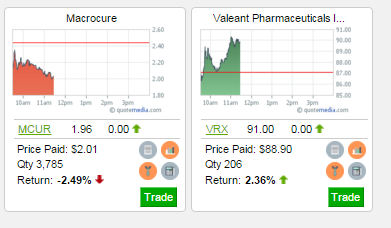
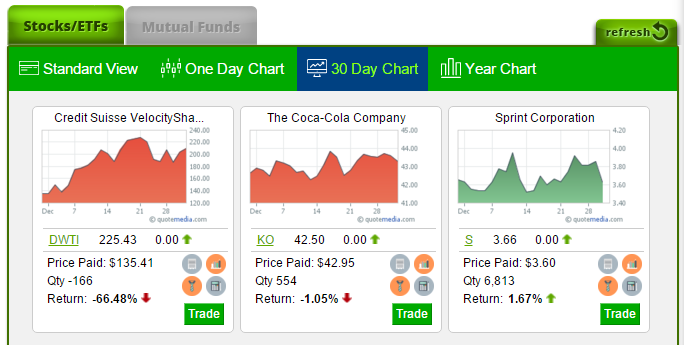
chartsWe’ve added some great new charts to the Open Positions page! Once you’ve purchased any stock or ETF, you can view your portfolio as a series of charts showing each stock’s performance. You can switch between the day’s change, for the last 30 days, or even the whole last year. Best of all, the charts are color-coded: Green if you’re making money and red if you’re losing it, so it is easy to see what is making your portfolio move the most.

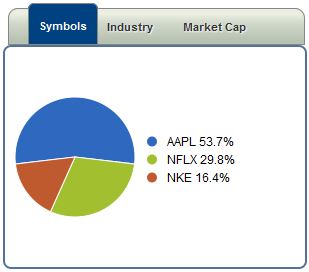
pie chartBesides the awesome new charts, we’ve made some huge improvements to the Pie Chart on the right side of the page.


The Pie Chart will now show how your portfolio is split between different stocks, how it is split by industry classification, and even how much you’re investing in big companies compared to small ones (“Market Capitalization”). The industry and market cap filters are provided by our data provider, and will continue to improve as we move forward.

However, if you’re new to HowTheMarketWorks and want a quick way to get started, we’ve also made an improvement just for you: if you don’t currently have any stocks in your portfolio, we will give you a rotating list of the most popular stocks trading right now (with the company logos and current day’s price movement).

It has never been easier to manage your portfolio, so check it out today!

As always, there have been tons of small changes, bug fixes, and performance improvements put in place every week. At this time, we have stopped further development of the old version of the site. New users and classes are encouraged to register on the new site, which is still found at new.www.howthemarketworks.com.

The first thing to consider with all personal finance is the idea of compound interest! This is what separates the “Piggy Bank” savers from the Warren Buffets; making use of interest compounding is how you can really make your savings grow!

If you have already used our Investment Return Calculator, you can use this calculator to see how different types of compounding will affect your overall return!

Once you can really see the impact of interest compounding and growth, try out our Credit Card Payments Calculator to see what happens when you are paying interest, not earning it!


Find out the difference between Simple and Compound Interest! See how big an impact your tax rates and inflation have on your savings over time!

If you have already used our Becoming A Millionaire Calculator, you can use your targeted Expected Investment Return numbers in this calculator to see how to make that return happen!

Once you see how moving the rate of return affects your profits, try checking out our Compound Interest Calculator to see how the different types of compounding can have a big impact on the final return!

Make sure you click the VIEW REPORT button below!
 

Check out some of our other calculators:


How to Become a Millionaire Calculator

millionaire

(A lesson in compound interest.)

Want to be a millionaire? Everyone does, but do you know how much you need to save and what rate of return you need to get on your investments to reach that million level? This financial calculator helps you learn how your savings grows over time and how sensitive your final savings balance is to the rate of return you are earning.

  • Did you know if you start saving $100 a month on your 18 birthday and put that money in a piggy bank, by the time you are 65 you will have $56,400 in your piggy bank (and $0 in interest).
  • But if you put that $100 a month in a bank savings account that paid 3% interest then by the time you are 65 you will have $122,425 in your bank account? That’s the $56,400 you saved plus the bank paid you interest of $66,025.
  • That’s a big improvement, but if you could earn 8% return on your $100 monthly savings, then by the time you are 65 you will have $566,754 in savings! This example uses 8% because that is the historical return of the stock market.
  • Better yet, if you save twice the amount per month ($200 instead of $100) you will have exactly twice the value at age 65, or $1,133,508.
  • So how do you become a millionaire? Start saving $177 a month on your 18th birthday, earn 8%, and have a bank account worth $1,003,155 on your 65th birthday.

If you have used our Home Budget Calculator, you can use your monthly savings plan with this tool to see how long it will take to reach your savings goal!

Once you see how big of an impact the Expected Rate of Return has on your savings growth, take a look at our Advanced Investment Return Calculator to see more details on how to make those big returns happen!


The biggest expense most people have is the place they live, one of the biggest decisions young people face is whether to buy their home, or continue to rent. Conventional wisdom says that buying will pay off in the long term, but believe it or not this is not always the case!

If you have used our Car Loan Calculator to see what kind of loan you can afford with your budget, you can use the same numbers you ended with there to get a great idea of where your personal cut-off would be between whether to Buy or Lease!

Once you know what kind of home you are getting, and how much you would have to pay a month, check out our Home Budget Calculator to build a budget around your expenses, and determine how much you are able to save every month!


We want to make it as easy as possible to teach real personal finance skills to your students, so we have been working with our friends at EconEdLink.org, along with our own team of personal finance experts and educators, to build a set of the best lesson plans and teacher resources anywhere in the world.

We also have dozens more lesson plans on different topics you can browse!

This collection covers other Personal Finance Lesson Plans that don’t fit well in those other groups.

Personal Finance Lesson Plans for All Age Groups

HowTheMarketWorks Lesson 1: Using The Stock Game In Personal Finance

  • Topic: Business and Stocks
  • Personal Finance Standard Covered: Investing (Standard 2) – Evaluate investment alternatives.
  • Source: HowTheMarketWorks
  • Description: This lesson plan is designed to give students the basics of what defines a “business” and why companies issue stock. It also covers a large amount of basic finance vocabulary, with practical examples.

Click Here To Access This Lesson Plan

 Personal Finance Lesson Plans for Elementary School and Up

Money Doesn’t Grow on Trees

  • Topic: Money
  • Personal Finance Standard Covered: Employment and Income (Standard 2) – Compare sources of personal income and compensation
  • Source: EconEdLink, by Patricia Bonner
  • Description: In this lesson students will identify methods for getting money, explain what to do when they find money and other things that belong to someone else, create a plan for earning extra money and conduct a survey to learn more about typical allowances provided to people their age.

Click Here To Access This Lesson Plan

What Do Other People Want To Be?

  • Topic: Career Planning
  • Personal Finance Standard Covered: Employment and Income(Standard 1) – Explore job and career options
  • Source: EconEdLink, by Connections Cross-Curricular
  • Description: Students identify several major career paths, and build graphs based on graphs of different people’s job choices. They can then visualize which jobs have the most competition.

Click Here To Access This Lesson Plan


Personal Finance Lesson Plans For Middle School And Up

Online scams and schemes

    • Topic: Scams
    • Personal Finance Standard Covered: Financial Decision Making (Standard1) – Recognize responsibilities associated with personal financial decisions.
    • Source: InspireFinancialLearning.ca
    • Description: In this lesson, students will learn ways to avoid financial scams and schemes designed to defraud customers.

Click Here To Access This Lesson Plan

About Consumer Privacy

  • Topic: Personal Information
  • Personal Finance Standard Covered: Financial Decision Making (Standard 7) – Control personal information
  • Source: Practical Money Skills
  • Description: The goal of this lesson plan is to provide students with an awareness of the importance of protecting their personal information and the potential consequences of their privacy being invaded by scam artists and identity thieves.

Click Here To Access This Lesson Plan

College: Where Am I Going To Go?

  • Topic: Career Planning
  • Source: EconEdLink, by Mick Duckworth
  • Description: This lesson plan introduces students to the opportunity cost of choosing one school over another, and a wealth of other information about how to look for schools, and how to approach applying for universities, and much more.

Click Here To Access This Lesson Plan

Entrepreneur!

  • Topic: Career Planning
  • Source: EconEdLink, by Connections Cross-Curricular
  • Description: This lesson plan is designed to help students understand why people start their own businesses, some of the risks, and some of the biggest challenges of getting their ideas off the ground!

Click Here To Access This Lesson Plan


Personal Finance Lesson Plans For High School And Up

Inflate your knowledge

    • Topic: Inflation
    • Personal Finance Standard Covered: Employment and Income (Standard1) – Explore Job and Career Options.
    • Source: InspireFinancialLearning.ca
    • Description: In this lesson, students have an opportunity to experience the effects of inflation first-hand through an interactive classroom auction! Students will learn about the Consumer Price Index (CPI) as a measure of purchasing power and standard of living and apply their knowledge to goods and services they purchase today.

Click Here To Access This Lesson Plan

Living on Your Own

  • Topic:Cost of living alone
  • Personal Finance Standard Covered: Financial Decision Making (Standard 5) – Apply communications strategies when discussing financial issues
  • Source: Practical Money Skills
  • Description: This lesson will help students understand the costs of living on their own and provide practice in setting up budgets. Help students to develop the skills and knowledge necessary to interpret and evaluate lease/rental agreements.

Click Here To Access This Lesson Plan

Open for Business!

  • Topic: Entrepreneurship
  • Personal Finance Standard Covered: Employment and Income (Standard 1) – Explore job and career options
  • Source: EconEdLink, by Marsha Masters
  • Description: This engaging lesson gives students the opportunity to identify risks and rewards of entrepreneurship and distinguish between entrepreneurs who start a business to produce a good or provide a service.

Click Here To Access This Lesson Plan

Invest in Yourself

  • Topic: Human Capital
  • Source: EconEdLink, by Scott Niederjohn
  • Description: In this lesson students will explain how human capital is related to career choices, opportunities, and income. They will define opportunity cost and give examples of it.

Click Here To Access This Lesson Plan

Want More? Click Here To Browse Our Full Collection Of Personal Finance Lesson Plans!

Welcome to HowTheMarketWorks, The Best Free Stock Market Game!

Get ready for our webinar series, where we will go through all the features of using HowTheMarketWorks in your class or club, and answer any questions you may have about the totally FREE platform!

If you missed our last webinar, you can view a recording of our Best Practices and Recommendations webinar below:

We give all webinars based on what works best for you! Leave your details below and we will send you an email with the details on the next webinar that fits your schedule. If you do not find a session you can attend on this list, just contact support@howthemarketworks.com to set up a new one!

Technical analysis software gives a user the ability to quickly manage information and is often provided by a brokerage for free or a small premium. You can also get the software without having a brokerage.

These software allow users to perform a variety of tasks depending on the specific tool you use.

They often have but are not limited to charting, news, fundamentals, trade automations, back testing, and many other features that are useful for trading. It is important to note that they are called technical analysis software they are not limited to just technical analysis; many can be used as stock screeners, fundamental research tools, and much more.

Anyone interested in day trading stocks should be familiar with the basics of technical analysis, and try one or two software packages to see what all the fuss is about.

Click Here to see a list of some of the technical analysis software packages we have reviewed.