Introduction

Chile is one of Latin American countries that have a vibrant market-oriented economy and an OECD member. It depends heavily on foreign trade due to its natural resources, and is a dominant and major exporter of copper.

Chile’s Main Industries

 Chile is economically known for its strength in:

  1. Mining and Minerals Sector
    1. Copper
    2. Lithium
  2. Agriculture Sector
    1. Fishing
      • Salmon
    2. Fruits and Vegetables
  3. Forestry Sector
    1. Radiata Pine
    2. Eucalyptus
      • Pulp
    3. Wood
    4. Lumber
  4. Services Sector
    1. Tourism

Chile’s Main Stock Exchanges

The two main stock exchanges in Chile by size are:

  1. Santiago Stock Exchange
    1. Chile’s dominant and principal secondary market
    2. Trading occurs in equities, bonds, derivatives, and commodities
    3. Main Index
      1. IGPA Index
      2. IPSA index, published by the exchange, contains Chile’s 40 most liquid stocks

    4. Private pension funds constitute an important investor group
  2. Santiago Electronic Stock Exchange
    1. Allows online trading
    2. Based on its real-time,  electronic-trading platform SITREL
    3. Trading in equities, bonds, derivatives, and foreign exchange

NOTE: The Santiago Stock Exchange has formally merged its stock exchange trading activities with those of Colombia and Peru, to form the Mercado Integrado Latino Americano (MILA), which will allow increased cross-listings of the three countries’ companies.

Glimpse into Chile’s Equity Market

Chilean equities weathered the 2008 economic crisis quite well, mainly due to a lack of exposure to the banking crisis and its commodity-rich resources and exports. The IGPA and IPSA Indices climbed above 35% in 2010, and have outperformed many other Latin American equities.

In $US dollar terms, market capitalization of listed equities surged by over 60% during 2010, from $US 209.5 billion in 2009.

After experiencing lacklustre IPO activity since 2005, Chile is witnessing a busy IPO season in 2011 with Chilean companies expected to raise up to $10 billion through 2012.  The recent integration of its securities exchange trading with Colombia and Peru may further bolster IPO levels.

Stock Index Performance 2011: IGPA

2011 Values:


Last


-1 Mo.

-3 Mo.

-6 Mo.

-9 Mo.


-1 Yr.

-3 Yr.

-5 Yr.

-10 Yr.


6/10/2011


5/10/2011

3/10/2011

12/10/2010

9/10/2010


6/10/2010

6/10/2008

6/12/2006

6/11/2001


Price

22,466.37


22,983.36

20,924.79

23,012.71

22,106.52


18,359.26

14,366.34


2011 Performance:


YTD


-1 Mo.

-3 Mo.

-6 Mo.

-9 Mo.


-1 Yr.

-3 Yr.

-5 Yr.

-10 Yr.

Value Change

-68116.00


-516.99

1,541.58

-546.34

359.85


4,107.11

8,100.03


% Change


-2.25%

7.37%

-2.37%

1.63%


22.37%

56.38%

132.25%

311.97%

Source: Datastream


Chile’s 10 Most Profitable Companies in 2010

Rank

Company

Industry Group

Sector

Symbol/Ticker

  Profit ($ mil)

Revenue ($ mil)

1

 Axxion SA

 Real Estate

Financials

 AXXION-SN

                    1,127.70

                719.42

2

 Empresas Copec SA

 Petroleum Refining

 Energy

 COPEC-SN

                    1,105.33

           13,246.86

3

 Banco De Chile

 Banks

Financials

 XBCH-MC

                       892.43

             3,288.51

4

 Saci Falabella

 Retailing

Consumer Discretionary

 FALABELLA-SN

                       883.31

             9,454.65

5

 Banco Santander-Chile SA

 Banks

Financials

 BSANTANDER-SN

                       850.18

             3,383.84

6

 Empresas Cmpc SA

 Paper Products

Materials

 CMPC-SN

                       695.11

             4,600.15

7

 Antarchile SA

 Petroleum Refining

 Energy

 ANTARCHILE-SN

                       657.42

           13,257.42

8

 Cap SA

Steel Mills

 Materials

 CAP-SN

                       643.67

             2,173.60

9

 Cencosud SA

Retailing

Consumer Discretionary

 CENCOSUD-SN

                       633.10

           13,237.98

10

 Quinenco SA

Diversified Financials

Financials

 QUINENCO-SN

                       623.16

             2,789.64


Ways to Invest in Chile
There are a couple of different ways to invest in Chilean companies:

  1. Through a Chilean Bank
    1. Regional banks in Chile allow investors to purchase equities
      • Banco de Santiago
      • Banco Credito Inversiones
      • Banco de Chile
    2. Through a foreign bank located in Chile
      • HSBC
      • Citibank
      • Banco Santander
  2. Canadian ETFs
    • ECH:NYSEArca – tracks the iShares MSCI Chile Index Fund
  3. Through some international online brokers:
    1. MB Trading
    2. Interactive Brokers
    3. TD Ameritrade
    4. E-Trade
    5. Questrade
    6. optionsXpress
    7. optionshouse
    8. tradeMONSTER
    9. Charles Schwab


Introduction

Serbia is a European country with an upper-middle income economy. It had one of the fastest growing economies of its region, in terms of GDP growth rates prior to the global recession, and attracted solid foreign direct investment.


Serbia’s Main Industries

Serbia is economically known for its strength in:

  1. Agriculture Sector
    1. Fruits
    2. Vegetables
    3. Live cattle
  2. Mining and Metals Sector
    1. Iron
    2. Steel
    3. Non-ferrous metals
  3. Industrial and Manufacturing Sector
    1. Metal processing
    2. Machinery
    3. Mechanical and household appliance production
    4. Consumer electronics
    5. Food Processing
    6. Textiles and Footwear
  4. Forestry Sector
    1. Timber
    2. Wood
  5. Natural Resources
    1. Oil
    2. Coal
    3. Copper
    4. Lead
    5. Zinc
    6. Bauxite
    7. Iron Ore


Serbia’s Main Stock Exchanges

The main stock exchange in Serbia is the Belgrade Stock Exchange (BELEX)

  • Founded in 1894
  • In 2004 became a member of the Federation of Euro-Asian Stock Exchanges
  • Trading mainly occurs in equities and debt of listed Serbian companies. Future plans are underway to include other instruments such as rights, warrants, and derivatives
  • Serbia’s Main Index is the BELEX 15 – consists of Serbia’s 15 most heavily traded listed companies

Glimpse into Serbia’s Equity Market

After experiencing significant negative impacts from the global recession, and performing quite poorly between 2008 and 2009, Serbian equities have rebounded in 2011 with a promising outlook for the near-term.
However, the Serbian stock exchange is not very liquid, which adds to its risk. As such, the good performance could be largely liquidity-driven and investors remain cautious. The Belex 15 stock index has increased around 15% since the beginning of 2011, with its energy stocks performing particularly well.


Serbia’s Top 10 Companies

Rank Company Profit 2009 (Euro) Revenue 2009 (Eur) Revenue Growth (YoY)

  1. Naftna Industrija Srbije AD -393,851,753 -92,165,916 -27.14%
  2. JP Elektroprivreda Srbije -144,741 -24,991,065 4.65%
  3. Telekom Srbija AD 162,153,620 62,646,388 1.63%
  4. JP Srbijagas 9,873,843 3,397,005 -4.78%
  5. Delta Maxi DOO 18,989,256 18,560,216 8.65%
  6. Termoelektrane Nikola Tesla DOO -17,739,454 -97,846,294 5.48%
  7. U.S. Steel Serbia DOO -153,051,128 4,914,422 -44.37%
  8. Mercator – S DOO 12,071,671 -4,259,543 318.49%
  9. Elektrovojvodina DOO -6,931,560 -8,322,647 2.99%
  10. YugoRosGaz AD 13,715,564 23,495,704 -32.94%


Ways to Invest in Serbia

There are a couple of different ways to invest in Serbian companies:

  1. Through a bank in Serbia
    1. AIK Banka
    2. Banca Intesa Beograd
    3. OTP Banka Srbija
    4. Alpha Bank Beograd
    5. Piraeus Bank
    6. Raiffeisenbank Beograd
    7. Volksbank Beograd
  2. ETFs with some exposure to Serbia
    1. ESR:NYSEArca– seeks to track the MSCI Emerging Markets Eastern European Index Fund
    2. GUR:NYSEArca – SPDR S&P Emerging Europe ETF

After months of development behind the scenes, the new version of HowTheMarketWorks is now live and available for all users to test out!

New features we’ve added in this major update:

  • Users can now join as many contests as they like! You are no longer limited to just 3.
  • Trade execution time is much faster – this means that the rankings are more accurate and there is no way for any users to “cheat the system”.
  • The current live quote is now on the trading page for each stock, so users do not need to preview their order before having an idea of how much the trade will cost
  • Charts have been added to the Trading page so you can get a clear view of the stock’s performance for the current trading day
  • Private contest forums where groups can post messages visible only to other members of their contest

We have also added a shop where users can buy HowTheMarketWorks merchandise like t-shirts and coffee mugs. This is the only part of the site that is not completely free, but everyone is encouraged to buy some merch to support our team!

The site has been fully re-built from the ground up with dozens more smaller updates around the site, see if you can find them all!

The site is still being tested to iron out all the kinks – the old version of the site will stay at www.howthemarketworks.com, we will have the new version at new.www.howthemarketworks.com, and everyone is invited to join in for testing. We will be holding our Official November Contest on the new site, with $500 in prizes available to the top finishers. Your portfolio on the old site will not carry over here, you will need to re-register, and will log in using a username instead of your email address.

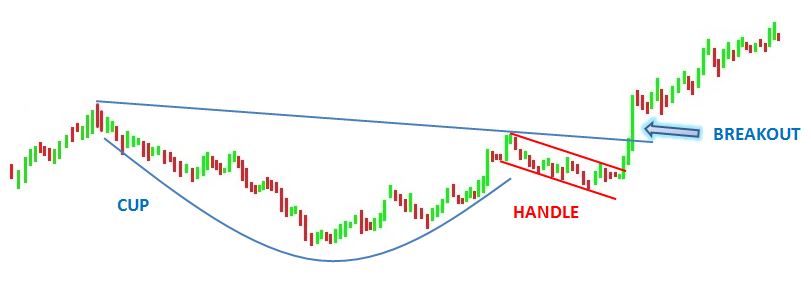
A cup-and-handle chart pattern resembles a cup of coffee with a cup (half circle) and handle (downwards trading pattern). It is a bullish continuation pattern that marks a pause (sideways trend) in the bullish trend. The entire pattern can be anywhere between 1 month to a little more than year. The handle should generally by anywhere from a quarter to a little less than a half of the cup duration.

The cup should be well rounded, it can be fairly steep but should not be so abrupt that it looks like a V. It should also not be so flat that it could be mistaken for a straight line. The handle should be a fairly narrow downward or flat trend.

The cup and handle should always start with an upward trend. The height of the cup and the initial up trend are also important to have a successful cup and and handle pattern. The height of the cup should be approximately between one third (1/3) to two thirds (2/3 of the initial upward trend.

For example, if we have a stock that initial moved from 20 to 30$ and then started to create a cup, the height of that cup should be between about 3.3 (1/3 * 10) and 6.6 (2/3 * 10).

cupandhandle

As with most technical analysis patterns, there are guidelines to indicate the strength of the trend.

1. The closer it is to a nicely rounded cup, the stronger the trent
2. The “handle” can only convert to a breakout when there is strong volume.


Latvia is an EU member country that experienced superior GDP growth rates prior to the financial crisis in 2008. It underwent significant privatization, which resulted in large foreign direct investment inflows. Its economy was ranked first among developing countries until 2008.

Latvia’s Main Industries

Latvia is economically known for its strength in:

  • Pharmaceuticals and Chemicals Sector
    • Phytopharmaceuticals
    • Paints and varnishes
    • Chemical compounds
    • Synthetic fibres
    • Cosmetics and perfume
    • Plastic and rubber products
  • Biotechnology Sector
  • Industrial and Manufacturing Sector
    • Electronics Manufacturing and Engineering
    • Electrical Engineering
    • Textile and Clothing Sector
      • Cotton
      • Wool
      • Garments and accessories
      • Linen
      • Synthetic fibre
  • Agriculture Sector
    • Fruits and Vegetables
    • Bread and Grain
    • Fish
    • Dairy
    • Meat
    • Beverages
  • Forestry Sector
    • Timber
    • Wood
    • Pulp
    • Paper
    • Fibreboard

 Latvia’s Main Stock Exchanges

 The main stock exchange in Latvia is:

A) Riga Stock Exchange (currently NASDAQ OMX Riga)

  1. Founded in 1993 as the Riga Stock Exchange
  2. Is a self-regulating organization, owned by the NASDAQ OMX
  3. Utilizes the highly advanced trading technology (INET)
  4. Serves trading in equities, fixed income, derivatives, and depository receipts
  5. Currently has 30 members on the exchange
  6. Indices

B) OMXR/RIGSE Index


Latvia’s Economic and Investment Performance

After superior growth, Latvia’s economy suffered a severe contraction mainly due to a credit-induced high consumption and bubble. Prior to that, it was a hub for foreign investment and capital, after privatisation led to its economy opening up.

After ranking first among developing countries, it suffered a significant economic contraction. Nevertheless, sound economic and investment policies enabled it to stabilize in 2010 and it remains a promising country with strong potential.


Latvia’s 10 Most Profitable Companies in 2010

Rank Company Symbol : Ticker Profit ($millions) Revenue ($millions)
1 Latvijas Gaze GZE1R-RG 668.29 48.78
2 Grindeks GRD1R-RG 123.22 13.45
3 Latvijas Balzams BAL1R-RG 98.84 7.42
4 Olaines Kimiski-Far OLF1R-RG 47.81 6.69
5 LATVIJAS TILTI AS LTT1R-RG 42.45 3.77
6 SAF Tehnnika SAF1R-RG 18.03 2.57
7 Valmieras Stikla Skiedra VSS1R-RG 74.08 1.17
8 Ditton Pievadkelu AS DPK1R-RG 14.6 0.72
9 BRIVAIS VILNIS AS BRV1R-RG 13.49 0.66
10 LIEPAJAS AUTOBUSU PARKS AS LAP1R-RG 10.15 0.45


Ways to Invest in Latvia

There are a couple of different ways to invest in Latvian companies:

  • Through a Latvian Bank
    • Aizkraukles Banka
    • Danske Bank
    • Nordea Bank
    • DnB NORD Banka
    • SEB Banka
    • Swedbank
  • ETFs
    • ESR:NYSEArce – has exposure to various Eastern European countries including Latvia


Actually, one of the better indicators historically of how well the stock market will do is just a Gallup poll, when you ask Americans if you think it’s a good time to invest in stocks, except it goes the opposite direction of what you would expect. When the markets going up, it in fact makes it more prone toward decline.

Belgium is an EU member located in Western Europe. It has a strong industrialized economy, well-developed transportation infrastructure, and a highly productive work-force making it an attractive destination for foreign capital.

Belgium’s Main Industries

  Belgium is economically known for its strength in:

  • Diamonds
  • Industrial and Manufacturing Sector
    • Engineering and Metal Products
      • Minerals Processing
        • Copper
        • Zinc
        • Lead
    • Steel and Iron Production
  • Heavy machinery and industrial equipment production
  • Motor  and Vehicle Assembly and Production
    • Automobiles
    • Ships and vessels
  • Petroleum
  • Food and Beverage Processing
  • Chemicals and Pharmaceuticals
    • Sulphuric Acid
    • Nitric Acid
    • Synthetic Ammonia
    • Crude Tar
  • Textiles Processing
    • Cotton
    • Wool
    • Linens
    • Synthetic Fabrics
    • Spinning
    • Weaving

Belgium’s Main Stock Exchange

The main stock exchange in Belgium is:

  1. 1.      Euronext Brussels
    1. Founded in the early 19th century
    2. Merged with the ParisBourse and Amsterdam Exchanges to form Euronext
    3. Euronext provides a single, cross-border exchange for markets in equities and derivatives
    4. Main Index

i.     BEL 20 – includes twenty highly liquid Belgian equities

Belgium is an important trading partner with many EU members, and as such, many companies in the EU region have also listed on the Euronext Brussels.

Glimpse into Belgium’s Equity Market

Belgium listed equities have rebounded following the 2008 financial crisis yielding around 30% from recessionary bottoms, as represented the BEL 20 index.

The Euronext Brussels market capitalization rose 17% from Euro 202 billion (2009) to Euro 273 billion (2010).

Ways to Invest in Belgium

There are a couple of different ways to invest in Belgian companies:

  • Financial or Investment firms
    • Brokerage services are provided by domestic or international firms in Belgium
    • Through a regional Belgian bank
      • Belgian banks offer securities investment services
        • AXA Bank
        • KBC Bank
        • BNP Paribas Fortis
        • Argenta
        • Belgian ETFs
          • EWK:NYSE ARCE – tracks the MSCI Belgium Investable Market Index
          • Through some international online brokers:
            • MB Trading
            • Interactive Brokers
            • TD Ameritrade
            • E-Trade
            • Questrade
            • optionsXpress
            • optionshouse
            • tradeMONSTER
            • Charles Schwab


Italy is an EU member country and one of G-8 leading industrialized economies, having the seventh largest economy in the world. Its thriving small and medium enterprises play an important economic role. Italy has world-leading companies in manufacturing, automobiles, textiles, and agriculture.

Italy’s Main Industries

 Italy is economically known for its strength in:

  • Agriculture Sector
    • Maize corn
    • Olive Oil
    • Fruits and Vegetables
    • Flowers
    • Wine
    • Meat
    • Dairy Products
    • Services
      • Financial
        • Banking
        • Insurance
        • Asset Management
  • Tourism
  • Precious metals
    • gold
    • Industrial and Manufacturing
      • Iron and Steel
      • Chemicals
      • Machinery
      • Automotives
      • Precision Engineering
      • Textiles and CLothing

Italy’s Main Stock Exchanges

The main stock exchange in Italy is:

  1. 1.      Borsa Italiana
    1. Founded in 1808 and operated under state ownership until privatisation in 1997
    2. In 2007 was purchased by the London Stock Exchange
    3. Serves trading in equities, and plays an important role in Italy’s fixed income and derivatives market
    4. Some Indices

i.     FTSE/MIB Index

ii.     MIBTel


Glimpse into Italy’s Equity Market

Foreign equity investors have remained cautious, with investment inflows not being significant in 2010. Italy’s equities have been considerably impacted by the Euro-zone debt and default crisis, and amid an uncertain economic outlook, with the stock index down 12% during the 2010 year.

Market capitalization of stocks has been stable, increasing from $317 billion in 2009 to $318 billion in 2010.


Ways to Invest in Italy

There are a couple of different ways to invest in Italian companies:

  • Through Italian Banks or foreign ones located in Italy
    • Banca d’Italia
    • Banco di Roma
    • Intesa Sanpaolo
    • Banca delle Marche
    • Canadian ETFs
      • EWI: NYSEArca – tracks the MSCI Italy Index
      • Through some international online brokers:
        • MB Trading
        • Interactive Brokers
        • TD Ameritrade
        • E-Trade
        • Questrade
        • optionsXpress
        • optionshouse
        • tradeMONSTER
        • Charles Schwab


Ireland is an EU member country with a knowledge-based economy and strong industries in services and technology. With attractive corporate tax rates, Ireland has been ideal destination for multinational corporations.

Ireland’s Main Industries

  Ireland is economically known for its strength in:

  • Agriculture Sector
    • Cattle
    • Beef
    • Dairy
    • Services Sector
      • Financial
        • Banking
        • Asset Management
  • Tourism
  • Mining and Metals Sector
    • Zinc
    • Lead concentrates
    • Alumina
    • Coal
    • Gypsum
    • Limestone
    • Industrial and Manufacturing Sector
      • Construction Sector
        • Residential property
  • Pharmaceuticals and Chemicals
  • Technology Sector
    • Hardware
    • Software related goods and services
    • Energy Sector
      • Supply and distribution of natural gas
      • Electricity
      • Coal

Ireland’s Main Stock Exchanges

 The main stock exchange in Ireland is:

  1. 1.      Irish Stock Exchange
    1. Founded in 1793 and is Ireland’s sole independently-owned exchange
    2. Has an established and extensive debt securities trading market
    3. Operates three principal markets

i.     Securities of established domestic and global Irish companies

ii.     Growth-oriented companies

iii.     Debt market

  1. Indices

i.     ISEQ Overall Index

Glimpse into Ireland’s Equity Market

Irish equities experienced negative returns following the 2008 economic crisis. With the Irish banking sector have a heavily credit exposure to a deteriorating and crashing property market, the economy underwent significant problems.

The 3-year return on the ISEQ overall index was -48%. The index has somewhat recovered however, with the last 9 months yielding 4.5%

Ways to Invest in Ireland

There are a couple of different ways to invest in Irish companies:

  • Irish Banks of foreign banks/investment companies in Ireland
    • Allied Irish Banks
    • Anglo Irish Bank
    • Bank of America
    • DePfa Bank
    • KBC Bank Ireland
    • Rabobank Ireland
    • Goldman Sachs Bank (Europe)
    • Irish ETFs
      • EIRL:NYSEArce – seeks to track the MSCI Ireland Capped Investable Market Index
      • EKH:NYSEArce aims to allow diversification through the performance of some of the largest European companies listed on the US market (has some exposure to Irish companies)
      • Through some international online brokers:
        • MB Trading
        • Interactive Brokers
        • TD Ameritrade
        • E-Trade
        • Questrade
        • optionsXpress
        • optionshouse
        • tradeMONSTER
        • Charles Schwab


Hungary is an EU member country with a medium-sized, liberal economy that is rapidly developing. It has the 5th largest economy in Central and Eastern Europe, with major exports in machinery, chemicals, textiles, and agricultural products.

Hungary’s Main Industries

 Hungary is economically known for its strength in:

  • Agriculture Sector
    • Wheat
    • Corn
    • Sunflower
    • Potato
    • Sugar beet
    • Canola
    • Apple
    • Pear
    • Grape
    • Wine
    • Livestock
    • Industrial and Manufacturing Sector
      • Automobile Production
        • Engine manufacturing and production
        • Vehicle Assembly
  • Heavy Industry
    • Mining and Metallurgy
      • Metalworking and processing
      • Steel Production
      • Metallurgy
      • Machine Production
        • Machine tools
        • Transport Equipment
        • Electrical Appliances
  • Energy Production
  • Mechanical Engineering
  • Chemicals
  • Food Processing
  • Services
    • Tourism

 Hungary’s Main Stock Exchange

The main stock exchanges in Hungary is:

  1. 1.      Budapest Stock Exchange
    1. Previously The Hungarian Stock Exchange (1864)
    2. Operates as a subsidiary of the CEESEG AG holding company, which owns around 70% of the BSE
    3. Over 40 domestic and international brokers participate in trading on the BSE
    4. Products traded include

i.     Equities

ii.     ETFs

iii.     Government and corporate debt

iv.     MBS

v.     Futures and options

vi.     Grain commodities

  1. Important indices

i.     BUX

ii.     MSCI Hungary Index

Glimpse into Hungary’s Equity Market

Hungary’s economy was severely impacted by the recent recession, owing partly to having one of the largest public deficits in the EU region. However, it has recovered quite well, and its equities have rebounded solidly over the past year.

The MSCI Hungary Index stock index rose 24.36% over the last year, with a year-to-date of 16.59% return.

Stock Index Performance: BUX

Ways to Invest in Hungary

There are a couple of different ways to invest in Hungarian companies:

  • Through a regional Hungarian Bank or a foreign bank/investment company located in Greece
    • Erste Bank Hungary
    • Budapest Hitel
    • OTP Bank
    • Deutsche Bank
    • BNP Paribas Hungaria Bank
    • Raiffeisen Bank
    • Investors can purchase equities through a regional bank
    • Hungarian ETFs
      • ESR:NYSEArca – tracks the MSCI Emerging Markets Eastern European Index Fund
      • GUR – aims to replicate the SPDR S&P Emerging Europe index, and has over 5% exposure to Hungary
      • Through some international online brokers:
        • MB Trading
        • Interactive Brokers
        • TD Ameritrade
        • E-Trade
        • Questrade
        • optionsXpress
        • optionshouse
        • tradeMONSTER
        • Charles Schwab


Peru is a Latin American country with an emerging, market-oriented economy that has been among the top performers in South America. Rich in natural resources, it is a major exporter of gold, copper, zinc, and fish.

Peru’s Main Industries

Peru is economically known for its strength in:

  • Agriculture Sector
    • Fishing
    • Artichokes, grapes, avocadoes, mangoes,
    • Cotton
    • Coffee
    • Sugar
    • Services Sector
      • Tourism
      • Natural Resources
        • Copper
        • Gold
        • Silver
        • Petroleum
        • Timber
        • Iron ore
        • Coal
        • Natural gas
        • Mining Sector
          • Gold
          • Coal
          • Copper
          • Zinc
          • Silver
          • Iron Ore
          • Manufacturing and Industrial Sector
            • Metal mechanics
            • Tobacco processing
            • Food processing
            • Textile

Peru’s Main Stock Exchanges

 The main stock exchange in Peru is:

  1. 1.      Bolsa de Valores y Productos de Asunción (BVPASA)
    1. Established in 1977 and is Peru’s only stock exchange
    2. Exchange provides trading services in equities and debt securities of both public and private companies
    3. Stock Index

i.     IGBVL index

Glimpse into Peru’s Equity Market

Prior to the global financial crisis in 2008, Peru experienced economic growth that was among the top-performers in Latin America (2007 and 2008). Political stability and liberalised economic policies have made Peru a very open investment regime, attracting significant foreign investment and capital

Equities performed exceptionally well in 2009 and 2010, with the IGBVL index rising 101% and 65%, respectively.  Between the same periods, the market capitalization of its exchange grew by 43% from $US 69.7 billion to $US 99.8 billion.

Ways to Invest in Peru

There are a couple of different ways to invest in Peruvian companies:

  • Through a Peruvian Bank or foreign one located in Peru
    • BBVA Banco Continental
    • Banco Financiero del Peru
    • Bank of Nova Scotia
    • JP Morgan Chase Bank
    • Banco Standard Chartered
    • Citibank
    • Peruvian ETFs
      • EPU:NYSEArca – Peruvian ETF that tracks the MSCI ALL Peru Capped Index
      • Through some international online brokers:
        • MB Trading
        • Interactive Brokers
        • TD Ameritrade
        • E-Trade
        • Questrade
        • optionsXpress
        • optionshouse
        • tradeMONSTER
        • Charles Schwab


Portugal is an EU member country with a high-income and service-based economy. It enjoys vast forests, has a strong industrial base, and is an important agricultural exporter.

Portugal’s Main Industries

Portugal is economically known for its strength in:

  • Agriculture and Fishing Sector
    • Cereals
    • Olives
    • Wheat
    • Maize
    • Wine
    • Oranges
    • Fish
    • Industrial and Manufacturing Sector
      • Oil refining
      • Cement production
      • Machinery and electronics
      • Textile and footwear
      • Food processing
      • Forestry Sector
        • Pulp
        • Paper
        • Services Sector
          • Tourism
          • Transport
          • Telecommunication
          • Financial
            • Banking
            • Natural Resources Sector
              • Lithium
              • Tungsten
              • Tin
              • Uranium

Portugal’s Main Stock Exchanges

The two main stock exchanges in Portugal by size are:

  1. 1. Euronext Lisbon
    1. Created in 1769 as the Lisbon Stock Exchange
    2. Acquired in 2002 by Euronext NV to become Euronext Lisbon. It became part of the NYSE Euronext Group following their merger in 2007
    3. Trading occurs mainly in equities, bonds, warrants, ETFs, and derivatives
    4. Index

i. PSI-20 – composed of Portugal’s 20 largest companies by market cap and share volume

  1. 2. OPEX
    1. An alternative trading system (ATS) geared for trading in small and medium sized Portuguese companies
    2. Listing criteria is not very rigid and regulated
    3. Specializes in alternative investments and securities such as

i. Warrants and certificates

ii. Derivatives

  1. Investors include private equity investors, hedge funds, and pension funds

Glimpse into Portugal’s Equity Market

The performance of Portuguese equities has been heavily impacted by the Euro-zone peripheral economies’ debt crisis, as well as its own. The Market capitalization of its exchange fell by 17% in 2010 to $81.9 billion, and its equities have significantly underperformed during the last 3 years with a -30% return.

Investor capital and equity outflows have been considerable during this period, and investment should be limited with the current uncertain outlook. Portugal has recently negotiated a $110 billion bailout from the EU and IMF.

Ways to Invest in Portugal

There are a couple of different ways to invest in Portuguese companies:

  • Through a regional Portuguese Bank
    • Portuguese banks enable their clients to invest in securities listed on the exchange
      • Banco Espirito Santo
      • Banco Comercial Portugues (BCP)
      • ETFs with exposure to Portugal
        • CUT:NYSEArca – tracks the Beacon Global Timber Index
        • DFE:NYSEArca – tracks the WisdomTree Europe SmallCap Dividend Index
        • Through some international online brokers:
          • MB Trading
          • Interactive Brokers
          • TD Ameritrade
          • E-Trade
          • Questrade
          • optionsXpress
          • optionshouse
          • tradeMONSTER
          • Charles Schwab

Romania is an EU member country, which has experienced positive foreign direct investment and GDP growth following privatization initiatives over the last decade. It has an upper-middle income economy strong in its industrial and agricultural sectors. 

Romania’s Main Stock Exchanges

The two main stock exchanges in Romania by size are:

1. Bucharest Stock Exchange

It was founded in 1882 and has merged with Romania’s OTC exchange (RASDAQ) in 2005.

The principle securities traded on this exchange include:

  1. Equities
  2. Government and Corporate debt
  3. Fund units
  4. Structured products

2. SIBEX

It is Romania’s second largest exchange, and is designed for trading in derivative securities such as futures and options on

  1. Stocks and indexes
  2. Currencies
  3. Interest rates
  4. Commodities such as gold

Glimpse into Romania’s Equity Market

Romania’s major index is the BET, which is composed of Romania’s 10 largest listed companies.

Romanian equities yielded positive returns of 16% during the last year, and have performed solidly relative to other European equities.

Market cap of listed equities increased 7% from $US 30.3 billion in 2009 to $US 32.3 billion in 2010.

Stock Index Performance: BET 20.

Ways to Invest in Romania

There are a couple of different ways to invest in Romanian companies:

1. Through a bank in Romania

  1. Banca Tanssilvania
  2. Romanian International Bank
  3. CEC Bank
  4. Alpha Bank
  5. ABN Amro
  6. Raiffeisen Bank
  7. Citibank Romania
  8. Libra Bank

2. ETFs

ESR:NYSEArce – It is an emerging markets ETF with high exposure to Eastern Europe

Austria FlagAustria is an EU member and currently the 12th richest country in the world. It has experienced sustained economic growth and attracts many foreign investors. Austria is home to internationally reputable law firms and banks, and has a vibrant tourism sector.


 

Austria’s Main Industries

 Austria is economically known for its strength in:

  • Services Sector
    • Financial
      • Banking
      • Asset management
      • Law
  • Tourism
  • Industrial and Manufacturing Sector
    • Metals Production
      • Iron
      • Steel
  • Machinery
    • Electric
    • Electronic
    • Equipment
  • Chemicals and Petro-Chemicals
    • Synthetic textile fabrics
    • Pesticides
    • Pharmaceuticals
    • Plastics
  • Textiles
    • Embroidery
    • Spinning
    • Weaving
    • Knitting
    • Forestry Sector
      • Pulp
      • Paper
      • Mining and Minerals Sector
        • Magnesite
        • Lignite
        • Iron Ore


The main stock exchange in Austria is:

  1. 1.      Vienna Stock Exchange
    1. Austria’s principal stock exchange
    2. Operated by the company Wiener Börse
    3. Core trading activities are equity and bond markets
    4. Also separately operates the Energy Exchange Austria and the CEGH Gas Exchange
    5. Main Index

i.     ATX


Glimpse into Austria’s Equity Market

Austrian equities have experienced a strong recovery following the recent recession, with the Market Capitalization of its listed companies increasing by 26% from $53.6 billion in 2009 to $67.7 billion in 2010.

In 2010, the Vienna Stock Exchange had 10 IPOs issued by domestic and foreign enterprises.

Stock Index Performance: ATX


Values:

Last

-1 Mo.

-3 Mo.

-6 Mo.

-9 Mo.

-1 Yr.

-3 Yr.

-5 Yr.

-10 Yr.

6/10/2011

5/10/2011

3/10/2011

12/10/2010

9/10/2010

6/10/2010

6/10/2008

6/12/2006

6/11/2001

Price

2,707.50

2,864.00

2,806.83

2,829.99

2,487.27

2,338.71

4,166.44

3,487.03

1,227.00

Performance:

YTD

-1 Mo.

-3 Mo.

-6 Mo.

-9 Mo.

-1 Yr.

-3 Yr.

-5 Yr.

-10 Yr.

Value Change

-24438.00

-156.50

-99.33

-122.49

220.23

368.79

-1,458.94

-779.53

1,480.50

% Change

-5.46%

-3.54%

-4.33%

8.85%

15.77%

-35.02%

-22.55%

118.72%

Source: Datastream


Austria’s 10 Most Profitable Companies in 2010


Rank Company Sector Industry Symbol/Ticker   Profit ($ mil) Revenue ($ mil)

1

Raiffeisen Bank International AG Banks Financials RBI-VI

1,458.88

12,853.72

2

OMV AG Oil&Gas Energy OMV-VI

1235

31,289.03

3

Erste Group Bank AG Banks Financials EBS-VI

1,172.9

15,954.51

4

Voestalpine AG Metals&Mining Materials VOE-VI

727.57

15,544.3

5

Verbund AG Electric Utilities Utilities VER-VI

537.68

4,437.64

6

Wiener Stadtische Versicherung AG Insurance Financials VIG-VI

509.45

12,533.49

7

EVN AG Electric Utilities Utilities EVN-VI

282.53

3,757.19

8

Telekom Austria AG Diversified Telecommunications Telecommunication Services TKA-VI

262.07

6,239.23

9

Andritz AG Machinery Industrials ANDR-VI

240.92

4,767.5

10

Strabag SE Construction&Engineering Industrial STR-VI

234.58

16,610.17


Ways to Invest in Austria

There are a couple of different ways to invest in Austrian companies:

  • Through established foreign and domestic investment or financial firms with brokerage services
  • Through a regional Austrian bank
    • Investors can access Austrian equities through Austrian banks
      • Bank Austria
      • Ostereichische Postsparkasse (P.S.K)
      • Raiffeisenbanken
      • Austrian ETFs
        • EWO: NYSEArce – tracks the MSCI Austria Investable Market Index
        • Through some international online brokers:
          • MB Trading
          • Interactive Brokers
          • TD Ameritrade
          • E-Trade
          • Questrade
          • optionsXpress
          • optionshouse
          • tradeMONSTER
          • Charles Schwab


Investing in Argentina
Image by www.slon.pics on Freepik

Argentina is a South American country that is one of the G20 economies. It is the third largest economy in Latin America and has the highest GDP per capita in its region. It possesses plenty of natural resources, a strong agricultural sector, and a well-educated population.


Argentina’s Main Industries

  • Agriculture: beef, fruits and vegetables, wheat, cattle, tabacco
  • Natural Resources: shale oil, coal, natural gas, forestry products
  • Metals: gold, copper, zinc, magnesium, uranium, silver
  • Manufacturing: food processing, chemicals and pharmaceuticals, auto parts, iron and steel, industrial machinery, textiles, cement

Argentina’s Main Stock Exchanges

The two main stock exchanges in Argentina by size are Buenos Aires Stock Exchange (BCBA) and Rosario Stock Exchange (BRVM).

Buenos Aires Stock Exchange

  • Argentina’s largest and primary stock exchange
  • Operates as a self-regulating, non-profit entity
  • MERVAL is the main index

Ways to Invest in Argentina

There are a couple of different ways to invest in Argentine companies:

Argentinian Banks and Financial Firms

  • Santander Rio
  • BBVA Banco Frances
  • BNP Paribas
  • BACS BANCO DE CREDITO Y SECURITIZACION

Argentina ETFs

  • ARGT: MSCI Argentina ETF
  • EEV: UltraShort MSCI Emerging Markets

International Online Brokers

Glimpse into Argentina’s Equity Market

Considered an emerging economy, Argentina attracts significant foreign investors and capital.

In 2022 Foreign Direct Investment (FDI) increased in Argentina to $15 billion, (source: World Investment Report 2023). With the 3rd largest economy in Latin America, it has gained a reputation as a country with high inflation and a complex regulations. However, the government has been implementing policies to attract more foreign investment.

There are opportunities in the energy industry as Argentina has significant shale gas and oil reserves. Mining is another big industry with several major producers of copper, lithium and other minerals in the country. Buenes Aires is also emerging as a major tech center for Latin America. With many skilled workers and a lower cost of living compared to other tech hubs, new Argentinian tech startups are experiencing a competitive advantage. The government is aiming to support continued technological innovation through tax incentives in high-tech sectors.

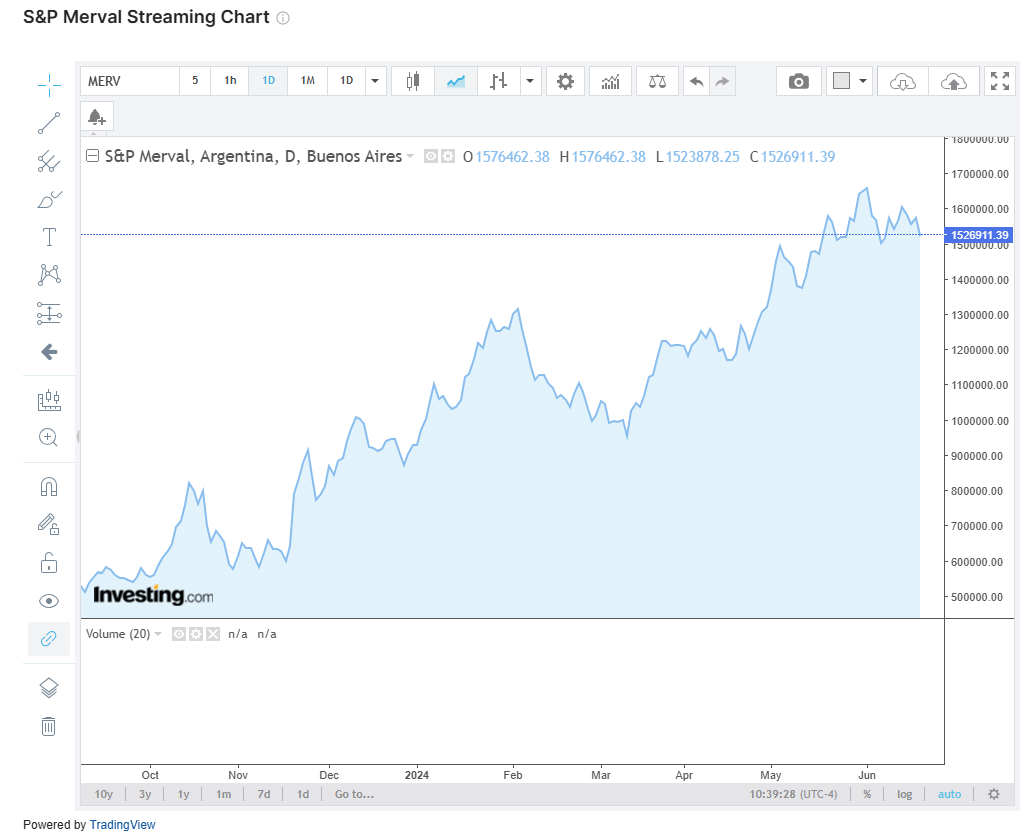
Stock Index Performance: MERVAL

The MERVAL (stock index) is a weight-adjusted fund that has been trading since 1986. It was initiated by the S&P Dow Jones Indices in 2019. MERV reached an all-time high in May 2024. Since the beginning of 2024, the index has increased 69.57%.

Source: Investing.com

Argentina’s Largest Companies by Market Cap (as of 2024)

  • MercadoLibre (MELI)
  • Celulosa Argentina (CELU.BA)
  • Yacimientos Petrolíferos Fiscales (YPF)
  • Galicia Financial Group (GGAL)
  • Banco Macro (BMA)
  • Ternium Argentina (TXAR.BA)
  • Transportadora de Gas del Sur (TGS)
  • Telecom Argentina (TEO)
  • Pampa Energía (PAM)
  • BBVA Argentina (BBAR)

Consultancy A.T. Kearney does a periodic study of worldwide investments by managers at the world’s largest companies and how the economy effects those investments. In 2007 there was an all-time high investment of $1.98 trillion in 2007 by these multinational companies.  Foreign direct investment worldwide fell 14% in 2008.  In 2009, it fell another 39%. A.T. Kearney says that these investments have only started to increase recently.  The multinationals postponed much of their planned investments due to continued market uncertainty and the problems in obtaining credit.

Recently there has been a rise of emerging markets. As you would expect, the top countries for investment include China, India, and Brazil. Poland has moved up 16 rungs to weigh in at No. 6. Other countries to enter the top 25 include: Romania, Saudi Arabia, Chile, and Egypt. For a more detailed look at the top countries for foreign investment by international executives, please visit these links:

Albania Hungary Peru
Argentina Ireland Portugal
Austria Italy Romania
Belgium Latvia Serbia
Chile Lithuania Spain
Columbia Luxembourg Sweden
Denmark Moldova Switzerland
Ecuador Netherlands Turkey
France Norway United Kingdom
Greece

Gross National Product is the value of all goods and services produced by a country’s residents.

GNP

  • Is based on the market value of goods and services
  • Takes only final goods and services into consideration
  • Relies on factors of production such as the country’s labor and capital
  • Is measured on an annual basis


How is GNP used?

Gross National Product statistics are used to

  • Measure the economic activity of a country
  • Evaluate and analyze economic growth
  • Assess how productive a country’s factors of production are
  • Measure the value of important goods and resources
  • Analyze the income earned by a country’s residents
  • Compare the performance of different countries
  • Develop economic policies aimed at improving GNP figures


How is GNP Measured?

Two approaches can be used to measure GNP: (1) The Income Approach (2) The Expenditure Approach

(1)    Income Approach

  • Measures the income or earnings received by the country’s factors of production (Labor, Land, Capital)

 GNP = Wages + Interest Income   + Rental Income + Profit

  • GNP or National Income is the sum of
    • Wages
      • The salaries, income or earnings that residents received for their work and labor during an entire year
      • Interest Income
        • Any income earned from holding assets or funds in
          • Bank savings accounts
          • GICs
          • Treasury-Bills
          • Canada Savings Bonds
          • Interest earned on foreign investments
      • Rental Income
        • Any income earned from owning and renting property.
        • Includes income from renting
          • A house
          • Apartments
          • Rooms
          • Office space
      • Profit
        • Income earned from investments (e.g., dividends from stocks)

(2)    The Expenditure Approach

  • Measures the amount spent or paid (expended) on all goods and services during the year at market value or prices
  • Uses and sums up two main components: (1) Gross Domestic Product and (2) Net Income from Abroad
    • We need to first calculate Gross Domestic Product (GDP)
      • GDP is the value of a country’s products and services produced in year
        • 5 main components of GDP
          • Private Consumption and Expenditure (households) – C
          • Investment Expenditure –  I
          • Government Expenditures – G
          • Exports   – X
          • Imports – M


GDP = Private Consumption + Investment Expenditure + Government Expenditures + Net Exports

GDP           =                C    +     I    +    G   +   (X   –   M)

 Next, we determine Net Income from Abroad, which is composed of

    • Income from Abroad – income received by citizens from overseas business activities
    • Income to abroad – income provided to foreign citizens from their business activities in the domestic country

Using both components, we calculate GNP as

GNP = GDP + Net Income from Abroad

Conclusion

The Gross National Product (GNP) is an economic measure of the market value of all goods and services produced by a country’s residents. It is an important and widely followed statistics that indicates the strength and growth of an economy, as well as the productive use of its factors of production such as labor and capital. It can be measured using the income or expenditure approach.


Key Words: Gross, National, Product, GNP, Economic, Activity, Measure, Market, Value, Goods, Products, Services, Residents, Citizens,  Country, Factors, Production, Labor, Capital, Resources, Gross, Domestic, Product, Income, Expenditure, Approach, Wages, Interest, Income, Rental, Profit, Private, Consumption, Government, Investment, Net, Exports, Imports, Abroad,

Free Cash flow is the cash available to all the capital providers of a company

There are two types of free cash flows

  • Free Cash Flow to the Firm (FCFF)
    • Cash flow available to pay out to all capital providers such as common stock holders, debt holders, and preferred stock holders.
    • Free Cash Flow to Equity (FCFE)
      • Cash flow that is available strictly to the company’s common stock holders (equity)

The FCFF and FCFE are not reported on a company’s financial statements, therefore, the analyst or investor must perform necessary calculations to arrive at these figures.

Financial Statement Items

First, we review some of the necessary financial statement items need to compute FCF

Net Income: the Earnings of the company after operating, interest, depreciation, and tax expenses have been made


Noncash charges: include items such as depreciation which do not represent an actual outflow of cash


Capital Expenditures:  the company’s investments in fixed assets and capital. These are an important source of future growth for a company


Working Capital:  the company’s short-term capital necessary to conduct its daily business operations. These include:

  • Receivables
  • Inventory
  • Payables

Cash Flow from Operations: The net amount of cash from the company’s operating activities

Interest Expenses: the company’s costs of assuming debt

Liabilities / Borrowing: The amount that the company borrows in terms of its debt obligations


FCFF and FCFE Equations

Free Cash Flow to the Firm (FCFF)

Cash available after operating expenses, working capital, and capital expenditures have been taken into consideration.

The company can use this cash flow to:

  • Pay its common equity holders with dividends
  • Pay its debt holders back (i.e., pay down its principal)
  • Pay its preferred equity holders


Equation:

FCFF = Net Income + Noncash items + Interest Expenses (1-Tax Rate) – Capital Expenditures – Working Capital Requirements


Free Cash Flow to Equity (FCFE)

Cash available to common equity holders after payments related to debt are made and working capital and capital expenditures are taken into account.

The payment s relating to debt include:

  • Payments such as interest expenses and debt principal repayment

The company can use this available cash flow to pay its common stock holders.

Equation:

FCFE = Net Income + Noncash items – Capital Expenditures – Working Capital Requirements + Net Borrowing


Why are FCFs used?

Some uses and applications of FCFs

  • To assess the company’s ability to pay its equity and debt capital providers
  • FCFs can be used when the company does not pay dividends, and as such, does not have a track record of paying equity holders. FCFs can indicate how much the firm can pay out
  • FCF can be used by a company to repay the principle related to its long-term debt
  • FCFs are used with for firm valuation purposes, such as with Discounted Cash Flow (DCF) models to measure a company’s intrinsic value

Conclusion

Free cash flows are a company’s cash available after operating expenses, capital expenditures and working capital requirements have been accounted for. It represents the funds available for the company’s capital providers. The FCFF represents cash available to both equity and debt capital providers, while the FCFE is the cash flow that can be reserved to the company’s common equity holders. FCFs play an important role in financial modeling and discounted cash flow techniques in determining valuation for an asset or financial security


Key Words: Free, Cash, Flow, Firm, Discounted, DCF, Equity, FCF, FCFF, FCFE, Available, Operating, Capital, Expenditure, Fixed, Assets, Working, Requirements, Common, Equity, Debt, Capital, Holders, Providers, Valuation, Financial, Statements, Net, Income, Noncash, items, Depreciation, Interest, Expense, Tax, Operations, Principal, Debt, Liabilities, Borrowing, Receivables, Payables, Inventory, Cost, Dividends, Intrinsic, Value, Preferred, Security, Dividends, Measure, Assess, Modeling

The Form-8K is a SEC-mandated report filed by public companies to report unexpected events or transactions that are material in nature, and thus have an impact on the share prices of the company.

In accordance with the Securities Exchange Act (1934), specifically defined events must be reported within 4 business days. The main purposes of the Form 8-K are to:

  • Satisfy regulatory requirements
  • To provide investors and shareholders with up-to-date company information
  • Update previously released reports such as the 10-Q (quarterly report) and the 10-K (annual report) with important developments.

The criteria for reporting such material events or transactions are defined within 9 major sections or categories. These events (or transactions) are deemed to be significant for investors and shareholders towards their investment-decision making.


Why are Form 8-K reports important?

To make sound investing decisions, investors need information that is timely, reliable, and accurate. Material information concerning the activities, operations, and business of a corporation can have a significant impact on important aspects such as

  • Future revenues, earnings, cash flows, and other financial items
  • Strategic direction
  • Competitive positioning in the market
  • The industry it operates in

Such factors inevitably will impact its share price in the market. Therefore, it is important that investors have access to important information that is crucial in making investment decisions.

Annual reports (10-K) and quarterly reports (10-Q) contain valuable information. However, there is a time lag between the issuance dates of such reports. The Form 8-K is therefore used as a vehicle to report material events not captured by the 10-Q or 10-K.


What are material events?

The actual Form 8-K is available for download on the SEC’s website at:

http://www.sec.gov/about/forms/form8-k.pdf

Material events fall under one of 9 main sections.

Section 1- Registrant’s Business and Operations

MATERIAL EVENTS:

  • Entry into a material definitive agreement
  • Termination of a material definitive agreement
  • Bankruptcy or receivership

Section 2- Financial Information

MATERIAL EVENTS:

  • Completion of acquisition or disposition of assets
  • Results of operations and financial condition
  • Creation of a direct financial obligation or an obligation under an off-balance sheet arrangement of a registrant
  • Triggering events that accelerate or increase a direct financial obligation or an obligation under an off-balance sheet arrangement
  • Costs associated with exit or disposal activities
  • Material impairments


Section 3- Securities and Trading Markets

MATERIAL EVENTS:

  • Notice of delisting or failure to satisfy a continued listing rule or standard; Transfer of listing
  • Unregistered sales of equity securities
  • Material modification to rights of security holders


Section 4- Matters Related to Accountants and Financial Statements

MATERIAL EVENTS:

  • Changes in registrant’s Certifying Accountant
  • Non-reliance on previously issued financial statements or a related audit report or completed interim review

Section 5- Corporate Governance and Management

MATERIAL EVENTS:

  • Changes in control of registrant
  • Departure of directors or certain officers; Election of directors; Compensatory arrangements of certain officers
  • Amendments to articles of incorporation or bylaws;
  • Change in fiscal year
  • Temporary suspension of trading under registrant’s Employee Benefit Plans
  • Amendments to the registrant’s code of ethics, or waiver of a provision of the code of ethics
  • Changes in shell company status
  • Submission of matters to a vote of security holders


Section 6- Asset-Backed Securities

MATERIAL EVENTS:

  • Change of servicer or trustee
  • Change in credit enhancement or other external support
  • Failure to make a required distribution
  • Securities act updating disclosure


Section 7- Regulation FD

MATERIAL EVENTS:

  • Regulation-required disclosures

Section 8- Other events

MATERIAL EVENTS:

  • other events deemed material or having important informational value

Section 9- Financial Statements and Exhibits

MATERIAL EVENTS:

  • financial statements of businesses acquired
  • pro-forma financial information
  • shell company transactions


Conclusion

The Form-8K report is crucial for investors and shareholders in remaining current on major or material events and transactions performed by a company.

Such events typically have the ability to affect the firm’s stock price. Therefore, investors use such information to update their investment decisions such as buying, selling, or holding the stock.

The Form 8-K report is mandated by the SEC, with the purpose of providing timely and relevant information not included in annual or quarterly reports.


Key Words: Form 8-K, Report, Securities, Exchange, Commission, Material, Events, Information, Revenues, Earnings, Cash Flows, Financial, Statements, Mergers, Business, Operations, Securities, Trading, Markets, Certified, Accountants, Corporate, Governance, Management, Asset, Backed, Securities, Regulation, Exhibits

Fixed income analysis is the process of evaluating and analyzing fixed income securities for investment purposes.

Fixed Income represents a distinct asset class. Investors and analysts perform fixed-income analysis to

  • Evaluate the risk characteristics underlying debt securities and to assess the capacity of the borrowing entity to meet its financial obligations (credit analysis)
  • Identify which debt securities represent attractive investment opportunities
  • Determine the appropriate valuation (or value) of debt securities in the market
  • Compare the investment characteristics (e.g., risk and return) of debt securities with each other and with other asset classes such as stocks, derivatives, real estate, or other.

Features and Characteristics of Fixed Income

Some important features of fixed income securities include

  • Government versus Corporate Bonds
    • On a very broad level, fixed income securities can be categorized as
      • Government
        • E.g., US Treasuries
    • Corporate
      • Bonds issued by public corporations
      • Issuer
        • The party, entity, or corporation that sells the debt obligation to investors
        • This is the borrowing entity
        • Borrower or Debt Security Holder
          • The party that has purchased the debt obligation (i.e., the lender)
          • Principal or Face Value
            • The amount borrowed which has to be repaid in full at a future date
            • Interest
              • The interest rate that is applied to the principal borrowed amount
              • Periodic Payments
                • The periodic dates during the life of the debt for which the borrower is responsible for making regular payments of interest or principal (or both)
                • Maturity
                  • The length of time from the inception of the debt to its termination
                  • Fixed-Income Options
                    • Options embedded within fixed income securities giving the lender or borrower the right to either redeem the obligation
                      • Callable Bond – the issuer of the debt obligation retains he right to redeem the bond before its maturity date
                      • Putable Bond – the holder of the debt obligation (the borrower) retains the right to redeem the bond before its maturity date
                      • Convertibility
                        • Convertible debt securities allow the debt security holder to convert the debt obligation into common equity


Elements of Fixed Income Analysis

The following elements are typically common when analyzing the fixed-income security of a corporation

  • Credit Analysis
    • Analysis of the company’s financial statements
    • Assessment of creditworthiness and capacity to pay
    • Analysis of collateral and covenants
    • Risk Analysis
      • Corporate fixed-income securities are exposed to certain risks, which can include one or more of the following
        • Interest rate risk
        • Inflation risk
        • Credit or default risk
        • Liquidity risk
        • Foreign Exchange risk
        • Sovereign risk
        • Fixed-Income Valuation
          • A time-value based formula and methodology is used to value fixed income securities
          • The bond’s interest payments and principal are discounted back to today, to arrive at a present value figure (which is the bond’s value)
            • The present value of each future cash flow is found and summed up
  •  The following are needed to perform the valuation
    • The coupon or interest rate
    • The coupon or interest payments
    • The Face Value or Principal amount
    • The discount rate used to find the present value of each future cash flow
    • Comparison with Government Debt Securities
      • Fixed-income analysis also includes a comparison of the corporate debt-security’s return or yield with that of risk-free US government debts (Treasuries)
        • These are highly safe, liquid, and debt obligations
        • The return on Treasuries is seen by investors as the minimum acceptable or possible return in the market
        • The return on corporate fixed income securities is compared to the return on US treasuries to measure the “extra” yield/return offered (also referred to as risk premium)
          • This extra return is required by investors for assuming the risks inherent in corporate fixed income securities (see above for list of risks)


Conclusion

Fixed income analysis is the analytical framework used to evaluate and assess fixed income securities for investment purposes. This includes credit and risk analysis, as well as bond valuation. It applies to securities such as government and corporate bonds, and plays an important role in the trading and pricing of such instruments in the market.


Key Words: Fixed, Income, Analysis, Debt, Securities, Obligations, Analytical, Framework, Evaluate, Assess, Investment, Credit, Risk, Free, Government, Corporate, Bond, Valuation, Financial, Security, Interest, Rate, Principal, Coupon, Maturity, Risk, Issuer, Borrower, Principal, Face, Value, US, Treasuries, Measure, Determine, Pricing, Market, Value, Options, Callable, Putable, Convertible, Financial, Statements, Creditworthiness, Capacity, Collateral, Covenants, Inflation, Liquidity, Sovereign, Foreign, Exchange, Default, Time, Present, Value, Yield,