After more than 10 years, the TDBank Stock Game was discontinued at the end of 2025. This can leave teachers used to their customizable games looking for a new alternative for 2026.
What was the TDBank Stock Game?
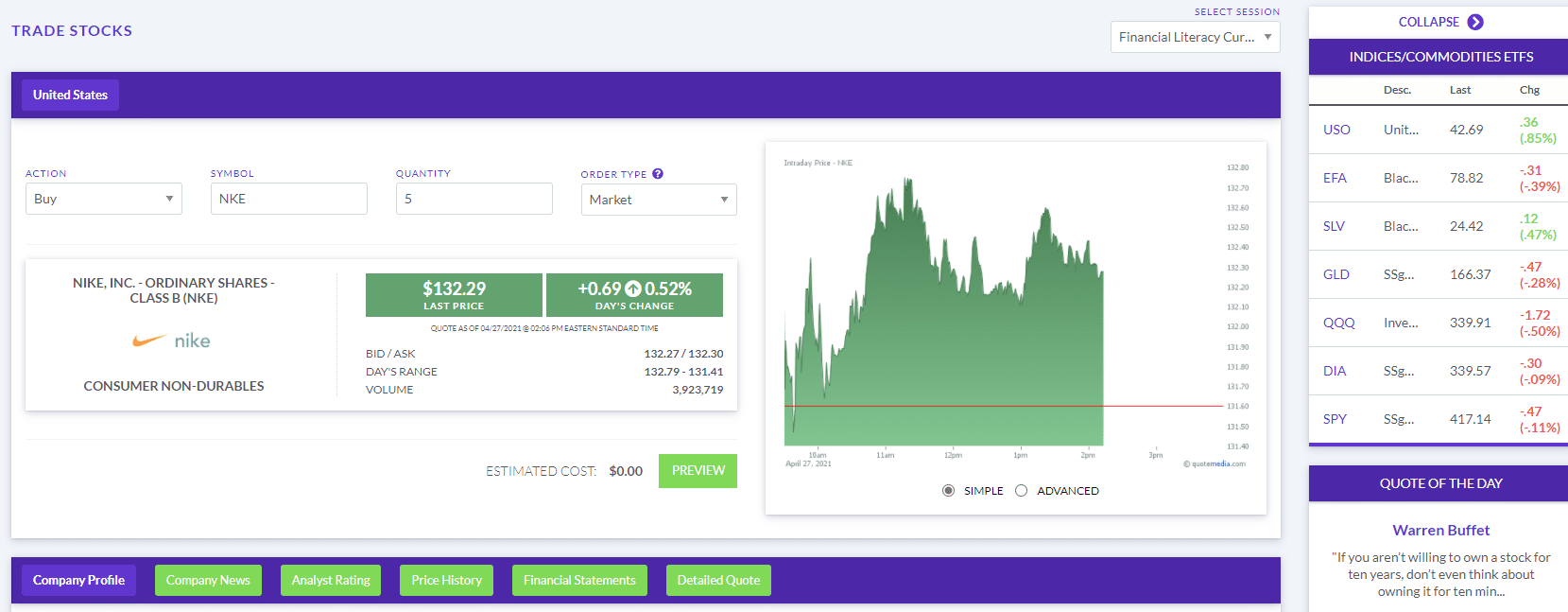
The TDBank Stock Game was a free stock market simulation made available as part of the TDBank Wow!Zone educational resources. The game allowed instructors to register and either generate student accounts in a pre-built trading session, or create their own custom stock game for their class.
Teachers also could assign reading materials, videos, or trading actions to their students as part of the game.
Best TDBank Stock Game Alternatives
The TDBank Stock Game offered the same simulation for everyone, but instructors looking for a new stock game for their class have a few options available to them.
HowTheMarketWorks
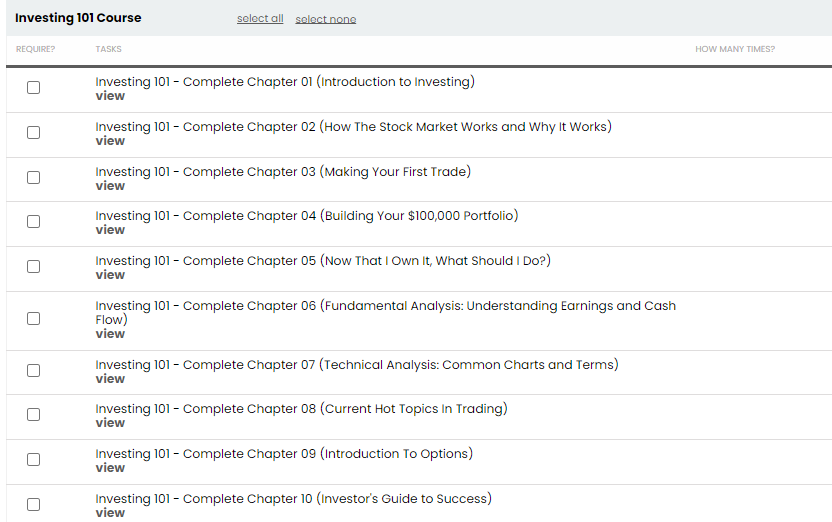
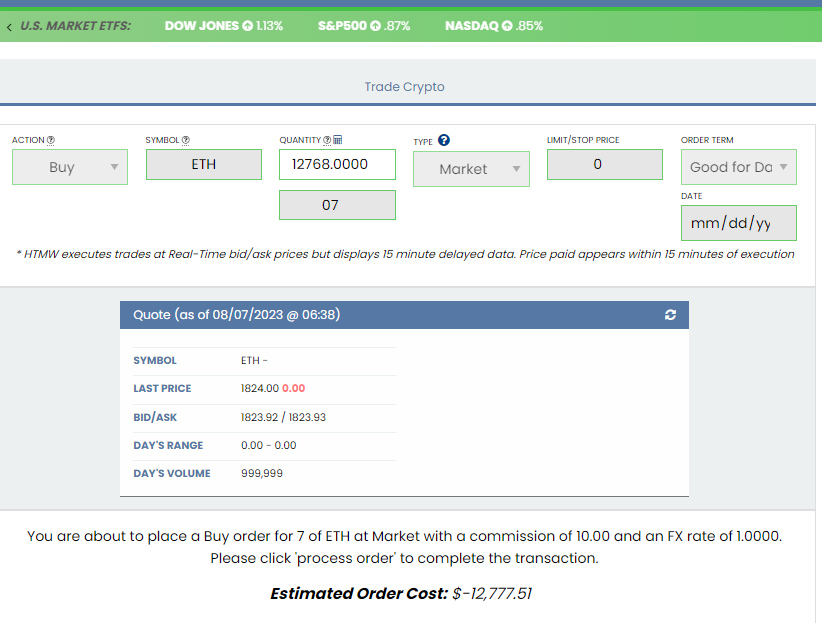
The HowTheMarketWorks free stock market game is the closest alternative for teachers looking to replace the TDBank virtual stock market. The HowTheMarketWorks game allows teachers to register for free, create their own custom investing contests with stocks, ETFs, and mutual funds, and even has the same ability to assign reading tasks, videos, and trading actions to their students that was featured on the TDBank stock game.
StockTrak is the best TDBank stock game alternative for colleges and universities. In addition to the basic trading features from the TDBank game, StockTrak also includes international investing, bonds, options, futures, and more – all customizable by the instructor. StockTrak is used in over 75% of top US business schools, and also includes built-in tutorials, lessons, assessments, and a library of suggested project outlines for first-time professors.
PersonalFinanceLab is the best TDBank virtual stock market alternative for K-12 schools. It has the same basic stock game, teacher reporting, and tutorials, plus over 300 automatically-graded, standards-align lessons, and an interative budgeting game for personal finance classes.
All teachers on PersonalFinanceLab also get their own dedicated account manager, live chat support (during market hours), and a huge library of lesson plans and class project ideas to help launch successful, immersive class projects.
The loss of the TDBank Stock Game is disappointing for teachers who have relied on the simulation for years, but there are some great alternatives out there, with the same (or better) features for all classes.
The VirtualStockMarket Stock Market Simulation has ended service in December 2025. This means teachers who previously used their free stock game need alternatives for their next classes.
Best Alternative Stock Games
If you previously used the VirtualStockMarket game in your classes, there are several alternatives available for your next class. These recommended alternatives use the same real-time trading engine, ability to create your own class session, class reading assignments, and live customer support during market hours.
PersonalFinanceLab
PersonalFinanceLab is the best stock market game for K-12 personal finance and economics classes. For teachers familiar with the VirtualStockMarket, PersonalFinanceLab will look very similar – as they are built on the same “backbone”.
In addition to US stocks, bonds and mutual funds, PersonalFinanceLab also includes international investments, options, and more – configurable by the teacher. It also includes a library of lesson plans, over 300 built-in, automatically-graded, standards-aligned lessons, and (best of all) an interactive Budgeting Game, taking personal finance classes to a whole new level. PersonalFinanceLab is also data-privacy friendly – with standing DPA agreements in place for most states for schools where student data is a primary concern.
Price
PersonalFinanceLab has a license cost per student, starting at $10 for just the stock game or $15 for both the stock game and budget game (both versions include the lesson library). Teachers who previously used the VirtualStockMarket can use coupon code “virtualstockmarket2025” for your first semester free (sign-up before March 1, 2026 and class ending before July 1, 2026).
StockTrak is the best stock market simulation for universities and higher education. It is used by over 70% of the top US business schools as part of their finance programs, and includes both the same investments that were available on the VirtualStockMarket, plus international investments, options, futures, forex, crypto, and more. It also includes built-in risk profiles for student portfolios, like Sharpe Ratio, Jensen’s Alpha, and Treynor ratios.
For university Personal Finance classes, StockTrak also includes the same learning library and budgeting game as PersonalFinanceLab, upgraded for a college audience.
Price
Professor registration on StockTrak is completely free – you can sign up and create a class at no charge. Once you have students register to your class, pricing depends on your simulation length and which options you wish to include (budgeting game, derivatives, ect). The cost can be paid by the university (school invoice), by students at the time of registration, or through VitalSource and Kortext (including Equitable Access, Inclusive Access, and First Day) via your school bookstore.
First-time professors using StockTrak coming from the VirtualStockMarket game can have their first semester’s classes license fee waived by mentioning “VirtualStockMarket Free Class” in the comments box when creating your class (offer good through February 28, 2026).
HowTheMarketWorks is a free stock game for high schools that uses the same trading engine as the VirtualStockMarket, but without support for bonds and more limited teacher reports. However, teachers can still create and customize their own class stock market contests, see rankings and trades, and either invite students to register their own accounts or generate anonymized logins for their class.
HowTheMarketWorks is completely free (supported by advertising), and you can have your class up and running in less than 5 minutes.
WallStreetSurivor is another free stock market game (supported by ads) with the same real-time trading engine used on the VirtualStockMarket. The biggest difference is that WallStreetSurvivor is tailored for individual learning, with integrated courses and investing tips built right in.
Users can build a portfolio of US stocks and options, plus crypto, to learn how to trade on their own. Once they master the basics, users can invite their friends to custom stock contests.
WallStreetSurvivor also includes live customer support, regular investing contests with prizes, badges, and newsletter recommendations.
There are also alternative stock market games available on the market – however, they do not share the same real-time trading engine (frequently enabling students to “cheat”), or the live support for teachers managing their classes. Most schools prefer one of these three options for their ease-of-use, ability to work with school data privacy restrictions, and additional support through lesson plans, built-in assignments, and real-time trading system.
If you’re just starting out in the stock market, you’ve probably wondered how some investors seem to consistently beat the market while others barely keep up. What do they know that you don’t?
For many retail investors, the difference comes down to having access to professional-grade research tools—and knowing how to use them. That’s where Seeking Alpha’s Alpha Picks comes in.
In this Seeking Alpha Alpha Picks review, we’ll explore how this data-driven stock recommendation service works, what makes its quantitative analysis so effective, and most importantly—how beginners can use it as a learning and idea-generation tool alongside the HowTheMarketWorks stock simulator.
What Is Alpha Picks by Seeking Alpha?
Seeking Alpha is one of the most respected platforms in online investing, known for its comprehensive research tools, community of analysts, and quantitative stock ratings that help everyday investors make smarter decisions.
The SeekingAlpha.com website has 3 levels of service. You can register free and get access to quotes, charts and some news. But what you really want is access to their highly regarded Quant Ratings. Their second level of service is Seeking Alpha Premium, which allows you to get full access to all their Quant Ratings and analysis on stocks, and you can link your own portfolio to get real-time feedback on your stocks. But if you want the best stock picks from the highest Quant Ratings stocks, you want their Alpha Picks subscription service.
Alpha Picks is Seeking Alpha’s stock picking service designed to help investors identify stocks that have the highest potential to outperform the market based on their proprietary Quant Ratings.
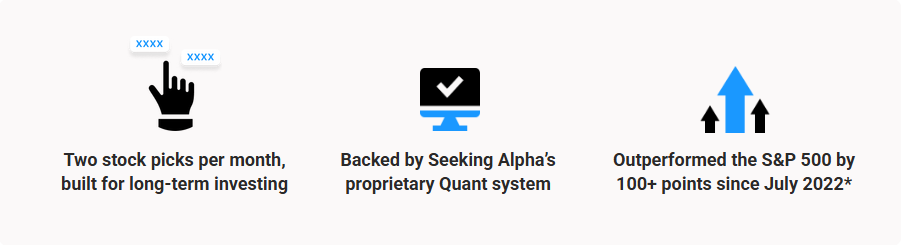
Each month, subscribers receive two hand-selected stock recommendations based on Seeking Alpha’s Quant Ratings—a proprietary scoring system that uses more than 100 data points to rank stocks by value, growth, profitability, and momentum.
In plain terms, Alpha Picks by Seeking Alpha aims to give you a shortlist of stocks with strong fundamentals and favorable performance metrics—stocks that the data suggest could deliver significant price appreciation over time.
Since its launch in 2022, Alpha Picks has built an impressive historical track record of market-beating returns. In fact, its Alpha Picks portfolio has consistently outperformed the S&P 500 over the same period, giving investors a chance to study quantitative strategies that actually work in real-world conditions.
Note: Seeking Alpha isn’t a broker or financial advisor. It’s an investment research platform that provides data and analysis but doesn’t execute trades or manage assets, so it isn’t regulated by the SEC or FINRA.
Alpha Picks Performance Updates:
Update January 1, 2026: Seeking Alpha Alpha’s picks was just declared the best stock newsletter under $500 based on their 2025, 2024, and 2023 picks’ performance as of the last Friday in December, 2025. See the chart below. Their October, 2025 pick is already up 117% in just 3 months. Their July, 2025 pick is up 92% and their February pick is up 82%. Their November, 2024 pick is up 246% in 14 months.
January 1, 2026: Seeking Alpha also just launched their New Year’s Sale, offering some of the lowest prices of the last 12 months and this sale is valid through the end of the month. In this Alpha Picks Review, I’ll explain whether Alpha Picks is worth it and show you where to access the best Seeking Alpha discounts
Alpha Picks Alert, April 19, 2024: A University of Kentucky study reports that Seeking Alpha Quant Ratings help investors beat the market. Their research showed that Seeking Alpha Quant-Rated Strong Buys significantly outperformed the market, supporting the accuracy and predictive strength of the Seeking Alpha Quant model.
How Alpha Picks Works: The Stock Selection Process
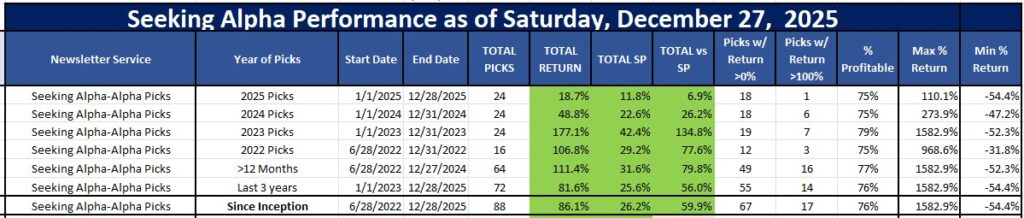
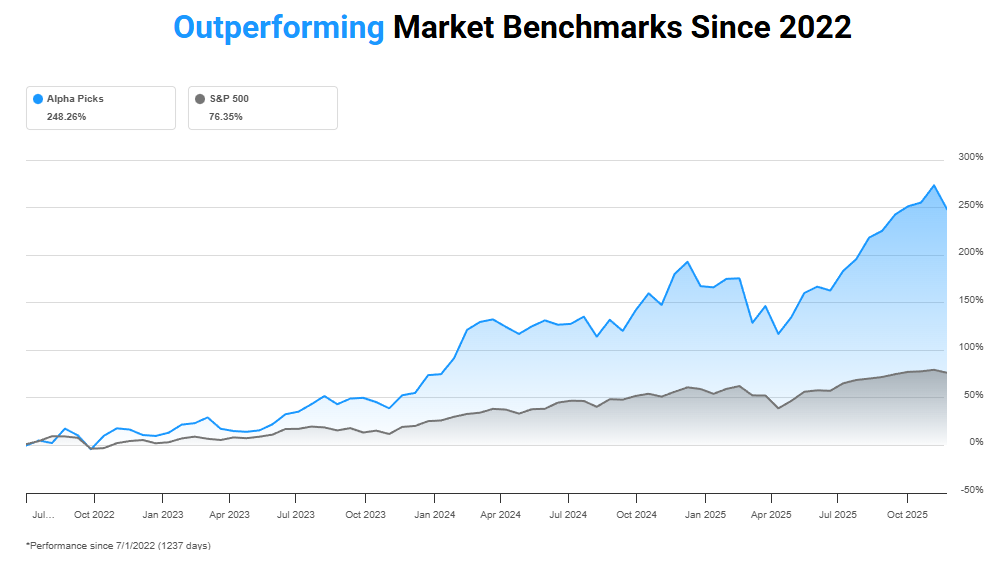
Here’s a snapshot of their performance as of December 27, 2025 to help you judge whether it’s worth it. The results speak for themselves—these returns have delivered substantial gains over the S&P since launch.
Look at those results. The average return of all picks since launch sits at 86%, while the SPY is only up 26%, meaning Seeking Alpha’s Alpha Picks have outperformed the S&P 500 by an average of 59.9% over the last 3.5 years.
If you had saved $1,000 a month and put just $500 into each of the 88 picks, your $44,000 contribution would now be worth $81,900. By comparison, investing that same money monthly into the SPY ETF would leave you with only $55,537.
That’s a total profit of $37,900—with $26,363 in excess gains over the SPY in only 40 months on a $1,000 monthly plan. No other newsletter has generated this much ALPHA. Is it worth $499 a year? The results strongly suggest yes.
Their 64 stock picks that are at least 12 months old are now up 111% and ahead of the market by 80%. Roughly 77% of those recommendations are profitable.
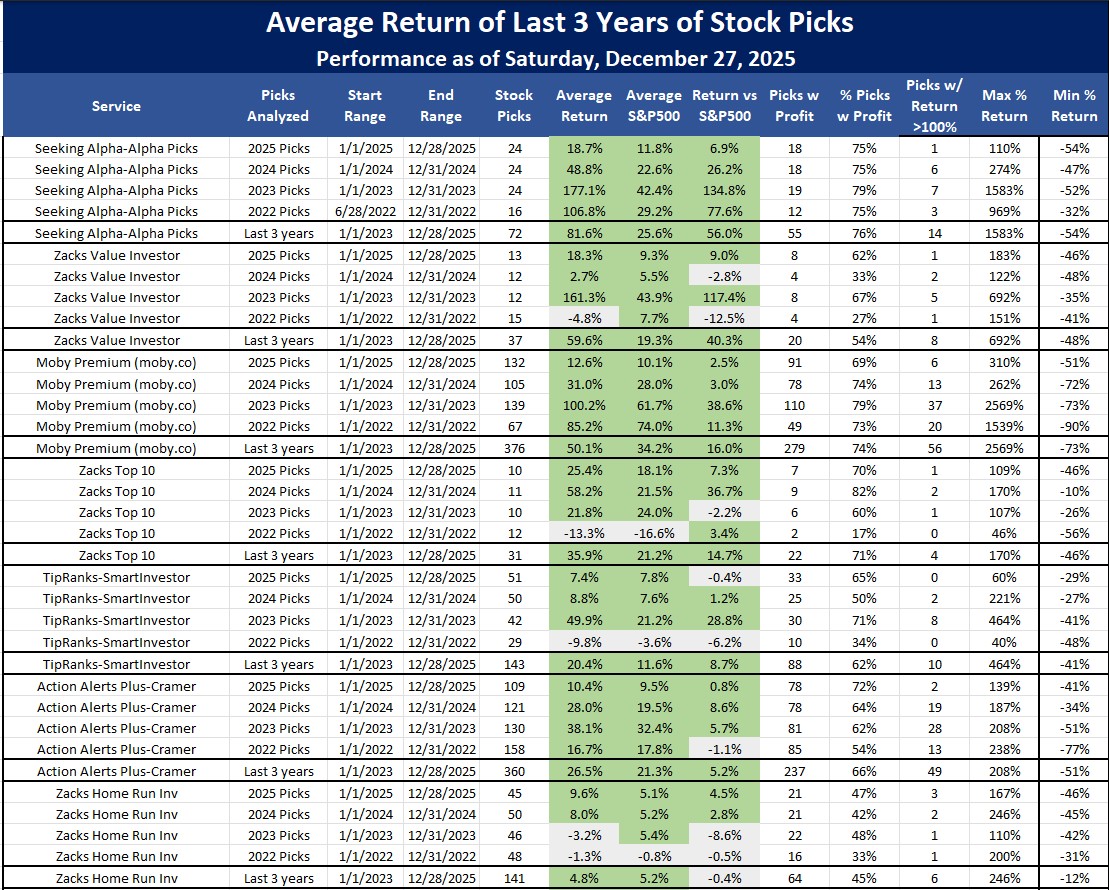
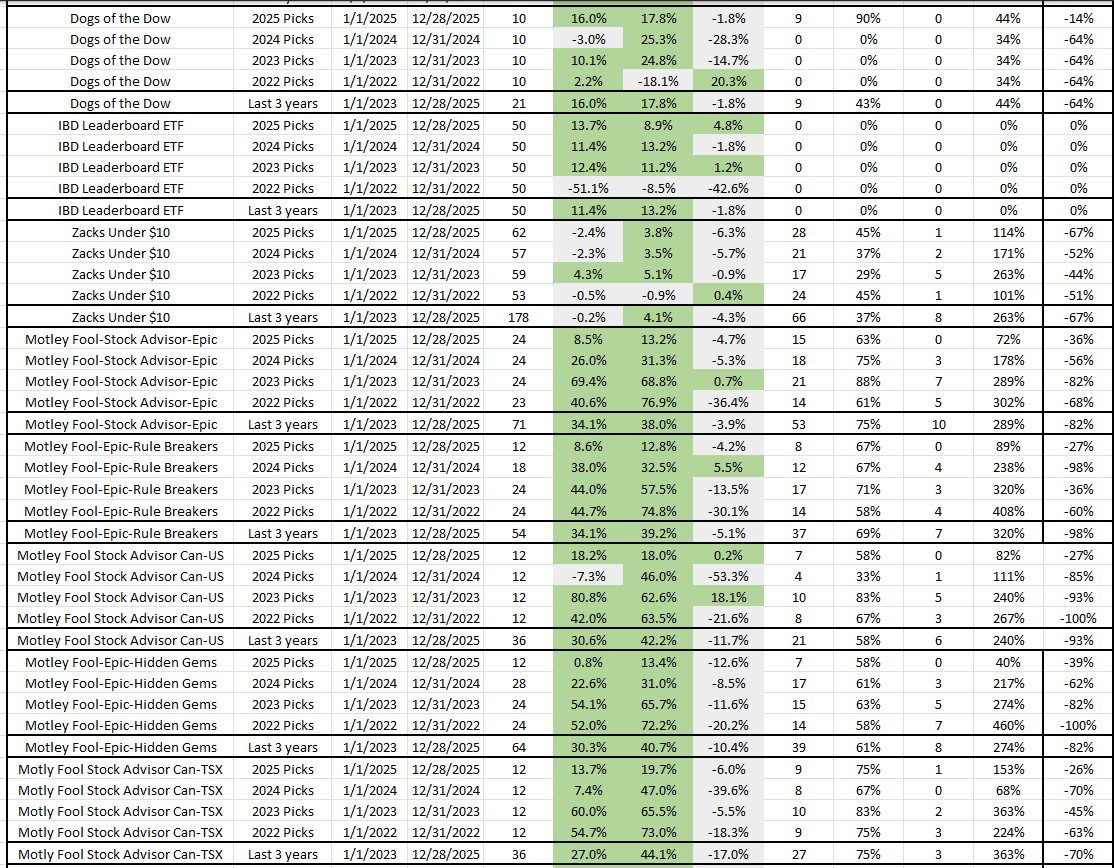
And here’s a quick look at how other popular stock newsletters have done over the last 3 years. This is sorted by 3 year AVERAGE ALPHA per stock pick. (ALPHA is a finance term for return in excess of the market.)
Alpha Picks performance is quite remarkable when you compare it to other services over the last 3 years. Their high profitability percentages and even their worst picks are not that bad. They have sold about 1/2 of their picks either to lock in profits or to avoid bigger losses.
Keep reading to see exactly how Alpha Picks works.
What separates Alpha Picks from other stock recommendation services is its quantitative foundation. Rather than relying on hype, headlines, or emotion, the team behind Alpha Picks employs a systematic stock selection process that filters thousands of publicly traded companies down to the best opportunities.
Here’s how it works:
Quantitative Analysis – Every stock in Seeking Alpha’s database is assigned a Quant Rating, which strongly predicts future returns according to independent academic research.
Fundamental Analysis – Each potential pick is reviewed for financial health, earnings growth, and valuation metrics.
Performance Metrics – The Alpha Picks team reviews stock price trends, market cap, and other key data to ensure each selection aligns with the goal of long-term capital appreciation.
Sell Criteria – Unlike many “set it and forget it” newsletters, Alpha Picks also publishes specific sell criteria, helping subscribers understand when to take profits or cut losses.
In short, Alpha Picks employs quantitative and fundamental strategies that combine to create data-driven stock recommendations—a great learning tool for beginners who want to understand the logic behind outperforming the market.
💡 If you buy Alpha Picks directly from their website, it will cost you $499 a year; but you can Save $75on THIS Seeking Alpha January, 2026  promotion page.

Or, if you want to try Seeking Alpha Premium, take advantage of their January, 2026 promotion and Save $45 on Premium here.
Alpha Picks Performance and Past Results
Let’s talk results—because that’s what most investors care about first.
Since inception, the Alpha Picks portfolio has shown remarkable performance, routinely outperforming the broader market and major index funds during the same period. While exact figures vary by year, Seeking Alpha reports that Alpha Picks has generated average returns far above the S&P 500, showcasing its ability to identify market-beating stocks.
In addition to the APP pick mentioned above, their 2nd best pick is Celestica (CLS) is up 1,167% since they picked it in October, 2023—one of the past Alpha Picks recommendations—delivered significant price appreciation after being highlighted by the service. That single pick alone would have substantially boosted a beginner’s portfolio (or paper trading account) if replicated.
Of course, as every investor knows, past performance does not guarantee future results. Market volatility can impact even the best quantitative models. Still, the performance metric Alpha Picks uses has proven to be a strong predictor of future returns, which is why so many subscribers consider it a core component of their overall investment strategy.
Or, if you want to try Seeking Alpha Premium, take advantage of their January, 2026 promotion and Save $45 on Premium here.
If you look at how their Top Rated Quant Stocks have performed since 2010, you get this chart (note their Strong Buy Recommendations’ Total Return vs S&P500 Return over the same period):
Even though Alpha Picks launched as a new product in 2022, Seeking Alpha’s Quant Ratings have been identifying top-performing stocks for many years. Alpha Picks simply delivers the very best of those top-rated Quant stocks.
You don’t need to be a numbers expert to appreciate results like that.
How Beginners Can Use Alpha Picks to Learn Investing
This is where HowTheMarketWorks readers have a real advantage.
If you’re new to investing, Alpha Picks isn’t just a stock picking service—it’s a classroom. Every pick is an opportunity to analyze why a professional research team believes a stock will outperform and how that logic plays out in real time.
Here’s how to use Alpha Picks as a learning tool:
Study the Rationale: Each pick comes with detailed analysis explaining why it earned a “Strong Buy” Quant Rating. Pay attention to the underlying factors—earnings growth, profitability ratios, valuation trends—that drive that rating.
Simulate the Trades: Use your free HowTheMarketWorks simulator to buy the same stocks in a virtual portfolio. Track your paper performance alongside Alpha Picks’ actual results.
Evaluate Over Time: Watch how each stock behaves through market volatility and news events. This helps you build your own judgment and own research skills.
Apply the Lessons: Use insights from Alpha Picks’ portfolio management—like diversification, rebalancing, and sell criteria—to strengthen your existing portfolio.
This “practice before you invest” approach lets beginners gain experience without risking a single dollar, while learning from one of the most data-driven stock recommendation services in the market.
VALENTINE'S DAY SALE HAPPENING NOW: Act Today; Offer Ends Feb 15th
Seeking Alpha is a very successful stock research and rating service. With that, they rarely offer discounts, so when you see a sale it's crucial to take advantage of it. They're currently offering one of their best discounts of the year!
You can get a free trial, save 20% off their premium services AND get their Lowest Price this Year.
Seeking Alpha Premium: 7 Day Free Trial & Save $45; usually $299 now only $254/year — Claim Your Discount.
Alpha Picks: Save $75; usually $499 now only $424/year — Claim Your Discount.
Seeking Alpha Bundle (get both): Save $159; usually $798 now only $639/year — Claim Your Discount.
Alpha Picks Cost and Subscription Details
So, how much does Alpha Picks cost?
The Alpha Picks subscription is part of the broader Seeking Alpha Premium ecosystem, which offers full access to Seeking Alpha’s quant ratings, equity research, and fundamental analysis tools.
Alpha Picks Subscription Cost: Typically around $199 per year, though promotions often make it more affordable.
What You Get: Two new stock recommendations every month, performance tracking updates, and access to the complete Alpha Picks portfolio.
Bonus: Seeking Alpha Premium subscribers also get in-depth research reports and the ability to track their entire portfolio’s Quant Rating in real time.
Compared to other stock picking services, Alpha Picks offers a solid value—especially for retail investors who want data-driven stock recommendations without paying thousands per year for institutional research.
Naturally, many investors compare Alpha Picks to Motley Fool Stock Advisor, one of the most well-known names in retail investing.
Here’s how they differ:
Alpha Picks by Seeking Alpha relies on quantitative analysis and objective performance metrics, filtering thousands of stocks down to the strongest buy opportunities based on data.
Motley Fool Stock Advisor, on the other hand, focuses on narrative-based investment advice, emphasizing the stories and management teams behind promising companies.
Both have strong track records and loyal followings. However, Alpha Picks is ideal for investors who prefer data and quantitative reasoning, while Motley Fool Stock Advisor appeals to those who value qualitative insights and long-term stories.
For beginners who want to understand both sides of stock picking—numbers and narrative—following both services (or comparing their stock selections) can be a great idea generation tool.
Alpha Picks compares favorably with Motley Fool’s stock picking service in terms of average return, portfolio process, and service’s strong performance—though both remind investors that past results don’t guarantee future results.
Who Is Alpha Picks Best For?
Alpha Picks isn’t designed for day traders or penny stock chasers. Instead, it’s best suited for:
Buy and hold investors focused on long-term capital appreciation.
Retail investors who want a simple, quantitative framework for finding undervalued or high-growth companies.
Beginners eager to learn how quantitative strategies can generate alpha over time.
Because Alpha Picks concentrates on a limited number of high-conviction picks, there’s an element of concentration risk—meaning investors must be comfortable with holding fewer positions.
However, when used alongside a diversified practice portfolio on HowTheMarketWorks, beginners can experience the benefits of this focused strategy without risking real capital.
Is Alpha Picks Worth It? Final Thoughts
So, is Alpha Picks worth the subscription?
For anyone looking to learn investing through real-world examples, the answer is yes. Alpha Picks combines fundamental analysis, quantitative data, and clear performance metrics in a way that’s educational and actionable.
Its track record of outperforming the broader market speaks for itself, and its transparent stock selection process helps demystify what professional investors actually look for in a winning stock.
Of course, no stock picking service can guarantee future results, but the insights you gain from studying and simulating Alpha Picks recommendations can dramatically improve your own analysis and investment strategy.
Whether you’re a seasoned investor refining your approach or a beginner learning the ropes through the HowTheMarketWorks simulator, Alpha Picks offers valuable lessons in portfolio management, equity research, and disciplined investing.
Alpha Picks is a stock recommendation service from Seeking Alpha that delivers two high-conviction stock picks every month based on the company’s proprietary Quant Ratings system.
How much does Alpha Picks cost?
The Alpha Picks subscription typically costs around $199 per year, but Seeking Alpha often offers discounts for new users.
How does Alpha Picks compare to Motley Fool Stock Advisor?
Both offer stock recommendations with strong performance records. Alpha Picks relies on data-driven quantitative analysis, while Motley Fool uses a more story-driven, qualitative approach.
Does Alpha Picks guarantee future results?
No—like any investing service, Alpha Picks cannot guarantee future results. Past performance is not a guarantee of future returns.
Can I practice Alpha Picks strategies on HowTheMarketWorks?
Absolutely! You can simulate Alpha Picks trades using your free HowTheMarketWorks account to track performance without risking real money.
If you’ve ever opened a trading app and wondered how to tell a good stock from a risky one, you’re not alone. Beginners often face an overwhelming mix of opinions, numbers, and charts—but there’s one platform designed to make sense of it all: Seeking Alpha.
Home to the world’s largest investing community, Seeking Alpha brings together millions of investors who share insights, stock ideas, and research. It’s where everyday investors and Wall Street analysts meet, offering a bridge between casual curiosity and professional-level stock analysis.
Seeking Alpha Premium promises high-quality investment research, Quant Ratings, and model portfolios that can help you make informed investment decisions—even if you’re just starting out.
Seeking Alpha was founded in 2004 by former Wall Street analyst David Jackson. His goal was simple but ambitious: give investors access to the kind of in-depth analysis and data typically reserved for professionals.
The term “alpha” comes from finance—it means outperforming the market. Seeking Alpha helps investors find that edge by providing data-driven investment research, commentary, and diverse perspectives from thousands of contributors.
Today, it has more than 20 million active users and 7,000+ verified authors who write daily about stocks, mutual funds, ETFs, and investment strategies. For beginners, it’s a powerful educational resource to learn how analysts think—and how markets really move.
Academic Study of Seeking Alpha’s Quant Rating: A 2024 independent study by professors at a major university found that Seeking Alpha’s proprietary rating system Seeking Alpha Quant Ratings “strongly predict” future returns and offer “pronounced benefits” to investors.
Dr. Jame and Ph.D. Candidate Yuling Guo, Gatton College of Business & Economics, University of Kentucky
Seeking Alpha isn’t a licensed broker or financial advisory service—it’s a platform for investment research and market analysis. While it offers quantitative data and stock insights, it doesn’t handle trades or manage client funds, meaning it isn’t directly regulated by the SEC or FINRA.
VALENTINE'S DAY SALE HAPPENING NOW: Act Today; Offer Ends Feb 15th
Seeking Alpha is a very successful stock research and rating service. With that, they rarely offer discounts, so when you see a sale it's crucial to take advantage of it. They're currently offering one of their best discounts of the year!
You can get a free trial, save 20% off their premium services AND get their Lowest Price this Year.
Seeking Alpha Premium: 7 Day Free Trial & Save $45; usually $299 now only $254/year — Claim Your Discount.
Alpha Picks: Save $75; usually $499 now only $424/year — Claim Your Discount.
Seeking Alpha Bundle (get both): Save $159; usually $798 now only $639/year — Claim Your Discount.
How Seeking Alpha Works
Getting started on Seeking Alpha is easy. You can sign up for free to read a limited number of articles each month, follow authors, and build a watchlist. But most investors eventually upgrade to Seeking Alpha Premium or Pro for full access to data and tools.
Free Plan
Access to daily market news and limited articles
Basic portfolio tracking
Stock quotes and community discussions
Premium Plan
Unlimited access to all analysis and news
Full Quant Ratings and Dividend Grades
Earnings call transcripts and financial metrics
Portfolio health check and monitoring tools
Alpha Picks
2 top Quant Rating stock picks each month with complete explanation
Quant Ratings – The Heart of Seeking Alpha’s Research Tools
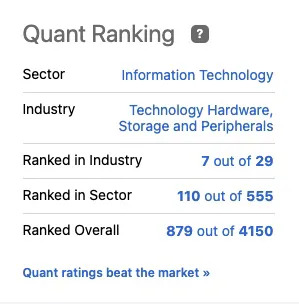
The platform’s most talked-about feature is its Quant Rating System, an algorithm that scores over 10,000 stocks as Strong Buy, Buy, Hold, Sell, or Strong Sell.
These Alpha Quant Ratings are based on five key metrics: value, growth, profitability, momentum, and EPS revisions. The system constantly updates using real-time market data.
Since 2010, stocks rated Strong Buy by Seeking Alpha’s quant model have consistently outperformed the market, while Strong Sell stocks have underperformed. That track record makes it a favorite among both active investors and students learning fundamental analysis.
For beginners, Quant Ratings provide a shortcut to understanding what professional analysts look for—without needing a finance degree.
Stock Analysis and Research Reports
Seeking Alpha’s core value lies in its independent stock research. Each day, contributors publish thousands of research reports, earnings call transcripts, and in-depth analysis covering nearly every listed company.
You can read multiple viewpoints on the same stock—bullish, bearish, and neutral—helping you develop your own research process.
Premium members get unlimited access to these insights, plus tools for portfolio tracking, real-time alerts, and analyst upgrades. If you’re learning how to analyze companies, this section is like a free classroom in investment research.
Dividend Grades and Income Investing Tools
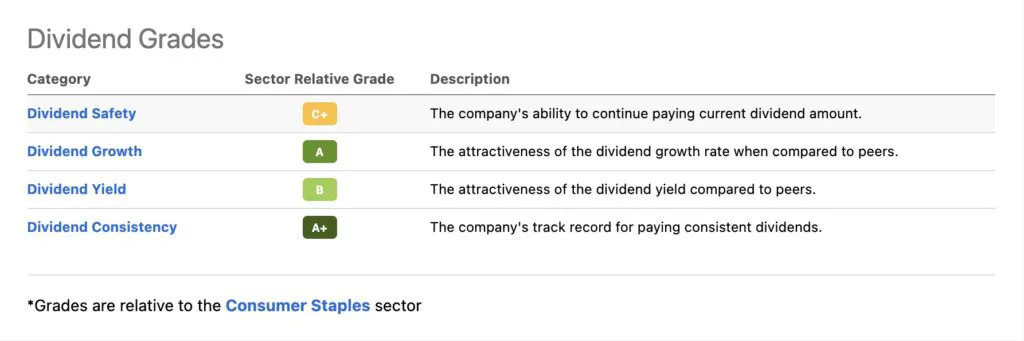
For income-focused investors, Seeking Alpha offers Dividend Grades that rate each company’s dividend safety, growth, yield, and consistency.
These grades help dividend investors quickly identify reliable income stocks without combing through balance sheets. It’s especially useful for dividend investing strategies or building a stable, long-term portfolio.
You can also filter by dividend yield, payout ratio, and growth history, giving students a hands-on way to practice evaluating stock ideas for passive income.
Portfolio Monitoring and Health Check
Seeking Alpha Premium goes beyond research—it helps you manage what you own. The Portfolio Health Check tool analyzes your holdings using Quant Ratings and provides insights into diversification, valuation, and performance trends.
You’ll also get real-time alerts when a stock in your portfolio gets downgraded or upgraded, so you can act quickly.
VALENTINE'S DAY SALE HAPPENING NOW: Act Today; Offer Ends Feb 15th
Seeking Alpha is a very successful stock research and rating service. With that, they rarely offer discounts, so when you see a sale it's crucial to take advantage of it. They're currently offering one of their best discounts of the year!
You can get a free trial, save 20% off their premium services AND get their Lowest Price this Year.
Seeking Alpha Premium: 7 Day Free Trial & Save $45; usually $299 now only $254/year — Claim Your Discount.
Alpha Picks: Save $75; usually $499 now only $424/year — Claim Your Discount.
Seeking Alpha Bundle (get both): Save $159; usually $798 now only $639/year — Claim Your Discount.
What Is Alpha Picks?
While Seeking Alpha Premium gives you the tools, Alpha Picks gives you the trades.
Launched in 2022, Alpha Picks is Seeking Alpha’s stock-picking service that provides two new stock ideas every month. Each pick is chosen from top-rated stocks in the Quant Ratings system and vetted by Seeking Alpha’s in-house analysts.
Subscribers also gain access to model portfolios and performance tracking to see how the picks stack up over time.
Historically, Alpha Picks has outperformed the S&P 500 by a wide margin—making it a top contender among premium subscription services like Motley Fool Stock Advisor.
Alpha Picks Update as of December 27, 2025: Since its launch in July, 2022, the 88 Alpha picks from 2022 thru 2025 are up an average of 86% and are easily beating the S&P500's return of 26% by 60%. But most impressively, their picks that are at least 12 months old are up 111% vs 32% for 80% ALPHA and 77% of their picks are profitable. Yes, these picks are almost 4x the SPY. Their October, 2025 pick (MU) is already up 49%S, July 1 pick is up 53%, and June 16th pick is up 69%, and their February pick (CRDO) is already up 110%. WOW!
And when we compare 3 year performance, you will see Alpha Picks is consistently profitable and outperforming the market. Take a look at this amazing table of performance of various newsletters priced less than $500 per year.
With a historical track record like that, Alpha Picks seems like a very safe investment!
Pricing and Subscription Plans
Seeking Alpha Premium
Alpha Picks
Seeking Alpha Bundle
Overall Rating
⭐⭐⭐⭐⭐
⭐⭐⭐⭐⭐
⭐⭐⭐⭐⭐
Service Type & Strengths
Full access to all their research; link your brokerage account to get Quant Ratings on your stocks and alerts of when to sell.
2 stock picks a month that have highest Quant Rating and most likely to outperform the market.
Includes both services.
Strengths
Strong Buy Quant Rating stocks have 5x the market since 2010. Quant Rating value now verified by academic study. 250,000+ Premium members.
Beating the market by an average of 60% in just 3 years; 17 picks have already doubled; 76% of picks are profitable. Quickly sell losers as half of picks have already been sold.
Get both to monitor your portfolio & get the best picks to buy.
Best for
Self-directed investors who want to easily optimize their portfolio’s return.
Investors wanting specific stock recommendations each month.
Investors looking to better manage their current stocks & get excellent picks to add to their portfolio.
Retail Cost
$299 a year
$499 a year
$798 a year
Current Promotion:
January, 2026 Sale: Save $45, get 7-day free trial
January, 2026 Promo: Save $75 & get access to all their recent stock picks. Next pick comes out .
January, 2026 Promo: Get Premium AND Alpha Picks for just $639
All plans include a 7-day free trial so you can explore everything before paying.
Seeking Alpha also provides occasional discounts on their services, which you can learn about in our Seeking Alpha discount article.
Is Seeking Alpha Reliable?
When it comes to reliability, few investment platforms have the track record Seeking Alpha does.
A 2024 University of Kentucky study found that Seeking Alpha’s Quant Ratings “strongly predict future returns” and provide “pronounced benefits” to investors who follow them.
Additionally, Seeking Alpha data feeds are sourced directly from SEC filings, earnings reports, and real-time market data.
The platform doesn’t just host opinions—it blends quantitative analysis, crowdsourced insights, and fundamental research, creating one of the most comprehensive tools for both new and experienced investors.
Seeking Alpha Performance
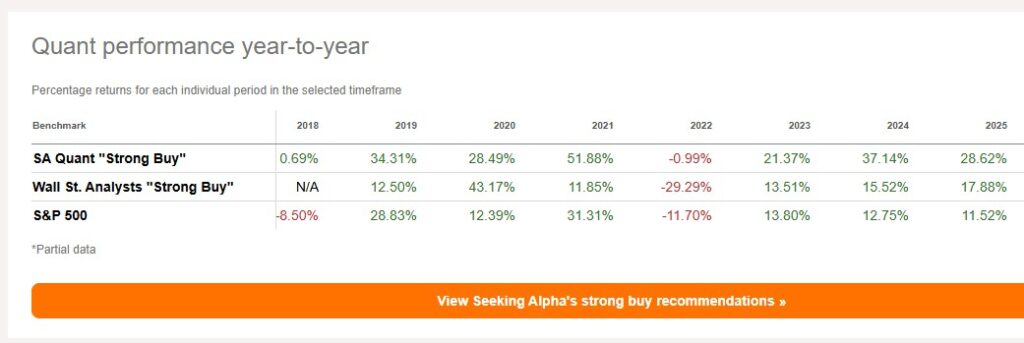
Here’s the proof that their Quant Ratings are valuable. Every year from 2017 to 2025 the Seeking Alpha Quant Ratings “Strong Buy” stocks have outperformed Wall Street Analysts and the S&P500.
Is Seeking Alpha Worth It for Beginners?
Absolutely—if you’re ready to take your learning seriously.
Here’s how different types of users benefit:
For Casual Investors:
Seeking Alpha helps you move beyond social-media hype to genuine stock research. Even if you read one or two analyses per week, you’ll gain a deeper understanding of how the market values companies.
For Active Traders:
You get real-time alerts, analyst upgrades, and financial metrics that can refine your timing and boost confidence in your trades.
For Students and New Investors:
It’s an incredible educational resource. By reading professional reports, following earnings call transcripts, and checking Quant Ratings, students can learn how to perform own due diligence and portfolio management like pros.
The bottom line: Seeking Alpha is worth it if you’re serious about learning to invest, not just speculate.
After reviewing Seeking Alpha’s research tools, Quant Ratings, and Alpha Picks performance, we can confidently say: Seeking Alpha Premium is worth it—especially for beginners who want to learn by doing.
It’s rare to find a platform that blends community insights, quantitative models, and expert analysis so seamlessly. The combination of investment research, portfolio monitoring, and educational depth makes it an ideal bridge between paper trading and real-world investing.
Whether you’re managing a student portfolio or making your first brokerage trade, Seeking Alpha offers the clarity and confidence every investor needs.
VALENTINE'S DAY SALE HAPPENING NOW: Act Today; Offer Ends Feb 15th
Seeking Alpha is a very successful stock research and rating service. With that, they rarely offer discounts, so when you see a sale it's crucial to take advantage of it. They're currently offering one of their best discounts of the year!
You can get a free trial, save 20% off their premium services AND get their Lowest Price this Year.
Seeking Alpha Premium: 7 Day Free Trial & Save $45; usually $299 now only $254/year — Claim Your Discount.
Alpha Picks: Save $75; usually $499 now only $424/year — Claim Your Discount.
Seeking Alpha Bundle (get both): Save $159; usually $798 now only $639/year — Claim Your Discount.
FAQs
Is Seeking Alpha Premium worth it?
Yes. It gives investors access to advanced Quant Ratings, stock screeners, and investment ideas proven to outperform the market.
Can beginners use Seeking Alpha effectively?
Definitely. The platform includes educational resources, fundamental analysis, and a community of investors who explain their reasoning in plain language.
How reliable are Seeking Alpha’s Quant Ratings?
Extremely. Quant Ratings are algorithmically generated and back-tested, with Strong Buy stocks outperforming the S&P 500 by significant margins.
Does Seeking Alpha cover mutual funds?
Yes, but its primary focus is on stocks, ETFs, and dividend investing. Mutual fund coverage is limited compared to individual stock research.
Can I link my brokerage account?
Yes, you can link most major brokerage accounts for automatic portfolio tracking and real-time alerts.
Does Seeking Alpha provide real-time data?
Premium members receive real-time alerts, earnings calendars, and analyst revisions, keeping you ahead of market moves.
If you’re serious about finding the market’s next big movers, Seeking Alpha Premium and Seeking Alpha’s Alpha Picks are two of the best research tools available—and there are a few ways to get it at a discount.
Seeking Alpha has become a go-to resource for investors who want more than surface-level commentary. It offers their proprietary quantitative stock ratings, expert analysis, and data-driven insights from thousands of contributors. But with subscription prices rising in recent years, investors are asking one question: What’s the best Seeking Alpha discount right now?
This guide breaks down every verified discount available in January, 2026, explains how to claim them, and helps you decide which plan gives you the most value for your money.
You’re in luck — Seeking Alpha is running a limited-time sale for the month of January, 2026. The offer expires at the end of the month, so it’s a great time to lock in your savings before it’s gone!
VALENTINE'S DAY SALE HAPPENING NOW: Act Today; Offer Ends Feb 15th
Seeking Alpha is a very successful stock research and rating service. With that, they rarely offer discounts, so when you see a sale it's crucial to take advantage of it. They're currently offering one of their best discounts of the year!
You can get a free trial, save 20% off their premium services AND get their Lowest Price this Year.
Seeking Alpha Premium: 7 Day Free Trial & Save $45; usually $299 now only $254/year — Claim Your Discount.
Alpha Picks: Save $75; usually $499 now only $424/year — Claim Your Discount.
Seeking Alpha Bundle (get both): Save $159; usually $798 now only $639/year — Claim Your Discount.
What Is Seeking Alpha?
Seeking Alpha is a stock research and analysis platform that aggregates insights from professional analysts, experienced traders, and retail investors alike.
Founded in 2004, it has grown into one of the largest crowdsourced investment research communities on the internet. Users can access fundamental data, earnings call transcripts, author track records, dividend grades, and advanced screeners—all designed to help them make better trading decisions.
Seeking Alpha is divided into four plan tiers:
Free: Access to limited articles and data.
Premium: Unlocks in-depth analysis, Quant Ratings, and full access to contributor content.
Alpha Picks: Their stock recommendation subscription model where you get the 2 best Quant Rating stocks each month.
Pro: Designed for advanced investors who want even deeper insights and stock tracking.
For everyday investors and experienced investors, and our users on platforms like HowTheMarketWorks, Seeking Alpha offers the research foundation you need to learn how professionals evaluate companies—without the institutional price tag.
Seeking Alpha isn’t itself a regulated broker or financial advisory firm—it’s an investment research and publishing platform. While it provides analysis and quantitative stock data, it doesn’t execute trades or manage investor funds, so it isn’t overseen by the SEC or FINRA.
What Is the Seeking Alpha Discount?
When we talk about a “discount,” we’re referring to the verified promotional offers and price reductions that Seeking Alpha periodically offers on its Premium and Pro subscriptions.
These promotions can take the form of:
Percentage-based price reductions
Fixed savings
FREE trials for new subscribers
Discounts are usually tied to specific seasons—like New Year, tax season, or Black Friday—but verified links often remain active for much of the year.
Current Seeking Alpha Deals (January, 2026 Update)
Finding a valid Seeking Alpha discount can be tricky. Many coupon sites claim to offer promo codes, but most are outdated or no longer active. While platforms sometimes list Seeking Alpha Premium codes, their offers aren’t always reliable.
To save you the guesswork, we’ve verified the following discounts and landing pages as the best available options — fully active and 100% valid for the month listed below.
Let’s break down the latest available offers as of January, 2026.
Seeking Alpha Premium
Alpha Picks
Seeking Alpha Bundle
Overall Rating:
⭐⭐⭐⭐⭐
⭐⭐⭐⭐⭐
⭐⭐⭐⭐⭐
Best for:
Self-directed investors who want to take the guesswork out of investing. Link your brokerage account and get real-time updates on the Quant Rating of your stocks.
Investors who want to take the stress out of investing and are looking for specific stock recommendations each month.
Both.
Retail Cost:
$299 a year.
$499 a year
$798 a year
Current Promotion:
January, 2026SALE: Save $45, get 7-day free trial on certain pages! Offer ends soon.
Remember: They do offer a 30 day money-back guarantee, so you have nothing to lose if you aren’t happy.
What Do You Get with Seeking Alpha Premium?
To understand whether the discount is worth it, it helps to see what Premium actually unlocks.
1. Quant Ratings and Factor Grades
Quant Ratings are Seeking Alpha’s proprietary, data-driven algorithm that ranks stocks on metrics like value, growth, profitability, and momentum. These are updated daily and provide a quantitative shortcut for analyzing potential buys.
2. Dividend and Earnings Analysis
Premium subscribers get access to Dividend Grades (A–F scoring system) and earnings performance history. This is particularly useful for income investors and for anyone learning how corporate earnings drive stock prices.
3. Author Track Records
Premium users can see each author’s historical performance—something that helps separate consistent analysts from one-time viral posts.
4. Portfolio Monitoring and Alerts
Seeking Alpha lets you build and track portfolios while receiving real-time alerts on news, dividend changes, and analyst rating shifts.
5. Unlimited Article Access and Stock Screeners
Free users can only read a few articles each month. Premium removes that cap entirely and adds access to detailed screeners for stocks, ETFs, and sectors.
The BEST, and my personal favorite, feature of Seeking Alpha Premium is that you can link your brokerage account so that when you login to Premium you will see the Quant Ratings of all of your stocks, AND get alerts when their Quant Rating change. This has proven very, very helpful to me to get alerts when the Quant Ratings fall. I then put a stop loss order on the stock in case it does start to drop.
Each of these features is designed to help investors make data-informed decisions rather than emotional ones. For investors and our users on HowTheMarketWorks, this makes Seeking Alpha a powerful companion tool to complement portfolio simulations.
Alpha Picks Performance
Seeking Alpha’s Alpha Picks subscription provides two top-rated stock recommendations each month, typically released around the 1st and 15th.
Launched in 2022, the service has consistently outperformed the market, aligning closely with the strong results shown in Seeking Alpha’s Quant Ratings performance data.
Alpha Picks Update as of December 27, 2025: Since its launch in July, 2022, the 88 Alpha picks from 2022 thru 2025 are up an average of 86% and are easily beating the S&P500's return of 26% by 60%. But most impressively, their picks that are at least 12 months old are up 111% vs 32% for 80% ALPHA and 77% of their picks are profitable. Yes, these picks are almost 4x the SPY. Their October, 2025 pick (MU) is already up 49%S, July 1 pick is up 53%, and June 16th pick is up 69%, and their February pick (CRDO) is already up 110%. WOW!
How to Redeem a Discount
Here’s a quick walkthrough for claiming your discount step-by-step.
Select a plan: Choose Alpha Picks or Premium and start a FREE trial.
Confirm discount: The discounted rate will appear automatically at checkout.
Create your account: Enter your name, email, and payment details to start your trial or full plan.
Start researching: Once inside, you’ll gain immediate access to Quant Ratings, author scores, and full market data.
If you don’t see the discount appear, clear your browser cache or open the link in a new incognito window—Seeking Alpha occasionally caches pricing cookies.
Is Seeking Alpha Premium Worth It?
The short answer: yes, for most investors and learners, it’s absolutely worth it — especially when you use a verified discount.
Unlimited access to contributor research and analyst reports.
Dividend and earnings tools simplify portfolio tracking.
Helps new investors learn how professionals value companies.
Cons
Full value comes only with regular use.
The interface can feel dense for beginners.
Verdict: If you’re an active investor, student, or educator using HowTheMarketWorks, Seeking Alpha Premium provides an edge in understanding market data and trends. Using the current discount saves you $30 instantly — making it one of the most affordable research platforms for January, 2026.
Quant Ratings of Premium Service
If you’re still not convinced, let’s take a look at the performance of Seeking Alpha’s Quant Ratings.
Seeking Alpha’s proprietary stock rating system, known as Quant Ratings, is one of its most powerful tools. In simple terms, stocks rated “Strong Buy” by the Quant system have historically outperformed the market, while those with lower ratings have underperformed.
If you’re building or fine-tuning your portfolio, the goal is to focus on stocks that earn a Strong Buy rating.
Check out the chart below to see how Strong Buy–rated stocks have performed compared to the S&P 500 over time.
Since 2010, Strong Buy–rated stocks on Seeking Alpha have outperformed the market by a significant margin.
Adding credibility to these results, a study published in April 2024 by two finance professors from the University of Kentucky found that Seeking Alpha’s Quant Ratings “strongly predict” future stock returns and provide “pronounced benefits” for investors.
To access Quant Ratings across the 10,000+ stocks covered on the platform, you’ll need a Seeking Alpha Premium subscription. Premium members can also link their brokerage accounts to see real-time ratings for every stock they own — and receive instant alerts whenever those ratings change.
Can Students or Educators Get a Discount?
While there isn’t a dedicated Seeking Alpha student discount, the Premium offer through verified links is available to everyone — including students, teachers, and classroom users.
For educators using HowTheMarketWorks simulations, Seeking Alpha’s data can be a practical classroom companion, helping students connect stock performance with real market research.
If you’re a student investor, using this discount lets you practice stock analysis at the same depth as professional traders.
Seeking Alpha Pro Discount
Seeking Alpha Pro caters to advanced and professional investors who need exclusive stock ideas, early notifications, and access to top-performing authors.
A Pro subscription typically costs more than Premium, and active discounts are rare — though you can occasionally find limited-time Pro promotions during Black Friday or at the start of the year.
For most users, the Premium discount remains the best deal overall, offering 90% of Pro’s functionality at a fraction of the price.
How Seeking Alpha Compares to Other Research Tools
When evaluating research platforms, Seeking Alpha stands out for its balance between professional-level analytics and accessibility.
Motley Fool Stock Advisor: Great for beginners who prefer curated stock picks.
TipRanks: Focuses on analyst ratings and target price averages.
Morningstar: Strong for mutual fund research and fundamental valuation models.
Seeking Alpha bridges all three — offering community-driven insights, real-time data, and transparent performance records.
For HowTheMarketWorks readers, this makes it a perfect bridge between learning and investing.
Frequently Asked Questions (FAQs)
Does Seeking Alpha have a student discount?
No, but all students can access the public Seeking Alpha Premium discount for $30 off or try a 7-day trial for FREE.
How long does the discount last?
Most discounts remain active for several weeks, though seasonal promotions (like Black Friday) may offer deeper savings.
Can I cancel my trial?
Yes, you can cancel anytime during the free trial without being charged the full annual price.
Is Seeking Alpha available internationally?
Yes, it’s accessible globally, though currency conversions may apply depending on your region.
What’s the difference between Premium and Pro?
Premium gives you full Quant Ratings, dividend data, and unlimited analysis. Pro adds early-access alerts and exclusive stock ideas for professionals.
Is the discount verified?
Yes. The offers linked here are verified through official Seeking Alpha partnerships, ensuring your discount is legitimate and secure.
Final Thoughts
For anyone serious about mastering the stock market — from active traders to students learning through HowTheMarketWorks — Seeking Alpha Premium is one of the most powerful and cost-effective research tools available.
When you pair its analytical depth with an active Seeking Alpha discount, you get institutional-level market data at an accessible price.
Morningstar has long been a trusted name in investment research, offering in-depth analysis, mutual fund ratings, and market commentary to help investors make more informed decisions. With the launch of the Morningstar Investor platform, the company has expanded access to its premium tools and content. But the real win for everyday investors? You can now save money on subscriptions using Morningstar promo codes and Morningstar coupon codes.
Whether you’re looking to build a more robust portfolio, evaluate mutual funds, or track performance metrics over time, Morningstar’s paid tiers unlock tools and research that casual investors typically wouldn’t have access to. The Morningstar website serves as a one-stop hub for these tools, and using Morningstar coupons can dramatically reduce your costs.
In this guide, we’ll explore the key features of Morningstar’s premium offerings, how to use a Morningstar discount code, where to find Morningstar promo codes, and how to take advantage of their current deals and free trial offers in 2025.
Morningstar and Regulatory Oversight
While Morningstar is not a regulatory authority itself, it does interact closely with the financial regulatory ecosystem. Its investment advisory subsidiaries are registered with the U.S. Securities and Exchange Commission (SEC), and the company complies with industry regulations in the markets where it operates. Morningstar also provides analysis and data on financial products that fall under the purview of regulatory bodies like the SEC and FINRA. This reinforces its credibility as a source of trusted investment research.
Morningstar Features and Pricing
Morningstar’s core value lies in its commitment to investment research. The Morningstar Investor membership grants full access to:
Morningstar ratings on thousands of stocks, ETFs, and mutual funds
Analyst reports and sector commentary
Portfolio tracking and performance analytics
Custom screeners and alerts
Expert financial insights, news, and trend forecasts
Offer
Details
Discounted Price
Requirements
New Members
$50 off first year
Varies by plan
None – available to all new users
Students
One year of Morningstar Investor
$25
Valid .edu email
Teachers
One year of Morningstar Investor
$99
Proof of educator status
Military Service Members
30% off first year
Varies by plan
Military verification (active or vet)
The Morningstar premium tier also includes custom views, deeper evaluation tools, and the ability to generate side-by-side fund comparisons. For investors who want an edge, this subscription can be an invaluable resource.
You can sign up for various pricing plans, including:
Monthly plan for short-term users
Morningstar annual subscription, ideal for long-term users
Occasional holiday deals or special bundles for additional savings
And with the right Morningstar promo code, you can access it all at a discount.
Discount Options
If you’re budget-conscious but still want access to top-tier investment insights, the good news is that Morningstar often issues promo codes to help you save money.
Where to Find Morningstar Promo Codes
You can often find Morningstar promo codes in the following places:
Directly on the Morningstar website (especially on the pricing or checkout page)
Email newsletters to subscribers
Partner financial blogs and investing sites
Reddit and investing forums
Sites that aggregate coupon codes like RetailMeNot or Honey
Morningstar also issues discount codes for:
New subscribers
Special events like market anniversaries or product updates
Annual promotions or end-of-year savings pushes
Student, Teacher & Military Discounts
Morningstar offers exclusive discounts to select groups:
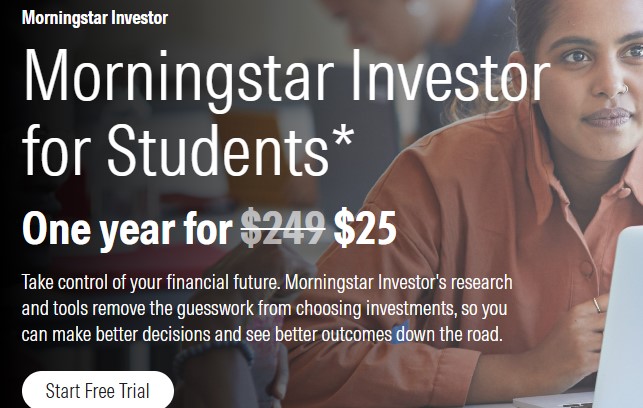
Students: Get Morningstar Investor for just $25 per year (regularly $249) with a valid .edu email. This is a deep savings opportunity designed to help students gain early access to premium investing tools.
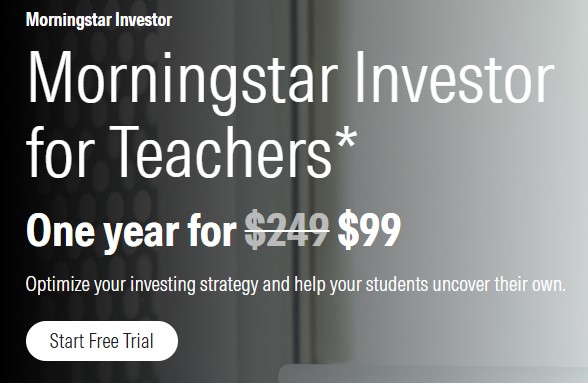
Teachers: Eligible educators can access Morningstar Investor for $99 for the first year. It’s a great way to support both personal financial growth and classroom education on investing.
Military Service Members: Veterans and active-duty military receive 30% off their first year. Verification is required, and the discount can be applied during account signup.
These special discounts offer substantial savings while granting full access to Morningstar premium features.
Special Offers for New Accounts
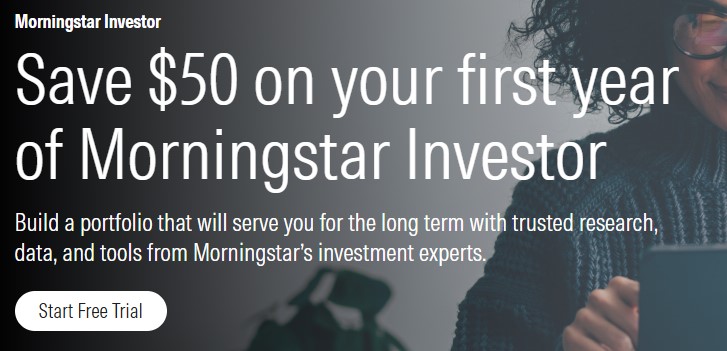
Morningstar offers a $50 discount on your first year of Morningstar Investor for all new members. This is one of the most popular and widely available deals, providing a strong incentive for new users to explore the platform.
One of the best ways to explore Morningstar is by activating their free trial offer. As of 2025, new users can sign up for a seven-day free trial to explore the platform’s full capabilities.
What the Free Trial Includes
Access to Morningstar Investor premium tools
Fund, ETF, and stock analysis with Morningstar ratings
Portfolio construction and tracking features
Comprehensive investment research and commentary
To begin the trial, you’ll need to verify your account and complete security checks. Once you do, you’ll have a full week to test the service with zero obligation. This is an excellent opportunity to get a preview before committing to a paid subscription or yearly subscription.
Pro tip: If you like what you see, applying a Morningstar discount code before your free trial ends can lock in the best price.
Latest Deals and Plans for 2025
Morningstar continually updates its promotional strategy, meaning savvy investors can often save if they know where to look. As of 2025, one of the top offers is $50 off your first year of Morningstar Investor for new users. This popular discount code is featured on the Morningstar website and applies to the full annual subscription.
2025 Morningstar Deals Snapshot
Up to 40% off with select Morningstar coupons during market events
Buy one, gift one deals during the holidays
Deep discounts on the annual plan during Q1 and Q4
Look for the latest deals on the Morningstar website, where many offers are exclusive to users who create a new account. Make sure to also check Morningstar’s blog and announcements page for special coupon offers and limited-time bundles.
How to Use a Morningstar Promo Code
Applying Morningstar coupon codes is straightforward. Here’s how it works:
Visit the pricing page on the Morningstar website
Select your plan (monthly or annual subscription)
At checkout, enter your promo code or coupon code
The discount should automatically apply
Complete verification and proceed with payment
Note: Some Morningstar promo codes are stackable with other discount codes, especially during holiday deals. Be sure to read the terms to maximize your savings.
Morningstar Customization and Support
Morningstar understands that not every investor has the same needs. That’s why their platform emphasizes personalization and support.
Custom Views & Portfolio Tools
Tailor your portfolio dashboard to reflect asset class, return history, and allocation
Set up alerts for stock rating changes or fund updates
Create custom watchlists or duplicate your real-life holdings
Account Support
The Morningstar website includes a robust support section:
Step-by-step articles on managing your account
FAQs for payment, billing, and verification
Contact info for live customer support
There’s also a vibrant Morningstar community forum, where you can ask questions, get advice, or share insights with fellow investors.
Who Is Morningstar For?
Morningstar is built for investors of all experience levels. It’s especially valuable for:
Long-term planners seeking deeper investment research
Investors interested in tracking mutual funds and ETFs
Professionals needing side-by-side asset analysis
Newbies looking to educate themselves before making big moves
Whether you’re managing your own investments, running a family trust, or just trying to understand your portfolio, the Morningstar Investor membership offers tools to help you succeed.
Why Use Morningstar Promo Codes?
Morningstar is a premium service, and that means the subscription cost can be a barrier. But with well-timed Morningstar promo codes, there’s no need to pay full price.
These codes let you:
Save money upfront or on renewals
Test-drive the platform without long-term commitment
Access the latest Morningstar research and tools at a lower cost
Choose the best Morningstar subscription plan with peace of mind
Remember to look for verified Morningstar coupon codes or a Morningstar discount during your checkout to score the best deals.
More Ways to Save with Morningstar
Morningstar continues to expand its lineup of offers and special promotions for subscribers. For 2025, the company has introduced more ways to access premium insights through an annual membership or annual plan at a reduced rate. As part of its ongoing push to increase accessibility, Morningstar issues discount codes regularly throughout the year. These available codes are highlighted prominently on the main page of the Morningstar website, especially during seasonal campaigns or product launches.
By staying alert for a Morningstar discount code, users can lock in lower prices for their first year of service. Whether you’re interested in daily portfolio updates or real-time market coverage, it’s easier than ever to get Morningstar at a price that fits your budget.
If you’re creating a new account, applying one of the many coupon codes or Morningstar promo codes available today can significantly lower your upfront cost. These offers aren’t just limited to major holidays—Morningstar frequently runs limited-time promotions and drops new coupon codes based on market trends and subscription demand. In fact, users can often find Morningstar discounts tailored to specific user profiles, like long-term investors or financial advisors managing multiple accounts.
The platform’s growing range of Morningstar coupon codes and seasonal deals reflect a larger mission to provide affordable access to elite-level research. Whether you want to test the waters with a day free trial, upgrade to a Morningstar premium plan, or subscribe with a discount code, Morningstar today offers more flexibility than ever.
Final Thoughts: Is Morningstar Worth It in 2025?
Morningstar continues to be a standout in the world of investment research. Its clean interface, deep data, and easy-to-use portfolio tools make it one of the best platforms for everyday investors and professionals alike.
While the subscription isn’t free, smart use of Morningstar promo codes, coupon codes, and special discounts can make it very affordable. From exclusive insights to personalized dashboards, there’s genuine value packed into the Morningstar Investor experience.
If you’re serious about investing, and want expert tools without overpaying, now is a great time to take advantage of Morningstar’s free trial and promo code offerings.
FAQs
How long is the Morningstar free trial?
Seven days. Full access, no commitment.
Can I use multiple Morningstar promo codes?
Sometimes. It depends on the offer. Check eligibility on the checkout screen.
Is there a student discount?
Yes, though it requires a valid .edu email.
Are promo codes available year-round?
Morningstar tends to release promo codes during major market events, holidays, and the new year.
Can I cancel before being charged?
Yes. Cancel before the seven-day free trial ends to avoid payment.
Investing in the stock market is not easy.[qsm_link id=76]Click here[/qsm_link]
With over 10,000 stocks in the U.S. markets, it is impossible to research all of them to find the proverbial “needle in the haystack.” So we, as investors, need to turn to other resources to help us find the best stocks to invest in.
With all the stock screeners and stock newsletters available it is still a challenging task to choose which service to trust.
Even investors like Warren Buffett can’t manage it on his own, which is why has a team of analysts doing all his research for him. All that’s left for Buffett to do is to review his team’s research and make decisions.
Now, with the new stock picking investing app called Moby, you can also have your team of Wall Street analysts doing your research for you. This Moby app review will give you a deep dive on this affordable and successful stock picking service. And it will answer the key question: is Moby worth it?
Moby was launched in 2020 buy a team of Wall Street analysts, CFAs, and hedge fund managers to make their top notch research and picks available to the investing public. Their website provides a few teasers to their free service, but ultimately you will want their paid service for $99 to get 1 or picks a week.
That sounds like a lot of picks, but they are neatly categorized by industry and objective so you pick and choose those that you believe will complement your own stock portfolio.
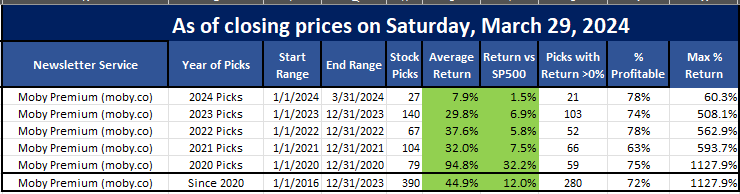
So are Moby’s stock picks any good? I was able to interview the CEO, the CFO, and their marketing manager to get more information about their stock selection process and their performance track record. Now, doing my own analysis on their picks since inception of their service, I came up with the following summary of the last 4 years of their picks, as of March 29, 2024 prices:
That is quite impressive that:
EVERY year their picks are beating the market,
that the average beat is 12% over the last 4 years over 390 picks,
and that 72% of their picks are profitable.
Moby App Summary
Here’s what you need to know about this service:
Moby was started in 2020 by a team of Wall Street Hedge Fund analysts and CFAs
It is really just an app based service. On their desktop site only their blog is available. So you must get Moby Premium app to get picks.
Delivers 1 or 2 stock picks a week, categorized by industry with a clear analysis and rationale for buying each stock.
Moby is a market-research platform for stock and crypto investors.
Instead of providing you with basic news articles and company updates (like many other sites), Moby does their own research and analysis and presents it in a format that everyone can understand.
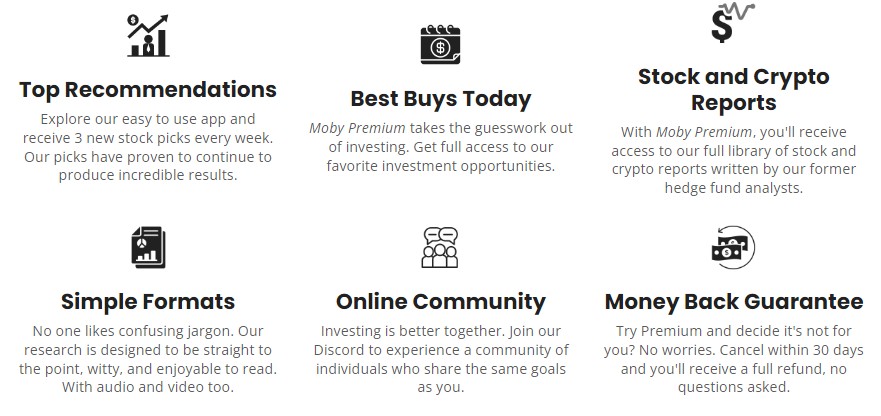
From their own website, this is what they say they do:
Every article is extremely easy to read.
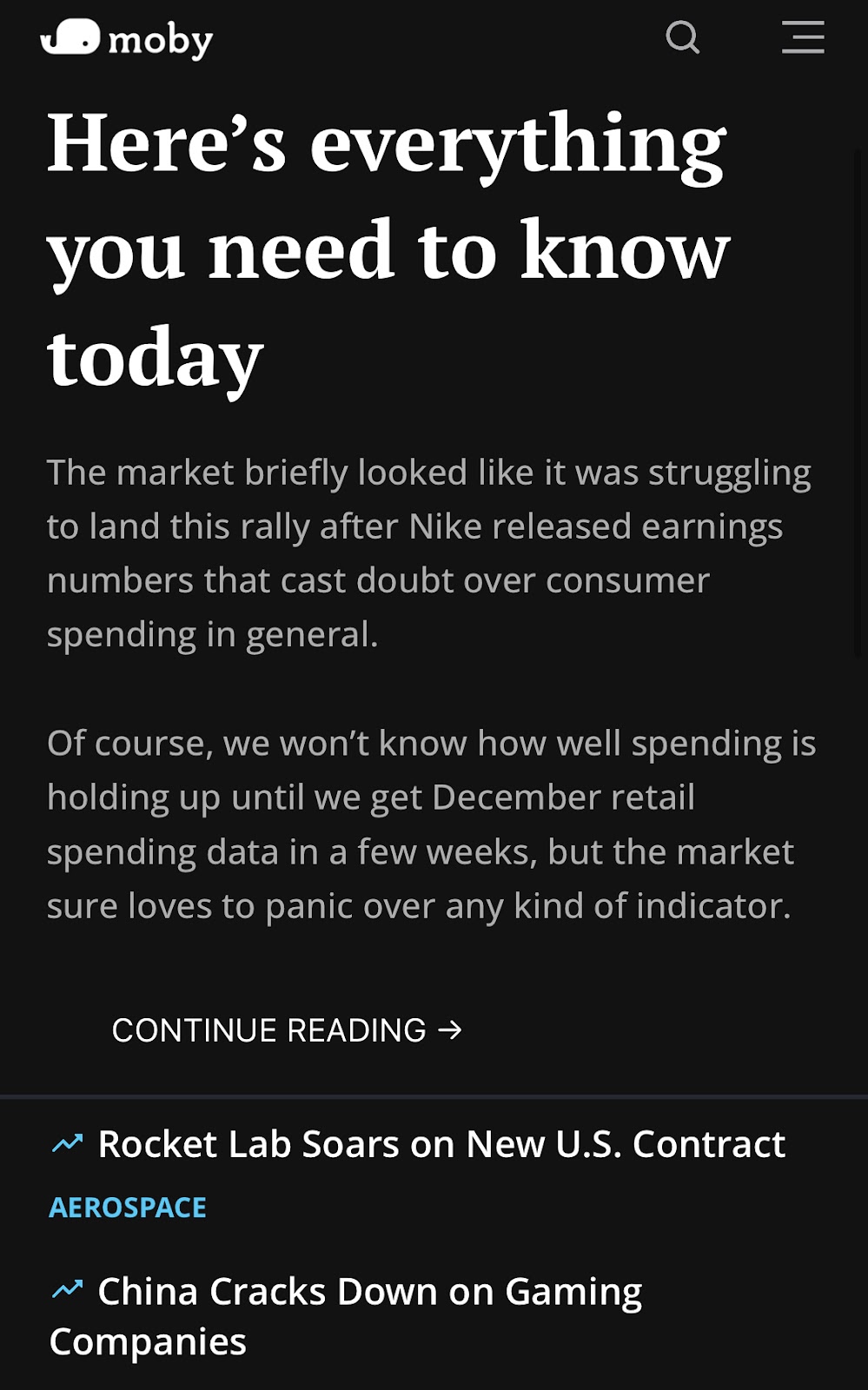
Moby (In-app) Market Headlines
In addition to its market summaries, the Moby app presents their proprietary stock analysis and recommendations with clear explanations of their expectations. Each report focuses on one company, identifies the industry, and the offers Moby’s reasons liking the stock. Unlike most other services, it also identifies a price target for each pick. Each recommendation takes maybe 5 minutes to read. Many of these reports include both fundamental and technical analysis. But they are all written in a novice investor style.
Moby also creates educational content, often focusing on emerging technologies and new trends.
While Moby does have a website you can go to, Moby was built to be mobile-first, and its app is the best way to use the service.
Moby Stock Picks
The reason you subscribe to the Moby Premium service and app are its stock picks. This Moby Premium Review will show you the performance of their picks over the last 5 years.
Moby Stock Picks
Moby took expert analysts from institutions like Morgan Stanley and Goldman Sachs and paired them with journalists who know how to distill complex financial jargon into easily-comprehensible and actionable advice.
In addition to its own research, the team also deploys machine learning and quantitative algorithms to find investment ideas.
Top Moby Performing Stocks
Moby 2024 Top 5 Picks As of August 31 and Their Returns:
CAVA up 125%
MMYT up 66%
FTAI up 51%
MSFT up 47%
TSM up 45%
Moby 2023 Top 5 Picks and Their Returns As of August 31:
NVDA: 233%
ELF: 147%
PLTR: 143%
META: 105%
W: 87%
Beyond the latest 2023 picks (last year), this system has made a number of exceptional picks:
MicroStrategy, picked 9/9/2020, up 836%
Tesla, picked on 4/9/20, is up 388%
Texas Pacific Land Corp, picked on 3/20/20, is up 324%
Nvidia, picked on 5/18/20, is up 991%
Eli, picked 1/18/2020, is up 453%
Elf Beauty, picked on 2/3/22, is up 409%
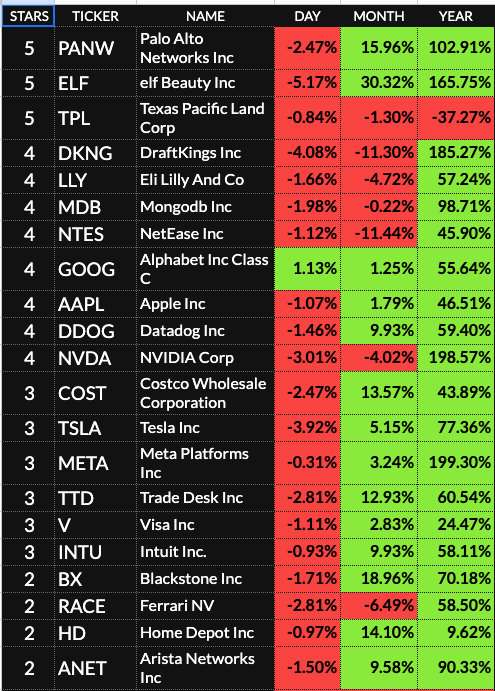
And these are just the tip of the iceberg. Here’s a screenshot of some of its other picks:
Moby is currently offering a free stock pick here and offering 50% off for new subscribers. With the WallStreetSurvivor Exclusive offer on this page, enter your email, and then you can save 50% 1 year for only $99. Don’t miss out on their next pick–remember they have 30 day money back guarantee.
From their own webpage, that show this: Last Updated – December 21, 2023
Breakdown of Moby’s 2023 Stock Picks (last updated – December 2023)
Moby Premium’s goal is to outperform the market. That outperformance should more than pay for the annual subscription.
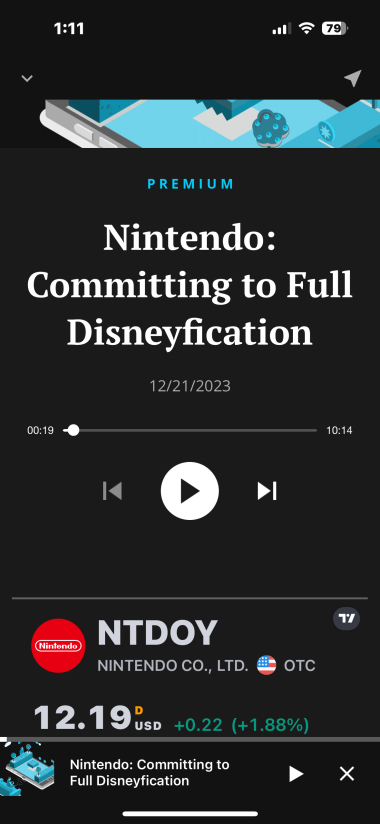
As mentioned above, each new trade alert comes with a short but thorough report on what makes it a good investment opportunity. Each of these reports also comes in an audio format, so you can listen to it on your commute:
Example of Audio Stock Reports
The team publishes 3 new picks per week.
Moby’s Model Portfolios
Moby also provides several model portfolios so you can get started investing right away (without waiting for new stock picks to come out). Each model portfolio is based on a different investing strategy.
Flagship – Moby’s Flagship Portfolio aims to outperform the market by primarily investing in undervalued technology companies.
Dividend – The goal is to build a portfolio of 10 high dividend paying stocks with sustainable earnings and dividends.
Offshore – The goal is to find the world’s best growth businesses in emerging markets (like China, Brazil, Colombia, South Korea, Taiwan, and more).
ESG – The ESG portfolio is focused on investing in companies that reflect your values.
Based on my experience, each of these portfolios tends to buy and sell a few stocks per month. If you’re using one of these portfolios, be sure to check your notifications for new trade alerts.
For example, this month’s Flagship portfolio has 4 entirely new stocks than it held last month (pictured above).
Additional Features:
1. Political Trades
Nancy Pelosi and her husband made headlines in 2022 after a series of excellent (and suspiciously well-timed) investments made the pair millions of dollars. Since then, investors have started paying much closer attention to the portfolios of senators and other members of Congress.
It’s no secret that politicians are privy to non-public information which could materially affect markets or specific sectors of the economy.
Moby makes it easy to track the latest trading activity of all major politicians with its “Political Trades” tool. The tool holds short reports on the politician who made the trade and the trade itself.
Political Stock Trading Notifications
If politicians are selling off your favorite stock, it might be time to reevaluate that position. If they’re buying up a stock in a beaten-down industry, there may be a catalyst for growth in the near future.
2. Asset Lookup
For a quick look at a stock’s price chart, you can head into the app’s Asset Lookup tool.
The tool also provides links to all of the Moby reports which mention the stock in question. It’s the fastest way to gauge the team’s sentiment about any specific stock.
3. Economic Calendar
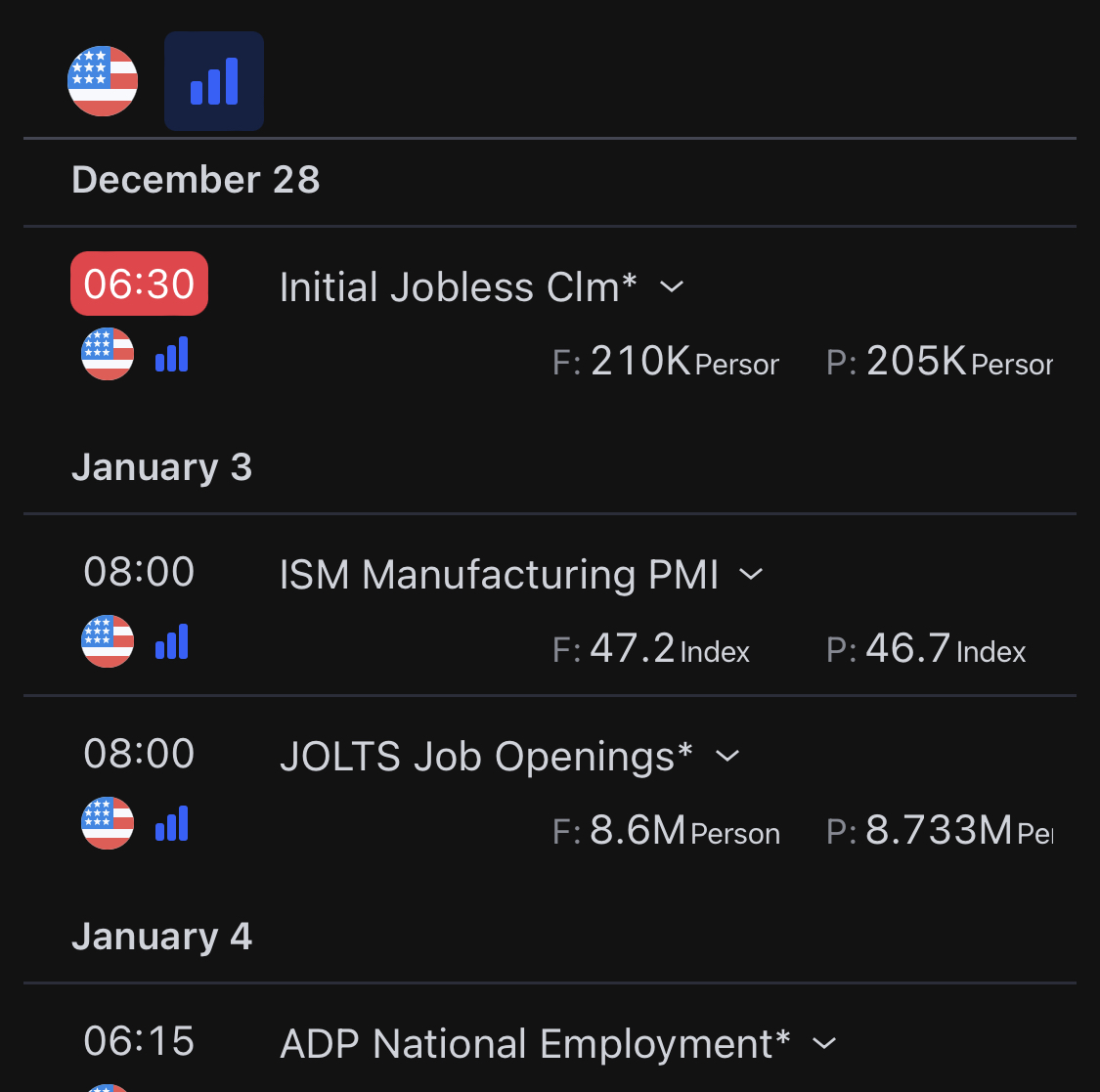
The next Fed meeting, inflation reports, jobless claims, spending data, building permits, GDP updates – there are a lot of economic events to stay on top of.
Earnings & Economic Calendar Tracker
Not only does Moby aggregate all of the past and upcoming events onto a timeline, it also provides summaries and recaps of what happened at those events. This is the simplest and fastest way to stay abreast of changes in the economy.
All your friends and coworkers will wonder how you know so much.
4. Crypto Screener
The crypto screener allows you to filter and sort by more than 480 cryptocurrencies to find potential investments.
You can track each coin’s market capitalization, current price, day’s change, total volume, and more.
5. Investment Course
Moby also offers a 5-part investment education course designed for people who are new to investing in the stock market.
The course covers investing in different types of assets (like stocks, bonds, cryptocurrencies, and commodities), how taxes work, and how to build a portfolio based on your financial goals and risk tolerance.
In all, the course takes around 3 hours to complete, but it will fast-track your financial acumen.
6. New Features
While not yet released, Moby is working on a handful of other features which will make it even more of a complete offering.
Some new features include:
In-App Trading: Soon, you’ll be able to receive your expert analysis and execute trades without ever leaving the Moby app.
Portfolio Linking: Moby is also developing a tool to link your existing portfolio to the app so you can get personalized notifications about your positions based on the team’s research.
Financial Advisory: Everyone needs some personalized financial advice from time to time, which is why Moby is working to integrate a way to connect with financial advisors 1:1.
Though these features aren’t live yet, I’ve been told that current users will be grandfathered into access to these features at today’s prices and will pay a lot less than future members.
There is much too unpack with Moby, especially as a newcomer in the space of investment tools. A key comparison to how one should use Moby is with the likes of Seeking Alpha, giving everyday investment decisions with unique insights into the market.
See for yourself on our Moby vs. Seeking Alpha article on which platform has better features for your portfolio strategy, learning more about each so you can equip yourself with the necessary tools for success.
Moby Pricing and Plans
Moby provides a lot of exceptional content for free (which is why it’s being used by over 5 million investors), but the bulk of its value (investment, model portfolios, and more) is only accessible with a Premium subscription.
Moby Premium costs $199 per year, but WallStreetSurvivor readers can get their first year for just $99 through our link below.
Moby is currently offering 50% off for new subscribers. Click on the WallStreetSurvivor Exclusive offer on this page & get 1 year for only $99. Don’t miss out on their next pick. Remember: They have 30 day money back guarantee.
Each subscription comes with a 30-day money-back guarantee, so there’s no risk in trying it.
Who is Moby Best For?
Moby is best for beginners or anybody who wants to outsource their investment research (to save time and increase their returns).
The entire platform is easy-to-use, and every article and research report is jargon-free. That said, while the investment analysis is beginner-friendly, you should expect to learn things about what to look for in companies or what factors drive the economy. It’s almost impossible not to learn something from Moby’s team of experts. They are going about their analysis differently than Seeking Alpha and their Quant Rating, but seeing excellent results. (If you want to do a deep, deep, deep dive into this read our Seeking Alpha Quant Rating Review).
Pros and Cons of Moby Premium
Pros
Cons
Outsource your investment research to a team of experts
More suited for intermediate investors, Moby simplifies decisions, offering guidance that may not cater to advanced investors seeking purely objective data.
Beginner-friendly investment analysis and market summaries
Many investment ideas to choose from
High-quality investment ideas and model portfolios
Mobile-first platform
Summary: Moby Review
There are two things really stand out to me about Moby’s Premium service.
First, is its team of experts. This team, which was assembled from hedge funds, CFAs, and Wall Street firms, is doing all the deep dive in filtering through thousands of stocks.
You are essentially outsourcing your investment research to them for just $199 per year (or $99 through our link) and reading their reports on their app to see which ones suit your needs.
Second, is its simplicity. You don’t need to spend much time on Moby. Its a great read while eating your breakfast or during your commute. The layout and user interface, the articles and research reports, the portfolios – everything is easy to use.
Compare Moby to Motley Fool, and see for yourself which tool you prefer for your investing utility belt.
When combined, this pair makes for a powerful tool to level up your investing and why I expect it to become the hub for hundreds of thousands of investors who want to grow their net worth for years to come.
To tease you into subscribing, they are offering their first pick free on this link…
Use this calculator to find Net Present Value, based off expected annual growth, cash flow over a variable number of years, and separations of cash flow between investments and operations.
This calculator will help you determine the attractiveness of a company by seeing how much it would be worth if you wanted to buy it today! You can start by taking an existing company and filling in the company’s costs (or Cash flow from Operations) and what the company makes (or Cash flows from Investing). You can then play around with the Weighted Average Cost of capital, expected annual growth and see what the company is worth today!
Margin Trading and Market Timing – High Risk Investing
A margin trading account is a type of investment account offered by brokerages that allow investors to borrow money to buy securities. With a margin account, an investor can borrow funds from the brokerage firm against the value of the securities in their account. This allows the investor to increase their buying power and potentially increase their profits.
Margin Accounts
A margin trading account is a type of investment account offered by brokerages that allow investors to borrow money to buy securities. With a margin account, an investor can borrow funds from the brokerage firm against the value of the securities in their account. This allows the investor to increase their buying power and potentially increase their profits.
In comparison, a margin account has the option of leveraging. Leveraging allows investors to use borrowed funds, or a loaned financial instrument from their broker, to increase the potential return of an investment. It involves using a smaller amount of capital to control a larger asset base with the expectation of earning a greater return on the investment. This provides the investor with greater buying power. An increase in the money invested results in an increase in the potential returns (or profits). After closing a leveraged position, the borrowed funds or assets must be repaid to the broker along with interest.
However, leveraging also amplifies the effects of any losses, as the investor could end up owing more than their initial investment. This makes leveraging a high-risk strategy that should be approached with caution. It’s important for investors to understand the risks involved, and to have a solid investment plan before using leveraging.
Example
Let’s say an investor wants to purchase $100 worth of stock but only has $50 available. By using leveraging, the investor can borrow the additional $50 from their brokerage firm to complete the purchase. If the stock price increases, the return on the investor’s initial $50 investment would be larger than if they had simply invested the $50 on their own. The risk in this scenario is the investor could lose more money than they have. If the stock lost all its value, the investor loses $100 instead of $50. Plus, they would still owe the broker $50 plus interest.
Anatomy of a Margin Account
A margin account will have a combination of the investor’s own money, and money the investor borrowed from their broker. The amount that the investor can borrow from the broker is determined by the maintenance margin.
Maintenance margin refers to the minimum amount of equity that an investor must maintain in a margin account, as required by the brokerage firm. Maintenance margin is set by the brokerages as a measure to minimize risk. It ensures that investors have a certain level of equity in the account to cushion against potential losses and reduces the likelihood of margin debt. It’s given as a percentage of the whole account balance.
For example, if a brokerage firm requires a maintenance margin of 30% for a margin account with $10,000 worth of securities, the investor must maintain at least $3,000 (30% of $10,000) in equity in the account. If the value of the securities in the account decreases and the equity falls below the maintenance margin, the investor may receive a margin call from the brokerage firm, requiring the investor to add more cash or securities to the account to meet the minimum maintenance margin requirement.
A margin call is when the broker calls the investor and informs them that they must increase the cash amount in the account to meet the maintenance margin. The investor should deposit more money, and if they don’t, the broker has the right to sell any of the investor’s other investments to meet the maintenance margin of the account.
Short Selling
Short selling is a trading strategy where an investor borrows securities from a brokerage and sells them on the market, with the expectation that the price of the securities will decline. The investor then plans to buy back the securities at a lower price and return them to the brokerage, profiting from the price difference. Here’s how it works:
The investor borrows the securities from their broker and sells them on the stock market at the current market price.
They wait for the price of the securities to fall.
Once it hits their desired target price, they buy back the securities at the lower price.
The investor returns the securities to the broker, returning the borrowed securities.
The difference between the initial selling price and the lower buy-back price is their profit.
The potential profit when short selling is 100% if the stock price, (i.e. if the stock itself) loses all value. Therefore, potential profit is limited.
There is a huge risk with short selling. If the price of the stock or financial instrument increases, the investor is at a loss. The stock price can reach any height and therefore the potential loss is unlimited. Investors short stocks or financial instruments due to speculation or if they want to hedge positions on investments.
Market Timing
Market timing is an investment strategy where an investor buys or shorts stocks and financial instruments based on their expectations of what might happen in the market. This is the buy low, sell high strategy, where investors try to buy stocks just before the price goes up, and then sells them at their peak.
The success of the strategy depends on how well an investor can predict the market. The investor’s predictions can be based on economic indicators or technical factors, such as trends. They would need to be very familiar and educated with using economic data and technical analysis to have a market timing strategy. Using these factors to decide which companies or industries to invest in or short sell. Trading styles can be either active or passive. Active investing means to frequently buy and sell securities. In comparison, passive investing is a buy and hold strategy. Market timing would fall under an active trading style.
Example
When President Trump was elected, using a market timing strategy to invest in banking stocks before the results of the election would have been very profitable. An analysis of President Trump’s policies would have suggested benefits for the investment banking industry. When he won the election, there was a spike in the stock price of investment banks. However, by investing in investment banks, investors were betting that Trump would win. Most investors had bet on Hilary Clinton winning. Therefore, their market timing strategy would have been unsuccessful.
Many academic studies have found that market timing is not a successful trading strategy; instead these publications favour long-term investment strategies. However, this is debated by active traders who argue in favour of market timing.
In general, it is considered an unreliable method of investing as the markets are unpredictable. The majority of investors who have a market timing strategy are unsuccessful. When comparing strategies, long-term investing strategies have many more success stories that their counterpart.
International Strategies
An international investment strategy is a method of investing in securities or assets outside of an investor’s home country. The strategy involves looking for opportunities in foreign markets to potentially achieve higher returns, diversify their investment portfolio, and hedge against risks such as inflation and currency fluctuations.
It reduces risk through diversification. Diversification is where an investor invests in more than one market to reduce the risk of exposure from any single one. In this scenario, an investor would have a smaller percentage of investments from their domestic market, with investments in foreign markets making up the majority of their portfolio.
If an investor only held American-based securities, and the US market took a dive, it would be very difficult to protect themselves against taking a financial hit, (or loss). However, if they had investments in many international markets; the other investments would be safe, allowing their portfolio as a whole to be less exposed.
The trade-off to this extra diversification is more risk. Each country has unique political situations that could affect investments; which need to be carefully tracked and understood. International investing also exposes investors to currency exchange rates.
Currency risk is a significant consideration when investing internationally, as fluctuations in foreign exchange rates can have a significant impact on the returns of an investment. Political instability, such as changes in government policies, can also impact foreign markets and investments. Additionally, regulatory differences in foreign markets can affect the ability of investors to invest in certain securities or assets.
Given the complexities and risks involved, investors should carefully assess their investment objectives, and risk tolerance before implementing an international investment strategy. Conduct your own thorough research, and seek professional advice to ensure that your international investments align with your specific financial goals and needs.
Is it worthwhile to use Robinhood for your stock and crypto investments instead of one of the many other investing apps out there? Given that Robinhood has over 23,000,000 users, it must be doing something right.
At HowTheMarketWorks, we provide our members with unbiased reviews of investing apps and tools. We do that by using the tools in question to make sure you’re getting the full picture before you try them for yourself.
Robinhood isn’t a stock recommendation service. It also isn’t a research tool although it does provide some useful educational resources to users.
What Robinhood is, is an excellent brokerage app for beginning investors to start buying stocks (and cryptos). Unlike other brokerage accounts, you can open an account and have a minimum deposit of as little as $10 to get started. In this article, we’ll explain what it is, how it works, and give you our honest take on whether using Robinhood to invest is worth your while.
And most importantly…
…we’ll also tell you about the Robinhood free stocks promotion and how to get up to $1,700 in free shares when you open a Robinhood account!
What Is Robinhood?
Robinhood is a mobile and online trading platform. Their mission is to “democratize finance for all.”
The company was founded by Baiju and Vlad, who met while they were undergraduates at Stanford. They moved to New York City and founded two finance companies, but before long, they realized something important:
Wall Street firms were trading stocks for almost nothing, while most Americans were paying commission for everything.
Their realization led them to move back to California to democratize finance and build a product that would become Robinhood: a financial tool that would give everyone affordable access to financial markets.
Robinhood is a commission free trading platform, which means that users can trade stocks for free. There’s a premium service called Gold, and we’ll get into the details of what that provides later in this article.
How do I get free stock from Robinhood?
Robinhood will give you a free stock (value of $5-$200) when you sign up for an account and deposit at least $10 into your account. Then, for every friend you refer, you AND your friend will get another FREE SHARE of a stock worth between $5 and $200. So you can get up to $200 when you open your account, and you can get up to another $1,500 per year in free stock when you refer friends.
Robinhood is a free app that you can use to buy and sell stocks and other investments and build your portfolio. It’s simple to use even if you know nothing about investing and we’ll walk you through the steps.
#1: Set Up Your Account
The first step is to set-up your new account. You can do that by entering your first and last name and a valid email address.
You’ll need to choose a secure password with at least 10 characters, and we suggest using a random string of upper and lower case letters, numbers, and special characters for maximum protection. After all, you don’t want anybody stealing your free stock!
#2: Link Your Bank Account
The next step is to link your bank account or debit card to your Robinhood account. You’ll need to do this to buy and sell stocks and to claim your Robinhood free stock.
To add your account, you’ll need both your account number and your bank’s routing number, which you should be able to find on their website.
#3: Find Investments to Buy
Robinhood will provide new users with a default stock watchlist so you can track market conditions as soon as you create your account. You can create your own lists by adding stock symbols.
There aren’t a lot of research options on Robinhood, but you can view stock prices and market caps. Clicking on any one stock will give you a chart of historical prices.
You may want to your Robinhood brokerage account with a separate stock research service or do your own research using Google. Their business model isn’t based on providing a full suite of research tools. So you’ll want to do some investigating on the potential future results of each company before committing to buying a stock. If you want stock ideas, we have seen excellent results from Seeking Alpha and their Quant Rating. (If you want to do a deep, deep, deep dive into this read our Seeking Alpha Quant Rating Review). Tipranks is another popular service for stock quality stock research and picks. Learn how to get the best Tipranks discount here.
#4: Buy Investments
When you look at the chart for an individual investment, whether it’s a stock, a cryptocurrency, or something else, you’ll see a box at the right-hand side of the screen where you can place your order.
You can choose from a a few different order types: a Buy Order, a Limit Order, a Stop Loss Order, a Stop Limit Order, a Trailing Stop Order, or a Recurring Investment.
At the bottom, you’ll see your total estimated cost and click the green button to review your order and finalize your purchase.
#5: Manage Your Portfolio
Every time you purchase an investment, you should add it to a watchlist that you create for your portfolio. You can have as many watchlists as you want.
When you click on Investing at the top of the page, you’ll be able to see cards that summarize your investments. These include:
Your pending deposits and deposit history
Your dividend earnings and payments
Completed and pending orders and transfers
These cards are updated automatically and you can see them whenever you log in.
#6: Claim Rewards
After you link your bank account and buy your first investment, you’ll receive your Robinhood free stock. You’ll get a notification when your reward is ready or you can click the Rewards tab at the top of your Robinhood screen to claim your reward.
You’ll have the option to earn additional rewards as you do more with Robinhood. There’s even an option to get rewards if you refer your friends to Robinhood.
Keep in mind that Robinhood allows for the purchase of fractional shares, so you’re not limited to stocks under a certain amount when you claim your rewards.
How do I get my free stock?
Robinhood will give you a free stock when you sign up for an account and refer your friends. For every friend you refer, you AND your friend get a FREE SHARE of a stock worth between $5 and $200. You can earn up to $1,500 a year in free stock from referrals.
As we mentioned already, Robinhood may be used on the web or with their free mobile app. The function of the website and mobile app are the same, with most of the differences related to how information is displayed.
Here’s a look at how the app displays the list of stocks that achieved a 52-week high.
You can also open Roth or Traditional IRAs through Robinhood and, if you have Robinhood Gold, you may be able to qualify for matching funds from Robinhood.
What we like most about the Robinhood app is that you can buy and sell stocks from wherever you are.
Is Robinhood Gold Worth the Money?
Robinhood Gold is Robinhood’s premium account option. Let’s run through what you’ll get and then we’ll give you our take on whether you should spend your money on it.
Robinhood Gold comes with a free 30-day trial. That means you can try it out without paying anything, and explore these features.
Get FDIC protection to insure your deposits with Robinhood’s partner banks.
Earn up to 3% IRA matching funds. (You’ll need to stay with Gold for a year and hold your IRA assets for five years or more to qualify.)
Get between $5,000 and $50,000 of your brokerage deposits instantly.
Access to professional research from financial analysts at Morningstar.
Access to real-time market data.
See bids and asks on securities with Level 2 market data from NASDAQ.
Robinhood Gold costs just $5 per month and you can cancel at any time.
Our take is that if you want access to additional features and don’t want to pay separately for stock research, Robinhood Gold is worth $5 per month.
How to Claim Your Free Stock with Robinhood
One of the best things about choosing Robinhood as your stock trading platform is the rewards you can earn. If you want to know how to invest in stocks use our free interactive stock market game to get practice. By playing the HowTheMarketWorks investing simulation, you’ll gain hands-on experience with trading, learn about different investment strategies, and compete with friends. So you can make the most of the most of the rewards you earn from Robinhood!
How Does Robinhood’s Free Stock Promotion Work?
There are two ways to earn free stock after you sign up for your free Robinhood account.
Your first stock will be awarded after you sign up, get approved, and link your bank account. You’ll need to choose your stock or you can have Robinhood pick for you.
You’ll also get additional rewards of free stock worth between $5 and $200 if you refer your friends to Robinhood. Robinhood says that 99% of rewards are worth $5 but some customers get stock worth $100 to $200.
Keep in mind that Robinhood allows for the purchase of fractional shares, so you’re not limited to stocks under a certain amount when you claim your rewards.
How to Claim Your First Free Stock
After you open your Robinhood account and link to your bank account, you’ll be able to claim your free stock. You’ll be given a choice of 20 companies and you’ll have 7 days to choose your stock. If you don’t choose within that window, Robinhood will assign a stock for you.
You’ll get a notification when your reward is ready or you can click the Rewards tab at the top of your Robinhood screen to claim your reward.
According to Robinhood, “The selection of stock is random and is not individually tailored to the customer’s circumstances.” If you want a choice, you’ll need to act within the first week of your approval.
If you want to sell your free stock, you’ll need to wait three trading days after the reward is granted and after that, you’ll wait 30 days to withdraw the cash value after you’ve claimed the reward.
How to Maximize Your Free Stock from Robinhood
The amount of each Robinhood stock reward is randomly assigned. Most people will earn a reward of $5, which they can use to purchase stock, including fractional shares.
The trick to maximizing your free stock rewards from Robinhood is to give yourself as many chances as possible to earn rewards.
After you receive your first share of stock for free, you’ll be given a unique referral link. You can share the link via email, text, or on social media.
For every friend who clicks your referral link and signs up for a Robinhood account, you’ll receive another reward. The range of values is the same as it is for your first free stock, so for each referral, you can earn between $5 and $200 of free stock.
The maximum amount of rewards you can earn in a year is $1,500. You’ll have the best chance of reaching that maximum if you share your link with as many friends and family members as possible.
Pros and Cons of Robinhood
As a trading platform, Robinhood has its upsides and downsides.
Pros:
Buying and trading stocks and cryptocurrency is easy, even for beginners.
Robinhood is free and there are no fees for trades.
You can trade 24 hours a day.
You can choose from the mobile app or a web-based version.
If you open an IRA with Robinhood, you may qualify for matching contributions.
You’ll get a free stock when you link your bank account and can earn additional rewards going forward.
Robinhood sells fractional shares, making it easy to invest in companies you like even if you can’t afford a full share.
You can earn up to 5.85% APY on your deposits with Robinhood.
Cons:
Investment options are limited in some cases; e.g. not every cryptocurrency is available on Robinhood.
Stock research features are not available with the free version, although you can get them with the Gold version.
The free version doesn’t come with up-to-the-minute market results.
The watchlist features are limited when compared to some other trading platforms.
You can’t buy mutual funds or individual bonds with Robinhood.
Customer support is limited.
If you’re looking for a good trading platform and aren’t in need of in-depth research features, then Robinhood could be the right choice for you.
How do I access my free stock?
Robinhood will award you free stock (up to $200 in value) when you sign up for an account and refer your friends. Then, for every friend you refer, you get a FREE SHARE of a random stock worth between $5 and $200. You can earn up to an additional $1,500 a year in free stock.
Robinhood was one of the first digital trading apps and it offers a solid option for beginner traders and people who prefer a simple and straightforward interface.
Robinhood isn’t ideal for people who want access to a full array of investment options. Its research features are lacking and its screeners are limited, so it’s probably not the best choice if you’re someone who wants to get in-depth stock research.
We love that there are rewards to earn. The option to buy fractional shares is also nice and something that’s not standard among trading apps.
If you’re looking for a bit more information, Robinhood Gold is an affordable option when compared to other premium stock research and trading platforms.
We have a big update to our assignments system for schools!
Our HTMW stock game has always paired well with investing courses – we even partnered in the past with Investing101, one of the best investing courses by CNBC, to give free access to schools in years past.
But for Fall 2023, we are excited to announce that teachers can assign all 10 chapters of Investing101 to their students, directly in HTMW!
How It Works
When teachers create a class contest on HTMW, they have the option to include an Assignment – articles, videos, and tutorials to help students build their first porfolio.
Now when creating an Assignment, teachers can also assign any chapter of the Investing101 course too! Students stay on HTMW – no separate login is required. Student progress is logged as “complete” when they work through the entire chapter.
What is included with Investing101?
Investing101 is a 10-chapter investing course. Each chapter has (on average) 10 mini-lessons on a particular topic of investing to help get students familiar with investing in the real world. The chapters include:
Introduction to Investing – introduces students to the concept of investing, and introduces different security types (like stocks, bonds, mutual funds, and gold)
How The Stock Market Works – discusses different stock exchanges and how buyers and sellers make exchanges
Making Your First Trade – introduces the basic tools needed to choose your first stock, including different approaches by famous investors (like Warren Buffet).
Building Your $100,000 Portfolio – once a student has their first stock, this chapter discusses how to continue to build a diversified portfolio
Now That I Own It, What Do I Do? – this chapter discusses goal setting, and how to know when it is time to sell
Fundamental Analysis – An introduction to financial statements (income statement, balance sheet, and cash flow statements), and what to do with the data once you can find it
Technical Analysis – Looking at chart patterns, and understanding what it means for predicting price movements
Current Hot Topics in Trading – Covers recent investing trends, like “short squeeze”, crypto trading, and more
Introduction to Options – What are options, and some basic option strategies
Investor’s Guide to Success – A final review, including proven sage investing advice
Getting More Out Of Investing101
All of the course content of Investing101 is now available free on HTMW, but you can get more out of it with our premium, ad-free site at PersonalFinanceLab.com. PersonalFinanceLab includes the course itself, plus end-of-chapter graded vocabulary quizzes and chapter summary exams, in addition to hundreds of other standards-aligned lessons on Personal Finance and Economics topics. You can learn more at PersonalFinanceLab.com.
Cryptocurrency trading has been part of HTMW for several years, but we’ve made some important updates for Fall 2023!
Cryptocurrency Trading Pit
Until now, cryptocurrency trading has been combined with our Stocks and ETFs trading page. This was less than ideal, since there are different data points that are relevant for quotes and research for cryptocurrencies vs other types of investments.
With this enhancement, cryptocurrency has its own dedicated trading page, which we will continue to refine for a more realistic crypto trading experience.
New Crypto Rules
Now that crypto has its own trading pit, we now also allow teachers to set separate trading rules for crypto. This includes crypto-specific commissions, position limits (how much students can invest in any one single crypto), and diversification rules (how much students can invest in cryptocurrencies as a whole).
This means you can, for example, enable cryptocurrency for your class, but limit students to only 10% of their portfolio in any 1 crypto coin, and only 25% of their portfolio in crypto as a whole. Is Coinbase safe?
We hope this enhancement gives teachers even more control over their class! Happy Trading!
In an ever-changing world of for sale financial courses and gurus, it has become increasingly difficult for student investors to find and utilize the best free tools on the market.
At How the Market Works, we focus on giving high school students the tools and resources to start investing in the stock market. But where do you go if you want to start learning about cryptocurrency?
In this article we will list our top resources for learning and experiencing cryptocurrency trading that come both risk and cost free.
1. Wall Street Survivor – Best Crypto Demo Account
Started in 2012, Wall Street Survivor is a free virtual stock simulator, just like How the Market Works, but focused on adult investors.
By allowing would-be and seasoned investors alike to practice and hone their skills in a real time free trading environment, WSS is the perfect place to learn how to trade with no strings attached.
Nevertheless, markets continue to change and in 2018, Survivors were granted full access to cryptocurrency trading.
Investors on the site can now practice this new aspect of trading solo or in monthly competitions that grant real cash prizes.
In our view, a free and simplistic trading experience rules and Wall Street Survivor has and continues to provide the best of both worlds.
With the ability to exchange play money for real Bitcoin, Crypto Parrot is one of the most popular sites for simulated crypto trading.
The site takes a new approach to financial education in the space and promotes a number of social features.
Badges, achievements, and other publishable trophies are awarded based on investors real time trades and track records.
These features permit investors to interact and learn from one another in a fun, learning-conducive environment.
For the more socially inclined investor, Crypto Parrot offers a new twist to paper trading with the potential for real world rewards.
3. eToro
One of the fastest growing platforms on the market, eToro has revolutionized the investing world with its emphasis on socially based investing.
By allowing users to follow and copy other traders’ portfolios, the site takes community investing to the next level.
Additionally, eToro offers a paper trading platform that allows users to access the social features of the site.
For those looking to learn from the mistakes and successes of others, eToro provides a simplistic, community oriented platform for users of all skill levels.
4. TradingView
Largely known for its superb charting applications, TradingView has launched its own for play trading simulator.
Although investors are required to pay for most of the more desirable features on the site, the free trial version does allow a decent amount of chart and trading functionality, as well as a chance to experience the platform risk free.
For investors seeking to increase their familiarity with charting and other common tools, TradingView is a great place to learn and explore before financially committing to a premium platform or service.
The features and applications on the site, could make a fantastic addition to any trader’s toolkit.
Did you know that we have 11,167 active contests HowTheMarketWorks? It’s thanks to teachers like you that students around the world are getting a safe space to practice investing in the stock market.
We want to offer you a special teacher discount for the ad-free premium version of HTMW called PersonalFinanceLab. It’s available only to teachers on HTMW! Order now the Stock Game and WIN the Budget Game for FREE.
You’ll get to use a similar product to the one you know and love, plus provide the full picture of financial literacy with the personal budgeting game on an ad-free platform. The discount code is TWOINONE-HTMW, and the offer is available until Friday, May 14th. Enjoy it!
You can also request a demo or a quote for your school here. Check out more details about PersonalFinanceLab below!
Stock Game
Teachers can customize the types of securities students can trade, the diversification, and amount of trades per day. The stock game provides integrated research and reports so students can make smarter investment choices. Great for distance learning, and engaging students through healthy competition and portfolio rankings.
Completely Customizable
Our stock game can be perfectly tailored for your class. Choose your own class contest length and dates, what students can trade (stocks, ETFs, mutual funds, bonds, commodities – even cryptocurrencies!), how students need to diversify, and over 50 different settings!
You can even require students to take notes with every trade to connect the stock game back to your current course topics, use the built-in forum to drive class discussion, and post announcements for your class.
This makes our stock game the perfect centerpiece for any personal finance, economics, business, entrepreneurship, or accounting class – you pick whatever rules work best for your set of students!
Integrated Research and Reports
Income statements, balance sheets, cash flow statements, historical prices, accounting ratios, SEC filings, option chains, and over 40 other data points are available in our Research Center. We even integrated company info, analyst ratings, symbol lookup, and charting tools directly into the trading page, so students can do all their investing research all in one place.
Teachers also get access to an unprecedented level of reporting and tracking, with real-time activity reports, diversification reports, trading activity, class summary data, and much more. Best of all, it is completely exportable to Excel or any other spreadsheet program!
Great for Group Work and Homework!
Our Teams feature lets you group students into collaborative portfolios, so you can see each student’s individual actions while keeping class rankings as a group project!
Since PersonalFinanceLab.com is entirely web-based with no software to install, students can also track their portfolios from home or even between classes on any mobile device for the ultimate gamified investing activity.
How to Use the Stock Game?
If you are not sure how to use our stock game, click the button below!
Are you ready to use PersonalFinanceLab? Click the button below and complete your order. Don’t forget to use your special discount code! If you have any questions, book a demo and our team can help you out!
Students learn how to build an emergency savings fund while balancing their monthly expenses. The game is set-up like a calendar and each “month” of gameplay takes 20 minutes to complete.
Students make impactful decisions that change the opportunities they face in the game. These choices also affect their Net Worth, Credit Score, and Quality of Life Score. As they play the Budget Game they complete integrated lessons, pop quizzes, and mini-games that make personal budgeting fun and interactive!
Real Life Scenarios & Events
Your students take on the role of either a college student with a part-time job or a graduate just starting their first full-time job. Either way, they are now living on their own, paying all their bills, and managing their variable income, expenses, and lots of unexpected life events!
Teacher Controls Game & Lessons
You set the initial fixed expenses, wages/salaries, income tax rates, and more to make the game unique to your class! You also choose the lessons that pop up and influence what types of “Life Events” occur so your game evolves with the topics you cover in class.
Impactful Decisions
Students need to constantly make financial decisions, like work extra hours or spend time studying in school? Buy renter’s insurance this month, or take the risk? Their game score increases as students reach their savings goals, improve their credit score, and build their Quality of Life.
Easy to Use: Full Reporting
Teachers can easily track student progress throughout the game. All transactions they make are exportable to excel or Google sheets; which includes their bank statements, credit card statements, and pay stubs!
With this information students can run activities in the class based on their actions in the game. For instance; cashflow statements, monthly budgets or compare the different choices they made.
How to Use the Budget Game?
If you are not sure how to use our budget game, click the button below!
Are you ready to use PersonalFinanceLab? Click the button below and complete your order. Don’t forget to use your discount code! If you have any questions, book a demo, and our team can help you out!
Registering your class to the PersonalFinanceLab comes with an extensive collection of experiential learning exercises to maximize your students’ understanding of personal finance, investing, economics, and business. Assignments include articles, videos, interactive calculators, and exams that are self-graded and included in the students’ progress reports.
6 Subjects, One Tool
In addition to Personal Finance lessons, PersonalFinanceLab.com also includes dozens of integrated activities for economics, accounting, investments, marketing, and management classes!
If you’re an investor, then you may already know that your family will most likely be interested in what you do and how you earn money. Moreover, if your investment strategies have often made you place personal funds or assets as collateral, then you have no other way but to explain to them how the market works.
You could also rely on some family law attorneys if your family believes that you shouldn’t be allowed to toy with money like that. Because let’s be honest, beginner’s introductions to market investments often look shady and far from inspire trust.
But, if you want your family to understand how the market works and what happens to their money, it is undoubtedly worth explaining this matter to them!
The Importance of Personal Finance
First and foremost, it is essential to mention that most people don’t know how to manage their personal finances, even after graduating. As such, some people don’t know how to pay their taxes, how mortgages work, and so on.
While you may be the only investor in the family, your children or spouse could use a bit of information about investments. Why? Well, because such information will make them notice financial opportunities that others may have overlooked.
Keep in mind that one can invest in more than just the market!
Risks and Rewards
One of the first things you have to explain to your family is how the concept of risk and reward works. The higher the risk, the better the reward. This concept also helps build better decision-making, especially for teens.
It would be best if you didn’t talk about market research, volatility, etc. until you explain to them other concepts such as the ROI (return on investment), for instance. In this case, set clear definitions for what risk and reward mean in market investments.
Investing in Stocks
The market often revolves around stocks. They are one of the first things people will invest in. When explaining to your family how stocks work, you must keep in mind to mention how they come with variable risks and rewards.
While other markets may be less volatile with their risks, stocks are high risk and high reward. Moreover, the risks of the stock market cannot be predicted. The latter is something your family must understand if, for example, you’re asking for advice before making a risky investment.
Investing is More than Just Buying Stocks
Finally, one has to make their family understand that they don’t just buy stocks or currency aimlessly. But to do so, you must show them the entire process behind an investment.
Namely, the part where you dig up information, look into the market, analyze past events, and predict the market’s future. Let them see that there is more to investing than just clicking buy on a specific stock.
The Bottom Line
It may be challenging to explain how the market investments work to someone interested in this topic, let alone explaining it to your family.
However, spend extra time explaining the basics of investment, risk, reward, and so on. Then, you’ll have no issue getting into volatility, strategies, bonds, and debt securities, to name a few.
While running your business towards success, you will need to be focused on enhancing and maintaining product or service quality while also focusing on strengthening customer relationships. However, your product or service and your customers are not the only elements you will need to safeguard as a business owner as you will also need to consider effective methods of keeping the future of your businesses finances secure. Your businesses relationship with lenders such as banks, creditors, suppliers, and others will need to be safeguarded to drive your business towards success. The following effective ways to protect your businesses finances are vital.
Cover Your Employees To Protect Your Business
Your employees are crucial elements in your business as they are right at the core of essential functions. While many business owners make the fundamental mistake of assuming that key employees can be replaced, not only will it be time-consuming and frustrating to find top talent, the process could also cost your business substantially. Therefore, you should consider Keyman Insurance or other similar coverage best to protect your employees as well as your business. Such cover will payout a lump sum to the company and beneficiary of the employee, protecting all key members of your team.
Liability Protection
It is impossible to entirely rule out the possibility that an employee may be injured while at work. What’s more, you cannot be confident that any client, customer, employee, or even delivery person will not experience an injury on site. Rather than hope injuries won’t occur, and your business won’t receive a legal summons, you should protect your business with liability cover policies that are relevant to your business.
The Importance Of Data Security
Data security efforts are vital for all businesses in the 21st century. Regardless of the size of your business and the industry you are operating in, data security can ultimately protect your business from cyber hacks that will compromise your finances as well as put customer and client information at risk. As a business, physical assets are not the only assets that are of vital importance as data is equally as important when it comes to running a successful business. Therefore, you will need to implement data security measures that protect your businesses information from an online perspective. Securing your wifi and consulting a professional to protect your data best is extremely important.
Minimize Debt Effectively
Businesses who are continually feeling chased by heavy debt burdens often crumble under the financial pressure and end up shutting their doors inevitably. Therefore, another effective method of protecting the finances of your business is to focus on ways of eliminating debts. You could consider the snowball method or other methods to pay off debts, and when it comes to avoiding the need for credit usage, you could consider creative ways of raising funds for your business rather than applying for loans. When considering just how excessive interest rates on business loans can be, it makes perfect financial sense to avoid lenders where possible.
Deciding on what type of career you should focus on can be stressful. While some people seem to be born with an idea of what they want to do, most people struggle. Different people have different priorities. While some want to focus on having the potential for high earnings, others would prefer to have job stability. The things you want in a career often change as your life changes as well. When you are fresh out of college, a job that is high stress and requires a lot of hours may be exciting and allow you to learn. As you get older, this type of work may lose its appeal.
One thing to keep in mind when you are weighing your career options is that nothing has to last forever. In past decades it was common for someone to take a job and work their way up in that company throughout their career. Today, it is much more common to not only jump from employer to employer but even to transition into a different career. Knowing that your decision today is not something you are stuck with forever can make it easier to commit to one path. Selecting a major that allows you flexibility in careers ensures that you will have a way to transition into a new career down the line.
Choosing a Career in Finance
If you are interested in a financial services career, whether it is working directly with clients on managing investments, or on the business side, you can expect a wide range of career options. Investment banking, brokerages, and many other banks and financial services companies have a great need for smart, eager to learn applicants. The field can be competitive, but there is a reason for this. Financial services work is well compensated. Even at the entry-level, the jobs pay more than traditional entry-level positions.
Landing a Job
This is not a field that employs people without a college degree. Applicants who major in math, economics, or a similar choice will stand out in the sea of resumes. You can take out private student loans to pay for this degree. Lenders are generous with borrowing limits, which allows you to focus on your education. Help boost your resume after graduation by taking at least one internship while you are in school.
Working in Finance
While it can be a challenge to land that first job in the financial field, you will find it much easier to move up the career ladder. There are many different types of jobs available for anyone hoping to work in the field. If you find that your first job isn’t the best fit, transitioning into a new position at your existing company allows you to explore other options. Some common positions available for new graduates include working as an investment banking analyst, financial analyst, and financial auditor. In any entry-level finance position, you will be responsible for performing research, producing reports, and often, developing forecast models. The first few years in your career will give you a good overview of the many positions available in the world of finance. That allows you to make a decision on what you find most interesting and how you want to direct your career.
If you want to make sure that you are the best you can be when it comes to investing, then you have to make sure that you follow these key tips. If you do, then you will soon find that you are able to make way more money and that you can be way more comfortable too.
Know why you are Investing
If you don’t know why you are actively investing your money or even what your goals are, then you may find that you end up making mistakes or that you end up losing sight of the bigger, financial picture. Getting rich should not be your ultimate goal. If you think this way, then you may find that you end up going down some sketchy paths and this can cause you to make some very bad choices in the long run.
Read Books
You should sign up to your company 401K and you should also open up an IRA as well. That being said, you have to make sure that you do not rush to invest your money. While investing in stocks is not too complicated, there is certainly a lot of information that you need to digest. It’s highly recommended that you dive into some personal financial books if possible, so you can then begin to explore the relevant options. If you visit www.bestinvoicingsoftware.com and you need some help with managing your business finances for investment purposes then this websites is a great source.
Never Invest in Something you Don’t Understand
Although this may sound very much like common sense, you would be surprised at how easy it is for you to fall into a trap when you are seeing nothing but dollar signs. You may find that you end up struggling to know what you are doing and that you end up throwing money down the drain as well. This can really go against you, so you have to make sure that you do everything you can to understand the topic of your choice before you go ahead and throw money at it.
Don’t Jump into Fads
Avoid jumping into fads, or things that everyone is talking about. At the very hype of Bitcoin, everyone was talking about it and everyone thought that it was the next digital currency as well. Most people don’t understand a lot about investing, so they jump onto fads and anything else of the sort. You have to avoid this if you want to become the best investor that you can be, or you may end up paying for it in the future.
Get Protective
You also have to make sure that you get protective when people are greedy. Be more cautious of your investment when people are trying to tell you to invest more or if they want something from you. Remember that there is nothing wrong with you talking to your friends and your family about your investment, but you do have to make sure that you are doing what you can to make sure that you are aware of the influencing factors around you. If you get greedy and see an opportunity you may find that you invest too much, and this can ultimately work against you far more than you realise.
If you want to make sure that you are doing what you can to try and capitalise on the economy then this is great but remember that other people are probably doing the same thing that you are. This may tip the scales a bit and it may make it harder for you to come out on top so keep that in mind if you can so you can make the best investment possible.