The new year is approaching fast, and that means many people are making resolutions for 2019. If you are looking to improve your financial status, you might want to consider including a financial resolution to your list. Resolutions are great as goals for the new year and can keep you on task when you want to make something happen. Whether you want to learn more about budgeting, interested in saving more for your retirement savings, or you are just getting started in investing, making it a resolution might be the best option you can make.
Saving a Portion of Your Income
Everyone has the best intentions and will say they want to save more money, but when you choose an actual amount, it’s more likely you will actually do it. We suggest you make a resolution to save 10 to 15% of your income every time you get paid. This doesn’t have to be a complicated process, either. You can choose to have an automatic transfer done each time you are paid, so the money goes into savings. You’d be surprised how easy it is to live off of 10% less and you’ll be set for emergencies in the future.
Check Your Credit Report Frequently
As you likely know, there was an information leak from Equifax this year, which should give you an idea of how important it is to monitor your credit score. While you can only get each credit report once a year from the major companies, there are plenty of other options. Sites like Credit Karma and Credit Sesame give you an idea of what your credit score is and you can access them as often as you like. We recommend checking on your score every three or four months just to make sure everything is in order.
Get Involved With Investing
If you’re just getting started in investing, it might seem a bit overwhelming, but it doesn’t have to be. All you have to do is set up your bank, so a certain amount goes into an investment account automatically. The reality is that bank sitting in your account earns very little and popping it into an investment account will grow your money for you. There are many options and some of them require only a small amount of cash to get started. You can work on your retirement savings or save for big purchases you have coming up.
Track All Your Expenses
There’s something about tracking your expenses that really opens your eyes. When you aren’t tracking, you have no idea how much you’re spending in a certain period on various items. There are free apps that can help you determine what you’re spending your money on, so you are more mindful about where your paycheck goes. This gives you a place to start if you need to cut a few things out of your budget to save money.
These are only a few options you have for making a financial new year’s resolution. Feel free to think about your specific needs and build a resolution all your own!
Although the origins of algorithmic trading can be traced back to the mid 1990s, for many individual traders, the practice is still shrouded in mystery. However, as markets change and become ever more data reliant, it seems that there’s no stopping the rise of algorithmic trading and its associated technologies. But what exactly is algorithmic trading and how does it work? Here, we take a quick look at the rise of the machines and how they might shape markets in the future.
What is Algorithmic Trading?
Put simply, algorithmic trading employs computers to process complex formulae designed to follow a specific set of instructions. These instructions are based on variables such as time, price, and volume among many others. For instance, you can write an algorithm that sells a specific stock if it ends in losses over 10 days or buy a stock if market liquidity increases over the same period. However, the overall aim of algorithmic trading is to execute high frequencies in lightening quick time—much quicker than any human might be able to.
There are currently hundreds of thousands, if not millions, of algorithms that are based around a broad range of data sets; and anyone, in fact, can author their own. This is perhaps why so much confusion surrounds this type of trading, with a seemingly unlimited scope for the buying and selling of orders. Historical data sets and statistical analysis are seen as particularly promising areas of algo trading, with formulae designed to ditch poor strategies automatically by making predictions based on previous market behavior.
Advantages of Algorithmic Trading
Some of the advantages of algorithmic trading are probably fairly obvious. Firstly, the reduced potential for human error, bias, or manipulation means that markets should, in theory, be more stable. Secondly, trades can be executed faster, more reliably, and at the best possible prices, with reduced transaction costs helping to sweeten the deal. Additionally, instant orders can be placed with high degrees of accuracy to give traders a better chance to execute at preferential levels.
Algorithmic Trading and Regulation
Among the less obvious benefits of algorithmic trading is its potential to provide the requisite proof of best execution. As market regulations become more comprehensive, and particularly in light of the MiFID II framework, the sell-side is obliged to provide more information than ever before. The data based nature of algorithmic trading makes this process easier by removing the human element and providing continual and accurate data to support choices made.
What Does this Mean for Individual Traders?
It is estimated that something like 70% of all trades are currently executed using algorithms—and it looks as though they are here to stay. It is also thought that algorithms will continue to grow in number and complexity, meaning that everyone within the industry should at least have a rudimentary understanding of how they work and the implications they bring. Whether learning to build your own, or simply selecting a few existing algorithms to become familiar with, it is important to be aware of their existence.
For anyone wishing to try their hand at algorithmic trading, then a broker neutral platform such as this will provide the right tools for the job. With an open architecture to create and deploy complex strategies and access to algorithms from brokers and other third parties, traders have the opportunity to study and experiment with algorithmic trading. Naturally, as with any type of trading, the goal is to make a profit but in the complex world of algo trading it is important to understand the fundamentals first and build a winning strategy from there.
Investing in the stock market involves a lot of unpredictable factors. So many first time investors get scared off by not knowing what stock(s) to buy at what time. Timing the market is a daunting task, but thankfully there are strategies that take timing out of the investing equation.
Dollar Cost Averaging is an investment method that mitigates the risk of timing the market by dividing up initial investment over time. The concept is simple. Rather than trying to buy low and sell high, the investor picks a fixed incremental dollar amount to allocate over time.
Dollar Cost Averaging Example
For example, Investor A wants to invest $5000 in stock XYZ. He decides to buy 100 shares at the current price of $50 per share. His friend, investor B decides to buy $5,000 of stock in the same stock, but $1,000 at a time on the first day of the next five months (dollar cost averaging).
Stock XYZ Prices:
Month 1: $50
Month 2: $45
Month 3: $40
Month 4: $48
Month 5: $52
Month 6: $60
By month six, Investor A has $6000 with a $1000, or 20%, net return. Investor B however, has a total equity of $6,437 for a net return of nearly 29%. Investor B took advantage of the changes in price in order to net greater returns by splitting up his initial investment over time! By fixing a dollar amount invested per month, Investor B was able to buy more shares at lower prices and fewer shares at higher prices.
Not satisfied? Let’s take a look at a real stock: Tesla.
Dollar Cost Averaging in Real Life
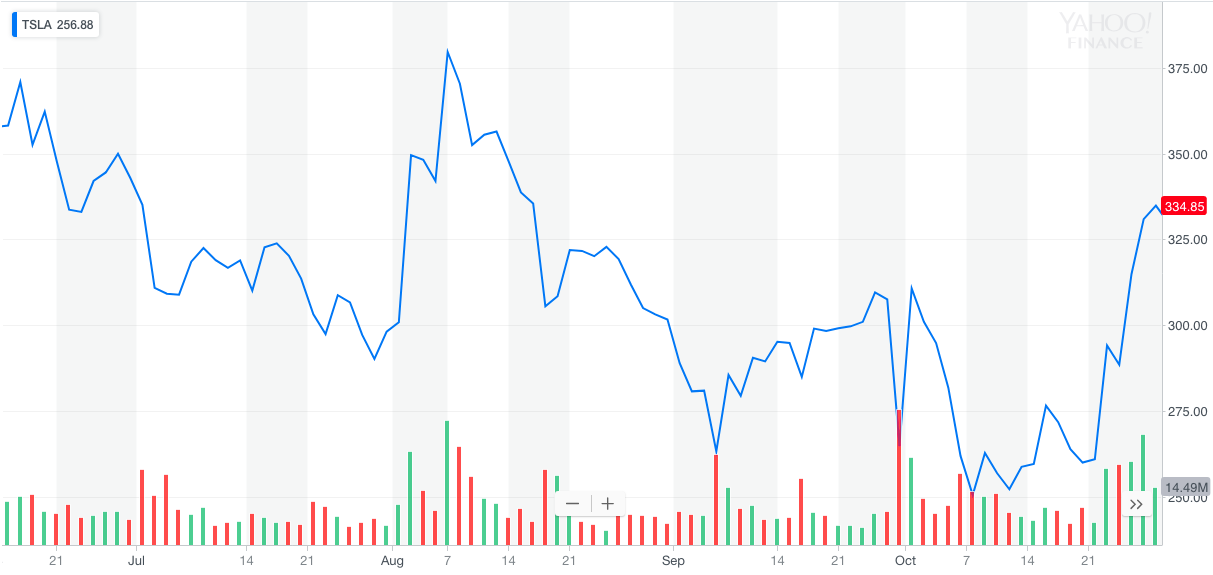
Tesla June 15, 2018 – October 29, 2018
Investor A decides to invest a lump sum of $50,000 into Tesla on June 15th, 2018 at a price per share of $354. Investor B also decides to invest $50,000, but in increments of $10,000 on the 15th of each month.
June 15: $354
July 15: $312
August 15: $342
September 15: $289
October 15: $260
Current Price: $333
At the current price, Investor A has actually lost money. His initial investment of $50,000 is now worth only $47,034. However, Investor B, who bought $10,000 worth of Tesla stock on the 15th of each month now has $54,146 for a net positive return of 8.3%.
While no investment method is foolproof, dollar cost averaging lowers risk for investors with long term investing goals. It’s not going to get you rich quick, but it is a smart way to make the most of changes in stock prices over time. Try dollar cost averaging with your Wall Street Survivor virtual portfolio today!
Conclusion
Every investor should understand dollar cost averaging. Investing a fixed dollar amount in increments, instead of a fixed number of shares, helps you buy more shares when the stock is down and buy fewer shares when the price is up. This way, your average cost is reduced and you make more money in the long run. Take the risk out of trying to “time the market” and just make sure you are investing a some each month!
In this ABCmouse review, I’ll try to answer all your questions about the product.
I’ll also show you some screenshots and give you my honest opinion, but if I forget something, please let me know.
I’ve searched the entire internet to find the best tools to use with my daughter. She is only 2 years old now, but I feel like it’s important that she learns as much as possible at home before she starts school.
ABCmouse.com offers a comprehensive educational program for young children. It was developed by the Age of Learning, Inc.
Just to be clear, ABCmouse is not an accredited school.
However, it is an extremely useful supplementary tool used by librarians, teachers, parents who home-school, and parents who just want an additional learning resource for their kids!
The vast material on this site includes 9,000+ individual learning activities and over 850 lessons.
It’s designed for toddlers up to those in second-grade, this site distinguishes between individual ages and abilities with 10 separate learning levels.
These levels are selected by the parent and can be changed depending on if the material is too challenging not quite challenging enough for the individual user. The curriculum on this site has received awards like the Mom’s Choice GOLD Award and the Teachers’ Choice Award.
The educational program was designed in collaboration with a versatile curriculum board of experts in early childhood education as well as field-specific experts. Examples of these experts include a Ph.D. of Curriculum Development holder, a geologist and science education specialist, and an experienced lexicographer (someone who complies dictionaries).
The curriculum on this site is divided into four subjects: reading and language arts, math, “the world around us” (which includes lessons on the body and health, plants, world maps, the solar system, etc.) and arts and colors.
The site also uses a wide variety of lessons types, including 450+ books, songs, puzzles, and games. Diversity amongst lesson styles helps children with different learning methods succeed in all subjects.
How much does it cost?
This platform is a paid, subscription-based site. So the big question is, is it worth the money?
There are lots of free websites that offer educational content for young children. For example, pbskids.org offers many games and lessons through a variety of mediums for free.
However, a subscription on ABCmouse.com costs $9.95/month ($79.99/year). This fee can be paid monthly, yearly, or in 4 installments with a credit card, PayPal or Apply Pay.
Despite having a lot of competing free options, the benefits a user gets from a platform that requires subscription are quite clear.
Most importantly, ABCmouse.com is anadvertising free, external-link free site that is safe and secure for young children to use with minimal supervision.
Although the site’s creators recommend parental supervision, especially when first navigating through the various features, the site is safe for children to use independently. This is really what sets this site apart.
Parents can be comfortable concentrating on other tasks while their children learn and have fun in this interactive online platform. Additionally, the fee contributes to the high quality of the curriculum mentioned previously. The fee also allows for developers to work on creating a child-friendly, stimulating platform.
An example of just how child-friendly this site is can be demonstrated with the audio features.
When you hover over various items in the site, an audio message explains what the item is to help users understand what the feature is and allows students to
You can signup now for a 30-day risk free trial. Click Here Now
So, if you and choose not to continue using them, don’t forget to cancel.
When you create an account, you’ll register one parent profile and up to three child profiles, which you can use simultaneously on different devices.
Next, parents will have to decide what level to place their children in.
There are 10 levels, that becoming increasingly difficult. The first sets of levels are geared towards toddlers, preschoolers, pre-kindergarteners, and kindergarteners.
The higher sets are geared towards first and second graders. The lessons are briefly described during registration, but don’t fret if you are unsure.
There is a detailed description in the Parent section, and the parent can change the child’s level at any time during the subscription. After parents choose a level, children choose an avatar from a pre-made list or they can create their own at no extra charge.
After registration you will be brought to the Student Home Page. The first feature on this page is called the “Learning Path”. After selecting the child’s level during registration, this creates a specified learning path geared towards that age group and ability level. The Learning Path is structured like a trail.
Along each step of the trail, the child is presented with a lesson, and once completed they get to advance to the next lesson. Each time a lesson is completed, the user earns tickets. These tickets, and the reward system they create will be discussed a little latter on.
Along the trail students will also get surprise rewards for every set of lessons they complete. They can track their progress from a bar along the bottom of the page.
Additionally, the trail goes through a variety of environments, each of which include key facts about the climate and vegetation of the area.
As children move along the trail, the lessons get more complex, and the rewards can become greater. This phased pre-set lesson plan is one of the best features on the site. It continues to challenge children every step of the way, whilst rewarding them for their progress.
ABCmouse.com also includes more freely structured lessons about basics of letters and numbers, music, books, calendars, the solar system, and more, which are accessible from the Classroom. The activities housed in this feature do not count towards the Learning Path progress but are still tracked for parents to see. All the work users do in their classroom will still yield tickets to use in the rewards system.
By now you’re probably wondering, what is this reward system anyway?
When you first sign up, each user gets a ‘Room’, ‘Aquarium’ and ‘Pet Place’ in addition to all the lessons. These features are interactive and allow students to learn but are more importantly the place where a student can use their rewards. As users’ complete activities, they are rewarded with tickets.
Different amounts of tickets are rewarded depending on the difficulty of the lesson, and extra tickets are rewarded along the Learning Path as incentive for kids to complete more lessons. Tickets are essentially virtual cash that the child can use in the sites shopping center.
Here, users’ can use their tickets to purchase items to customize their avatar or they can purchase items for their room, aquarium, and pet place. They can also purchase pets and take breaks from lessons to care for or play with the pets.
Once they have purchased something new, they can interact with it in the specific space it was designed for.
The more valuable, exciting items for sale are obviously more expensive, and therefore encourage saving on behalf of the users. Giving students rewards for their work, encourages students to continue to work harder, as long as the rewards remain important to the recipient.
What are the benefits of ABCmouse?
Some of the most important benefits offered by ABCmouse.com have already been mentioned.
This site has an extensive curriculum built in collaboration with teachers and education experts that offers wide-ranging lesson options targeted to young children.
The fee required by this site ensures that it remains ad-free and safe for kids to use with minimal adult supervision. The fee is also quite reasonable considering that one account can be shared between three children of different ages and abilities.
Parents can also opt in to an option called the “Assessment Center”, which offers a variety of tests to assess the areas in which a specific child can improve in.
There are a lot of free sites with educational games and lessons for young children, but they do not offer the structure and safety that are inherent in ABCmouse.com.
Additional Bonus features
One of the other major benefits of this website, over it’s alternatives, is that it offers parents a lot of control.
The password-protected Parent section is easily accessible from any options menu on the site.
This page includes sub-sections to purchase the assessment center, view details about the account, change settings, take an in-depth look at the curriculum, access customer support, and provide feedback. This page also allows you to access the Progress Tracker, which allows parents to follow their child’s/children’s accomplishments on the site.
This visually appealing tracker has easy to read graphs and charts that demonstrate the number of lessons completed, and of what type or subject they are in, as well as how many tickets are being collected and spent.
The best part about this Parent feature is that parents can customize the settings for their children’s accounts.
For example, parents can restrict ticket spending to require their password, they can change the Learning Path level if the profile is too easy to difficulty, and they can set restrictions for how long the child can use the website a day.
Additionally, the site offers an “Assessment Center”, which contains tests to determine where your child stands on certain skills. This feature often requires parental supervision when completing the tasks and has additional costs. Although many other sites have educational tools, few offer the control and administrative capabilities that ABCmouse.com offers its customers.
ABCmouse Review Conclusion: Is it worth it?
In my opinion, it’s definitely worth the money.
Firstly, you can’t put a price on your child’s education. According to Johns Hopkins University, “Early education can play a critical role during this important developmental period. Research linking early intervention to both cognitive and socio-emotional gains has fueled the proliferation of early childhood programs since the early part of the twentieth century.”
So, the importance of early education is undeniable.
But I’ve contemplated just using free stuff online, rather than paying for a premium service like this.
However, i’m getting more and more fed up of the Ads and I also find the quality of the education is not as good.
So, I am a customer of ABCmouse and I am very pleased with their product so far.
Whenever I think about if I should keep the product or cancel it, I ask myself; “is $9.99/month worth it if my daughter learns ONLY 1 new thing that month?” The answer is always yes…
I also tell myself, I pay $11.99/month for Netflix, which has no educational value for my daughter. So, of course I can justify paying $9.99/month for ABCmouse.com!
Ramaphosa’s job isn’t an easy one, the current president of South Africa having to pick up from where Jacob Zuma left off in February of 2018, trying to gradually undo all past mistakes by committing the government to allow private investments. Some criticize the current president for holding meetings and summits where nothing really appears to get done, but a little patience should be granted in this case, especially considering that there are at least 10 companies willing to invest in the progress and development of the country, helping create new jobs in the process to aid resolve the issue of high unemployment stats.
As there was a great loss of credibility during the Zuma era, the country facing a severe image damage inflicted by the opaque and unpredictable government formed by the prior ruler. Thus, Ramaphosa has been facing a great challenge since the get-go under the form of credibility recovery. For this reason, summits and meetings are held often, the president trying to convince investors to drop a dime and aid the country’s development process go smoothly.
Companies have already pledged to invest
On the second day of the Investment Summit, 10 pledges had already been amassed. Rain Mobile commits R1 billion to build a new 5G network that would help improve the telecommunications sector considerably, while the Mara company is said to invest R1.5 billion towards the same sector, putting a bigger emphasis on creating more jobs to concomitantly help lower the unemployment rate as much as possible.
Ivanplats, a subsidiary of Ivanhoe Mines, is willing to invest R4.5 billion in the local economy, Sappi pledging R7.7 billion for the same purpose with the added intent of focusing on manufacture and textiles more. Naspers intends to invest R4.6 billion while setting up a tech innovation hub to create more jobs. Vedanta offered a staggering R21.4 billion for the metal industry, while Mercedes-Benz South Africa gave R10 billion and Mondi pledged R8 billion for the country. The biggest surprise yet came from Anglo American, a mining company that commits an R71.5 billion investment in the mining industry that spans over the next 5 years.
Up to this point, R134.1 billion have been raised and the good news keeps rolling in, a positive outlook on the country’s situation not seeming as impossible as it did the past years. As long as Ramaphosa will have a strong hold over government and not allow the internal situation to decay as his predecessor did, investors are bound to aid as they won’t fear losses, and South Africa will be on the right path to economic growth and development.
Oppressing developmental issues that Ramaphosa must tend to
Poor regulation of the energy, telecommunications, and water industries must be fixed under his presidency for him to regain credibility in the eyes of foreign investors. Evidently, when discussing these industries we must take into account the impact held on country inhabitants as some major issues emerge:
People don’t have the same access to information and communication means as those in better-developed countries do, which harms a number of life quality aspects, education receiving the biggest blow.
Water pollution is a major issue that has led to serious health detriments for inhabitants, thus decimating the number of people who are apt to work and who would have otherwise contributed to a more rapid development. At home sanitation doesn’t come as easily for inhabitants as it does in developed countries as earnings are significantly lower, so it is up to the state to fix this oppressing matter.
There can be no real development without the energy department thriving as it is needed not only for life quality increase among the populous but for sustaining the rest of the industries that can help South Africa in its developmental process. As it basically stands at the core of all actions, energy is the department where Ramaphosa and the government must get most heavily involved.
What the future holds
Aware of how important Africa’s development is for Europe as well as the rest of the world, Chancellor Angela Merkel has personally urged companies to shift their focus towards this continent to back efforts in prosperity so that the people of the continent will finally enjoy the same luxuries as the rest of the world. With backing from one of the most respected political figures at the moment and Ramaphosa on the right track towards winning trust, the future seems brighter than ever for South Africa in particular.
The summit might have seemed a bit too pretentious to some as its showbiz style scene and the fanfare were indeed over the top, but this isn’t what we should take away from it. The vast audience that tended to the event, which was composed of approximately 1300 business and government leaders, was pleased with the outcome as pressing issues regarding the country’s reliability when it comes to investment were clarified, the president reassuring the business community that their properties and investments are now safer than ever and will remain this way.
In the event that even more businesses commit to aiding South Africa in its journey toward growth, people who live in unsanitary conditions, who are faced with pollution-induced health issues, who live in poverty, and who don’t have proper access to education will likely see an end to their troubles as not only will new jobs invade the market, but life expectancy and quality will grow as a result of industrial and economic growth.
Summary:
With South Africa’s economy struggling, the recent investment summit led by Cyril Ramaphosa was intended to revive economic growth in the region. Addressing the structural weaknesses in the economy and improving the investment framework could be the moves that will eventually lead to a fix, especially with the right external help.
Although the paycheck is the only thing people think about before accepting a job, there is more than this involved in the equation. Of course, salary matters, but other parts of the compensation package or even training opportunities matter enormously. Besides, you want to make sure that the employer is a reliable one. You want to be sure that for that paycheck you won’t have to take extra working hours or double shifts. And most certainly, you want to make sure that your employer’s workplace attitude is a positive one. Here are some things that you may want to consider before jumping into that boat and accepting a job offer.
Carefully assess the job offer
Before you say yes to any job offer give yourself some time to think of the offer as a whole. Consider the whole compensation scheme. The salary, benefits, work environment and working hours matter enormously, not only how much you’ll be paid from month to month. The monthly salary may allow you to pay your expenses and food, but the perks are those that will help you raise your living standard. Also, the work environment matters enormously. This is what will determine your workplace productivity and your future mental state. Think about how happy you will be working the job you are about to accept. Is the job description making you happy? The schedule is another thing you should pay attention to. If you will have to work extra hours on a frequent basis, you may want to reconsider your decision.
Think of the pros and cons of working that job and compare it to other offers you might have received. You may be surprised to find out that other jobs are better, although, at first glance, they didn’t look like.
Employee benefits matter
Health insurance, retirement plans, these are things that you should consider before accepting a job offer. Other perks that might make a job appealing are vacation plans and disability plans, sick leave and other similar compensations. Take your time and compare different job offers. You won’t be asked to accept the offer right away so this won’t damage your employment chances. A good retirement plan is more important than a bigger salary, in most of the cases. But make sure that you assess your retirement plan carefully. A great retirement plan should weigh more than a generous salary at another employer, so make sure that you make a good decision.
The history of your employer matters
Have you ever thought of checking your employer’s history and background? A background check matters enormously and you should perform it before accepting the job. This will offer more information on your future employer and the company if they previously had any sort of legal issues and so on. It will help you get a better image of how your activity in their enterprise will look like and the company’s stability.
Assess which are the perks and benefits you give up by leaving your current job
Unless you are working a horrible job, there are most probably some things that you love about your current employer. Assess the perks and see if you will still have them by switching jobs. Make a list of the pros and cons of your current job and compare those to the ones you will have at your potential future job. Maybe at your current job, you have short commute intervals. This should matter more than a couple of extra bucks offered by your future employer. In the end, comparing the two jobs will be fairly easy.
Will you have growth and development opportunities?
This is a topic that should be one of the main determinants before accepting a job. If you have growth and development opportunities, the company offers training programs for their employees and the promotion chances are real, you should most probably take the job. You have to think of your future career as well, not only what you currently have. It has been proven that employees that enjoy more development and growth opportunities are happier with the employer and their career choices. They also seem to deliver better in the workplace and be more productive.
New challenges and new skills will make you more valuable on the human resources market and will offer you more profitable and advantageous employment opportunities in the future. The pace at which employees are promoted inside the company also matters, thus, assess that carefully as well.
Do you feel comfortable in with your future employer’s corporate culture?
Everyone has their own idea about a positive corporate culture, so if yours doesn’t match your employer’s you may have a hard time in in the future. If you’re unproductive in an open-floor company, you will have a difficult time working in such work environments is you are the introverted type. If the workplace environment encourages collaboration, creativity and interaction and you’re not inclined to such behaviors, you will have a difficult time adapting, so assess this aspect carefully. Other variables that you should pay attention to are the noise level, the physical space available, the behavior of your colleagues and employer. These all will determine how comfortable you’ll be feeling in your new workplace but also how fast you will adapt.
Why do current employees leave your potential employer?
If you hate stress but this job is the one that makes people leave in herds because of it? Well, you may want to reconsider the whole employment opportunity. This is unlikely to bring any long-term benefits to your career or financial status. Search for a company that values diversity and pay big attention to why former employees have left the workplace. It may be a manager with a toxic leadership mentality or it may be something worse, but inform yourself.
These are some of the most important things that you should do and consider before accepting a job offer. If you don’t pay close attention, you may end up in the worst workplace environment until then and you will most likely regret the decision.
***Motley Fool Stock Advisor Performance Updated as of November 9, 2024***
Does the Motley Fool’s Stock Advisor newsletter provide good stock recommendations and is it worth the price?
At HowTheMarketWorks, one of the services we provide our users is that we subscribe to dozens of stock advisory services and we buy all of the recommended stocks from each service in a virtual trading account.
This allows us to have objective performance results of each service.
In this article I will review the performance of the Motley Fool Stock Advisor stock picks from years 2016 through 2024, and show you the profitability of all these stock picks. You’ll get to see: Is the Motley Fool legit? Is the Motley Fool worth it? Or is this stock picking service a scam?
I will show you some of the Motley Fool stock picks that were excellent stock picks and gave us huge profits. I will also show you how we used stop-loss orders to protect our initial capital.
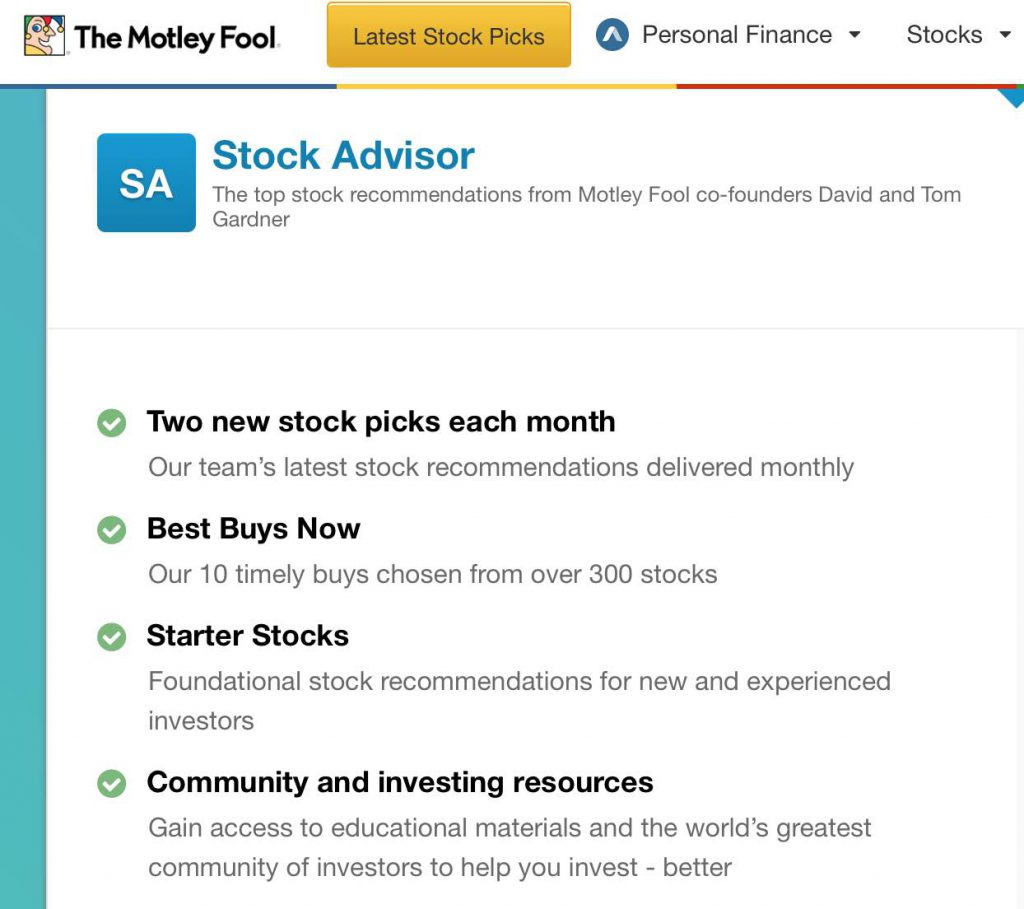
Here are the 4 main things you get when you buy the Motley Fool Stock Advisor service. This is directly from the Motley Fool’s webpage:
First of all, note that you get TWO new Motley Fool stock picks each month. These are the stocks that we are testing. Their “Best Buys” and “Starter Stocks” are just re-recommendations of stocks that they have previously picked that they still like.
Motley Fool Background
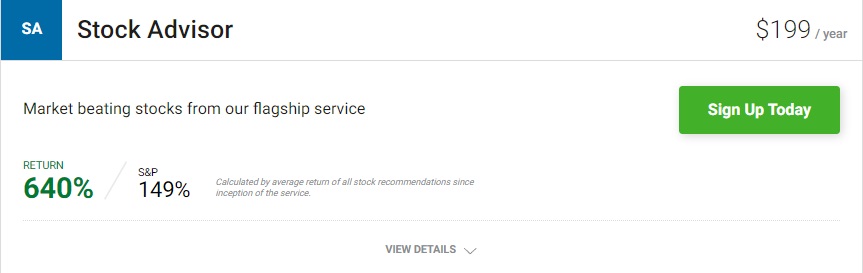
The Motley Fool has been providing stock market commentary and specific stock recommendations to the general public since 1993. They truly exist to help you make money in the stock market. Currently they offer about a dozen stock recommendation newsletters that cover a variety of investment strategies. The price for these stock advisory services ranges from $199 a year to $13,999 a year for full access to all Motley Fool stock services.
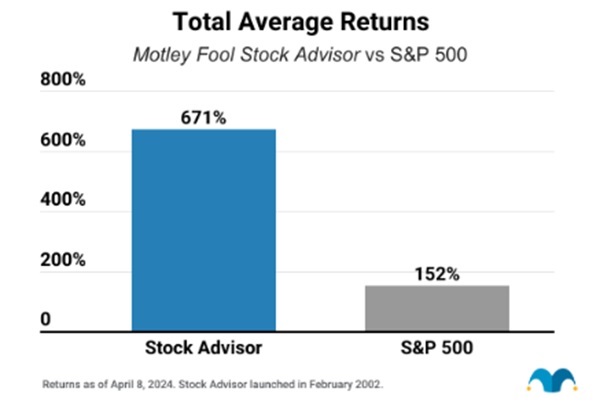
The Motley Fool Stock Advisor is their most popular service and their most affordable. Their marketing page says it has over 500,000 subscribers.
Their office is located in Alexandria, Virginia. I have even been to their offices several times over the 30+ years I have been in the stock market education business. As of 2024, the Motley Fool has over 700 employees.
The Motley Fool’s “Stock Advisor” newsletter is their most popular and their most advertised stock picking newsletter.
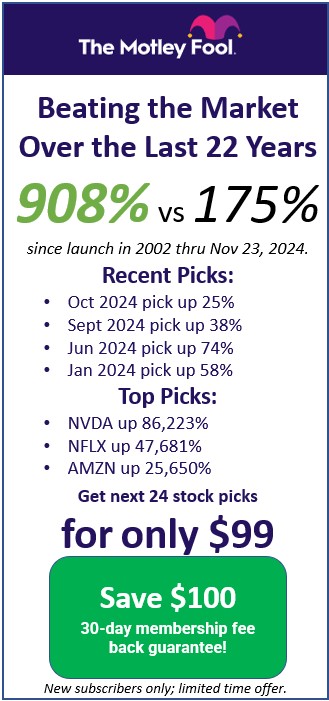
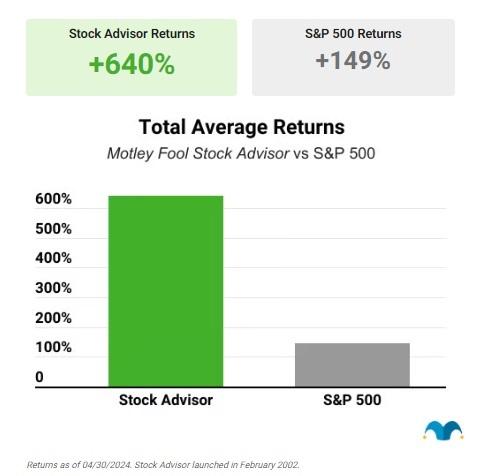
They claim this service has returned 908% versus the SP500’s 175% since the Stock Advisor’s launch in 2002 (as of November 23, 2024). See their latest ad below…
That claim is enough to get everyone’s attention. In fact this is the first service we bought so we could paper trade their picks to find out if their performance claims were realistic.
My Motley Fool Stock Advisor Performance
With the Motley Fool Stock Advisor newsletter they send you two NEW stock recommendations each month. You will also get updates on previous recommendations, and occasionally a few sell recommendations. The emails are short and concise, and if you want to click to get more information, you can read their full analysis.
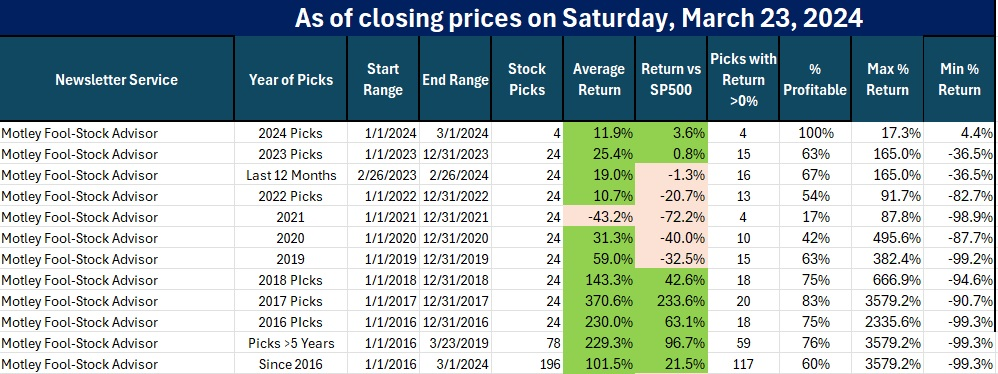
This Motley Fool Stock Advisor Performance is based on my own experience as a subscriber since January 2016. At 2 picks a month for 98 months that is 196 stock recommendations.
Here is a table summarizing the performance of those 196 stock picks:
Summary of the Motley Fool Results
As of the date noted above, here are the highlights of the Motley Fool Performance for the last 8 years:
83% of the Motley Fool stock picks were profitable
the average return of their 120 stock picks is 215% vs the market’s 80%
they achieved that incredible average by picking many stocks that have doubled and tripled:
55 of those 120 stocks at least doubled
37 of those 120 at least tripled
23 of those 120 at least quadrupled
one of their 2016 stocks is up 4535% (Shopify)
The Motley Fool really does have a great knack for finding a few stocks each year that have fantastic returns. Think about it. If you buy 24 stocks a year, lose 8% on 4 stocks, make 10% on 16 of them, have 2 that double and 2 that triple, your portfolio will be up 30% in one year. In 3 years you will double your portfolio. That is essentially what the Motley Fool Stock Advisor has done for the last few years.
More About My Experiment
Since I work for HowTheMarketWorks, at first I set up a virtual Motley Fool account with $100,000 and just started buying $5,000 of each of the stocks they recommended. Like most of you, I am a busy person. I can’t always stop what I am doing when I get their emails. Generally I would place my buy orders as a market order within an hour or 2 after getting the Motley Fool stock picks. I have been burned (ie, lost money) from other stock services. So to be cautious, I placed a stop loss order at 30% below my purchase price.
After seeing the positive returns on 8 of the first 10 buy recommendations that I paper traded in my HowTheMarketWorks account, I decided to start buying the Motley Fool stock picks with my real brokerage account using my real money. At first I started buying $2,000 of each of their stock recommendations. I have to say that I am very, very pleased with the results. I just wished I had more money to buy more of their picks!
For their 2020 stock picks which on average are up 83%, 17 of those 24 are up as of August 13, 2021. Here are some of their specific recommendations:
January 2020 stock pick TSLA is up 733%
February 2020 pick DXCM is up 62%
March 2020 ZM is up 187%
April 20200 pick SHOP is up 332%
June 2020 stock pick CRWD is up 154%
July 2020 pick ASML is 106%
Obviously these are just some of the recent Motley Fool stock picks. My point of showing you these is that they really do pick stocks that double and triple each year. And THAT is how they have made the amazing returns they advertise.
In addition to the 2 picks per month, they also send out a few other BUY lists like this one…
Here is a sample email that they sent in May 2018 of their Starter Stocks recommendations. Here are 10 solid stocks. I am showing you a 2018 email because the Motley Fool investing philosophy is that they recommend you hold their stock picks for at least 5 years.
Motley Fool Stock Advisor Sample Email
Of those 10 stocks (AAPL, AMZN, ANET, FB, HAS ,MA, MAR, MKL, NFLX, PYPL), they have all gone up since I received that email.
The cost of the Motley Fool Stock Advisor has fluctuated over the years from as low as a few hundred dollars to $995 a year. Right now they show the price at $199 a year, but are currently offering 12 months for only $99 to new subscribers.
*** THE BEST STOCK NEWSLETTER OF 2020 -- March 1, 2021 UPDATE --
We are constantly monitoring over a dozen stock recommendation and advisory newsletters. There is one newsletter that is consistently outperforming all of the others and that is The Motley Fool Stock Advisor.
The BEST newsletter of 2020 was the Motley Fool Stock Advisor service who had 22 of 24 profitable stock picks with an average return of 89%, including 7 picks that more than doubled.
Most impressively, over the last 5 years that we have been tracking every recommendation, their average stock pick is up 201% compared to the the SP500's 53%. That means the Motley Fool is almost 4x better than the market! No other stock newsletter comes close to that. The Fool has done so well because they quickly identify stocks that will perform well BEFORE everyone else does. Now with a new President and a COVID vaccine, make sure you get their next stock pick!
Take a look at these recent picks as of March 1, 2021:
Their December 3, 2020 pick is already up 80%
Their November 5, 2020 picks is up 56%
October 1, 2020 pick is already up 84%
Fiverr Intl (FVRR) -- September 2, 2020 pick is already up 135%
CrowdStrike (CRWD) -- June 4, 2020 pick is already up 132%
ServiceNow (NOW) -- May 7, 2020 pick is already up 54%
Shopify (SHOP) – April 2, 2020 pick and it is already up 271%
Zoom Video (ZM) – March 19, 2020 pick and it is already up 239%
DexCom (DXCM) picked Feb 20, 2020 right before the market crashed and it is still up 35%
Tesla (TSLA) picked January 2, 2020 before the crash and it is up 890%
HubSpot (HUBS) picked December 5, 2019 and it is up 170%
Netflix (NFLX) picked November 21, 2019 and it is up 76%
Trade Desk (TTD) picked November 7, 2019 and up 343%
SolarEdge (SEDG) picked September 19, 2019 and it is up 244%
Now, no one can guarantee that their next picks will be as strong, but our 5 years of experience tracking the Fool shows that their picks are doing better than ever.
Updated as of April 11, 2021 -- The Motley Fool Stock Advisor service has won our award for the Best Stock Newsletter of 2020--that's now four years in a row. The Motley Fool 2020 stock picks have a 78% return and 20 of those 24 stock picks were profitable. FIVE of those 24 stocks have now at least DOUBLED! TSLA was their top pick and is now up 687% since they recommended it in January 2020. Also their 2019 stock picks are now up 115% compared to SP500's 47%; and their 2018 stock picks are up 209% compared to SP 58%. Now with a new President and a COVID vaccine that seems to be working, most analysts expect the market to continue up. But make sure you have the right stocks in your portfolio so you can CRUSH THE MARKET like their last 5 years of stock picks have done!
In fact, over the last 5 years the average Motley Fool stock pick has almost tripled, being up 192%! This time period covers the 2016 election, the Trump administration, the China trade negotiation, COVID, and now the Motley Fool is continuing their excellent stock picks with one of their 2021 stock picks already up 23%. Don't miss out on the Motley Fool's next stock pick. Here is their schedule for the next few weeks:
April 15, 2021 - David's New Stock Recommendation
April 22, 2021 - David's List of 5 Best Stocks to Buy Now List
May 6, 2021 - Tom's New Stock Recommendation
May 13, 2021 - Tom's List of 5 Best Stocks to Buy Now
FYI--Their October and November picks are already up 92%, 18%, 29% and 41%. And remember, if you are not impressed, you can always cancel within 30 days and get a full refund.
If you subscribe to the Motley Fool Stock Advisor, you might find yourself making more stock trades than you normally do. So be careful of the commissions you pay with each trade. Commissions will eat up your profits if you are only investing a few hundred or thousand dollars.
If you don’t already have a real stock brokerage account, then open a new account and take advantage of the special “Commission Free” offers that a lot of the brokers have right now. To review all of the “Commission Free” stock broker offers for new accounts, CLICK HERE.
If you already have a brokerage account, don’t be shy to switch brokers or open a second or third account. I have 4 brokerage accounts myself. It has literally saved me thousands of dollars! I have 4 brokerage accounts for a reason. I take advantage of special offers to trade commission free, and you should too. A penny saved is a penny earned.
Also be warned, the Motley Fool business model is they use this service as their entry level subscription service. Once they have your email address, they try to upsell you to their other services. They don’t call you, they just send you emails. So I don’t find them annoying at all.
Final Thoughts
Some people ask me if the Motley Fool is a legitimate business. Yes, absolutely they are legit and they are there to help you make money. I have visited their offices in Alexandria, VA several times. I have met several of their key personnel and I see them at investor education conferences. They take their job seriously and are truly focused on helping their subscribers make money in the stock market. If you are ever unhappy, you can always cancel. And yes, when you call they will answer their phone! If you want to know how it rates against other stock picking services, then read this best stock newsletters.
My Conclusion
The Motley Fool Stock Advisor service is the best value for the money.
Don’t just take my word for it, feel free to read this other Motley Fool review.
If you are just getting started investing in the stock market, or even if you have been managing your stock portfolio for years, the Motley Fool Stock Advisor is a great service for the money. I never would have bought SQ, MAR and NVDA without their recommendations. If you want to try the service, click on the link below…
The Stock Advisor newsletter is currently available to new subscribers for $99 for 12 months. At this price it is a NO-BRAINER to spend $99 and get their next 12 months of stock picks and market commentary. All of their stocks will probably NOT go up. From my experience, however, most will go up over the long term. Most importantly, they seem to have a way of finding stocks that double or triple in a year. Stocks like NVDA, MAR, AMZN, and SQ did that for me. It’s always great to have a few stocks that double in a year to offset a few of their losing picks..
How Do I Open a Robinhood Account and Get up to $1,700 in FREE STOCK?
To open a Robinhood account, all you need is your name, address, and email. If you want to fund your account immediately, you will also need your bank account routing and account number.
As its current promotion, Robinhood is giving away a FREE STOCK (valued at $5 to $200) to anyone that opens a new account this month if you click on the promo image below. Then, once you open and fund YOUR account with at least $1, you will receive more free stock (again valued at $5 to $200) for referring your friends and family. The more people you refer, the more free stock you get. Click on this promo below to start your Robinhood account application and get your first FREE stock.....
Bonus Tip: Use this link to get a free stock (up to $200 value) when you open and fund your account with at least $1 and start investing in stocks, options and cryptos:sign up for Robinhood today, you'll get a free stock (up to $200 value!) FURTHERMORE, for each friend that you refer, you will receive ANOTHER free stock valued at up to $200. This is perfectly legit and you WILL get more free stock for every friend or family member you refer.
Why do they give away so much free stock? Because they spend their advertising dollars this way instead of buying TV, radio, print, or online ads! They WANT you to refer friends!
[noad]
NEW SUBSCRIBERS: CLICK HERE to get the next 12 months of of picks for only $99.
As a trader or investor, it is important to understand that the nature of the stock market has changed in some big ways over the last 20 years. This article will highlight the 5 big trends.
Private Investors are Less Involved in Active Trading
In 1998 60% of U.S. adults had investments through mutual funds ore retirement plans, this has reduced to 38% in 2018 according to a 2018 Gallup Poll. The exact reasons for this are unclear but all indications point to less disposable income as U.S. wages are not increasing as they used to in previous decades. Also, younger investors up to the age of 35 have lived through 2 mighty crashes, the dotcom crash in 2000 and the financial crisis of 2007. For younger investors this has weakened their confidence in the stock market and holds them back from long-term investing.
The Rise of the Robots
As the numbers of independent investors in the market have decreased, the amount of robotic or algorithmic trading has increased dramatically. According to JP Morgan the robotic trading accounts for 90% of all volume in the stock market. This one of the few sure-fire ways to make money in the markets as the robots are there to scalp small amounts from the bid and ask prices on the exchanges.
Improved Chart Analysis Tools
The last 20 years however have seen huge improvements in the quality of software available to the independent retail investor. With advances in the compute power of PC’s and Tablets we see the rise of stock market charting software like MetaStock that can run complex systems to back test ideas and even forecast results into the future.
Also, with improvements in the stability of the internet and cloud storage, you do not even need a powerful computer to analyse the stock market, companies like TradingView enable a full chart analysis experience through a web browser using HTML5.
Microscopic Media Coverage
The rise of news outlets covering the financial sector and specifically the stock market has grown tremendously over the last 2 decades. CNBC markets, CNN Money and of course Bloomberg cover the markets on TV but also over the internet there are thousands of news outlets, websites and blogs covering tiniest moves in the market. It can be overwhelming. Sometimes you need to simplify the overwhelming amount of information and distil it down to the essential analysis of what is actually happening in the stock market today.
Too Big to Fail
The concept of too big to fail gained popularity in the financial crisis of 2007 as the U.S. government and federal reserve worked to piece together the broken U.S. economy. The too big to fail notion means refers to companies or institutions that are so large that if they were mismanaged and failed that they could break an economy. The shadow of too big to fail still looms large and those institutions have not been broken up enough to remove the threat.
What Has Not Changed?
The market continues to go up over the long-term. According to stock market statistics a single $1000 investment in 1930 in the S&P500 index would have yielded nearly $160,000 dollars, essentially a return of 160 times the original investment, despite 18 recessions and crashes.
When you’re a business owner, one of your biggest goals is likely to make that business a success. Unfortunately, not every owner has the know-how for getting to a period of sustained, long-term growth. That’s why we’ve put together this guide of 5 easy steps you can take to start seeing that growth you want, without all the mess of trial and error. Whether you’re a business owner who has been in the game a long time, or you’re a newcomer looking to make a mark on your industry of choice, these tips can help. Keep reading to get the details.
Look to your current customers
One of the biggest mistakes we’ve seen business owners make when trying to scale their company is to focus most, if not all, of their attention on establishing a new customer base. While trying to enter a new customer market isn’t bad in and of itself, neglecting your current customers is. If you can create a solid rate of customer retention, you’ll be flush with both happy customers and opportunities to get those new clients you were looking for. Those referrals from current customers are gold mines for business growth. The happier your customers are, the more likely they will be to refer others to your business. The more they do that, the more likely you will be to close deals.
Get creative with funding
In an ideal business world, you would never experience a cash shortage. Unfortunately, in today’s world, that isn’t the reality. In fact, 40% of small businesses have experienced a cash shortage in the last 12 months. Chances are, you’ve been among that number at some point in time. You may even be part of the 40% right now. Luckily, there are ways to soften the blow, and sometimes even prevent it from happening. One of those options is to look into how to get trade credit for your business. This is a financing option that enables businesses that are low on cash flow to purchase products and supplies without paying right away. Another option is to establish passive income, which provides you with a steady stream of cash, but doesn’t require the same amount of attention that your business might. Doing either of these options enables you to experiment with your company structure without worrying about losing everything if something goes wrong.
Build a sales funnel
If you haven’t yet established a sales funnel for your business, then this step is essential. No company can expect to see solid, long-term growth without investing in a sales funnel. This is because sales funnels help automate your business so it can scale and grow quickly without breaking the bank. And although sales funnels can take time to execute well in the beginning, they are an incredible long-term investment that can help you see results and growth for years to come.
Research the competition
You’ve likely heard the phrase “killing two birds with one stone,” and if you haven’t, you’re about to learn how it can apply to business growth. Here’s what we mean. As a business, a major goal you have is likely to beat out your competitors. That means their successes and failures affect you and your bottom line. But what if we told you their wins don’t always have to mean your losses? In fact, let’s take it a step further. Their wins can also be your wins. If you emulate the tactics your competitors excel at, and beat them in the ones they don’t, you’ll be able to scale your business that much faster.
Conclusion
No matter what size your business is, or what your company’s current finances look like, we hope you’ll give these tips a try. It can be difficult to see the light of growth when you’re working in the depths of your business, but it is possible. By taking the time to read through these tips, you’ve become one step closer to achieving the growth model of your dreams. Good luck, and know that we believe in you, your goals, and your business.
All successful traders were newbies sometimes, who studied trading from the very foundations. The experience and success came in time. While many of them are self-taught, there are now many online courses to help you familiarize with the Forex platform, professional terms, trading principles, etc.
As a practice, vast of them mostly use fictitious demos that need to simulate trading day on Forex. Everything looks real, losses, profits, changes in courses, and this is about enough to start. True excitement (and stress) comes once you enter the platform for real.
As the initial step, you are just looking at trading on the Forex market. You know that some people managed to make money there, so you also decide to try it out. After completing a course or reading a couple of books, everything seems pretty clear to you. You can sit at home and make money, using all the benefits of modern technology. If it was easy, everyone could be a billionaire.
Go with the Strategy
But you realize it won’t happen overnight, and no one can guarantee you the success. Many strategies and tactics of trading were developed by companies and individual investors, who spent years of learning, examination of the market and following the news and daily, monthly or periodic rates.
Reviewing strategies and successful trading styles comes in the stage when you notice that the market “goes against you,” whatever you do (here something you can learn in order to deal with these situations). Entire copy-paste of a single tactic is not possible, as you have to adapt it to technical conditions, but also to your trading preferences and personality.
We’ll show you some of the strategies that are popular among today’s traders. Each of them has a detailed methodology, which you have to learn before the actual application. Each upgrade of tactics through creativity, constant analysis, and market monitoring, will bring new results and favorable trades. In the end, it forms a unique style of the trader.
Strategy of Daily Charts
For Daily Chart strategy, you need to know and monitor the smallest shifts in the value of the currency you are trading with. On charts that show everyday movements, over a hundred such changes, also known as pips, can be found. Although this is a short-term strategy, it can give good predictions for some future trading.
A good choice of trading strategy gives you the opportunity to “swim” smoothly on the market, using forex signals created by professionals. Movements in the currency market are cyclical, and the best predictions you’ll get if you monitor these over some extended period. In this way, you can determine in which direction your further trading will go. It is important not to rush, and to wait patiently for the right signal to enter the market. Also, set the real limits when you’ll leave the market after hitting a stop loss.
The hedging strategy is relatively safe, but let’s be honest; without risk, there is no profit. That’s why it takes a bit of “toughening” the trading, through more detailed analysis and using additional methods for predicting trends because hedging can’t do that. It’s just here to push you to take advantage of the current dynamics of the market.
One-minute Trading Strategy
The one-minute scalping strategy is a simple strategy for beginners, which allows a high frequency of trading. As the name says, within minutes, you track the movements of your currency pair. Using one of the many programs, set the indicators to indicate which action you need to perform. You have to do this in just one click, through Forex trading programs and applications. So this strategy requires quick reflexes, good sense of trading and mathematical skills.
The appearance of the signal depends on the market movements and the setting of the indicators. They serve to anticipate rate changes or to inform you about future actions, based on previous “experiences.” The opening of “buy” or “sell” action depends on the position of the indicators. The point is to use “small shifts,” even when there are no significant changes on the market – scalping.
On the currency market, fluctuations in prices occur very often. The ability of a good trader is to anticipate and use it. Since it is impossible to rely only on your lucky star, you have to use some “scientific” methods. Besides a reliable strategy, a good “sense” for action on the market is essential. And you can’t learn this at the trading course; it’s a matter of practice.
The prevailing opinion about credit cards is that 7 in 10 Americans have at least one credit card— the largest number of the millennials’ demography could even own two credit cards. Beyond the obvious convenience that credit cards offer in making it easy to function in a cashless economy and access credit that you could pay off monthly, credit cards issuers offer a wide variety of perks and benefits designed to incentivize you to use their plastic over their competitors.
Some of the perks attached to credit cards are easy to understand, but many people still grapple with the concept of cash back rewards and some users still wonder if there’s a catch of sorts. This piece provides insight into four key points to understand about earning cash backs on credit cards.
Your card issuer is not necessarily at a loss with the cash backs
There’s no catch in cash backs, your credit card issuer is not trying to trick you into anything by offering a cash back, and the issuer technically doesn’t run at loss by offering a cashback reward. When you sign up for a credit card, the card issuer is guaranteed to make money off the interest payments you make on the credit consumed. The credit card issuer also makes more money in the form of the card interchange fees that it charges merchants when you buy stuff with your card. The card processing fee is typically 2% to 3% of the value of your transaction; hence, for every $100 charged to your credit card, the merchant actually gets $98 or $97 in the end.
When your credit card issuer offers a cashback rewards plan, it is only giving you a fraction of the interchange that it collects from the merchant. The credit card company is making a long-term play by offering you a cash back to ensure your loyalty to their brand.
You could have a flat rewards rate or rotating cash back categories
There are different types of cash back credit cards and the difference is based on how their rewards model is structured. Some cash-back rewards are structured along a flat rate such that you earn a specific percentage on all purchases. The key selling point of the flat rate rewards is its simplicity because you can make all purchases with a single card without any special calculations.
Some cash back rewards are structured to deliver cash backs on rotating bonus categories. For instance, you could get 3% cash backs at supermarkets, earn 1% cashbacks in gas stations, and earn 2% cash back in department stores – the percentage available however changes monthly or quarterly. Earning cash backs on bonus categories takes some deliberate calculation to maximize the cash backs but it offers more comparative returns that the flat fate model.
There are more than one ways to cash out your rewards
There are varying options for redeeming your cash back rewards depending on the kind of rewards. One of the most popular methods for redeeming cash back rewards is to use a statement credit to reduce the amount that you eventually pay back as your credit card bill. For instance, if you have earned $300 in cash backs over the last couple of months and your credit card bill comes in at $1500, you can choose to redeem the $300 on your statement so that you only pay back $1300 on your credit card bill. You can also redeem your cash backs rewards for a paper check or direct deposit into your bank account. Another option is to redeem your cash back rewards for gift cards which you can then use to buy products/services at eligible stores.
You might need to choose between a cash back or low APR
If you pay off your credit card balance each month, you’ll enjoy the full benefits of cashback rewards; however, if you tend to carry credit card debt, you might find out that you the temptation to get cash backs ultimately causes you to fall deeper into credit card debt. An interesting point to note is that credit card that have lower APRs typically don’t deliver a robust rewards program. The most promising and attractive rewards programs are usually seen in credit cards with higher APRs. Hence, you might need to think about what works best for your personal finances – a low APR or a competitive cashback rewards program.
The battle cry to cut the plastic, spend only cash, and never buy anything on credit has become increasingly louder over the last couple of years. There are far too many sad and unfortunate stories about how people fell into financial ruins because they overspent on their credit cards or didn’t manage late fees properly. However, the truth remains that credit cards bring an undeniable layer of convenience to financial transactions.
Credit cards are simply tools for accessing short-term loans for covering expenses so that you can pay off the bill at the end of the month technically without interest. Many credit cards also offer a suite of interesting perks and benefits such as cashback rewards on qualifying orders. However, beyond the convenience and cashback rewards, there are many hidden benefits of using a credit card many users have missed over the years. Below are four benefits you may not know that a credit card offers you.
1. Fraud prevention and protection
Cyber criminals are always roaming around the internet looking for vulnerabilities through which they can harvest people’s personal information and financial data. When data breaches happen, and your financial information is stolen, you may not even know until the bill arrives at the end of the month and you start seeing expenses you didn’t make. Many credit card companies have built customer profiling and risk prevention algorithms that know where and how much you are likely to shop. Hence, your credit card company is more likely to flag and halt a fraudulent transaction than a bank is likely to detect an unauthorized expense on your debit card.
Even when thieves succeed in charging expenses to you credit card, you can dispute the unauthorized expense and trust the charges to be reversed. The folks at Money Under 30 have graciously compiles a comprehensive list of credit cards that provide fraud protection perks. However, if an unauthorized charge goes through on your debit card, the bank is not likely to return the money to you until it has completed investigations.
2. Extended warranty on qualifying purchases
When you buy stuff from retailers, they’ll most likely try to upsell you with extended warranty offers that prolongs your warranty for a fee. Hence, if the manufacturer’s warranty is for one year, an extended warranty cover for two years could still cover the costs of repairs or replacement if the device becomes faulty after the manufacturer’s warranty has expired. Interestingly, some credit card issuers will offer you extended warranty as a perk on electronics or home furnishing purchases charged to their cards. Of course, such purchases tend be capped at a certain amount across different categories; hence, you may want to contact your card issuer to find out about the specifics.
3. Car rental insurance
Car rental collision insurance is probably one the simplest ways to lose money because you don’t think twice about how expensive it is – you’ll typically spend between $15 and $30 a day on auto rental insurance. If you charged the entire cost of your rental car to your credit card, you might be eligible to get free car rental insurance. Hence, you should take a moment to double check on the perks attached to your credit card before you allow to the car rental company to upsell insurance to you.
4. Travel or missed-connection insurance
If you are a frequent flier and you have a travel-centric credit card, it might be a needless waste of funds buying travel insurance or missed-connection insurance when you travel. Your credit card will most likely offer complementary travel insurance that covers emergency medical situations, trip interruptions, lost/stolen baggage, flight delay, hotel/motel insurance or travel accident among others. Some of these elements of travel insurance when bought individually can cost you upwards of $500 – this is money that you could save if you take a moment to read the fine print or call your credit card issuer to know if they offer such perks.
5. Price protection with refunds after price drop
Sometimes you’ll want into a store to buy stuff and go home feeling proud of your financial prudence only to walk into the store three weeks later and see the same item on sale at 40% off. If you paid with your debit card, you’ll only hate the fact that you bought the item too early and hope to catch a better deal next time. However, if you bought the item with your credit card, you might be able to get your credit card company to give you a refund of the difference between the old and new price up to a certain cap. In fact, many credit card issuers offer price protection refunds on qualifying items for up to $1000 in a calendar year for each account holder.
The price of cryptocurrency is volatile, and the volatility could see prices trade upwards or downward rapidly within minutes or hours. In January 2018, Bitcoin was trading around $17,000; over the last three quarters, the cryptocurrency has lost about 56% and it trades around $6,600. Before the end of the year, some analysts have predicted that could be trading up at $10,000 and some bulls believe that a $20,000 trading price is possible.
Unlike stocks or other traditional securities, the price of cryptocurrencies is not tied to any core fundamental analysis. Traditional investors who try to predict cryptocurrencies based on fundamental and technical analysis often find their models useless in the fast-paced world of cryptocurrencies. Nonetheless, below are five notable factors that have consistently proven powerful enough to influence the price of cryptocurrencies.
Hype
Many people disdain the fact that cryptocurrencies tend to move on hype – but the disdain will not change the realities of the market. Influencer tweets, fake news, exaggerated promises, and misleading headlines could move the price of cryptocurrencies positively or negatively. Some traders choose to ignore the hype and trade cryptocurrencies purely on its merit as a disruptive force across target industries. Some other traders choose to ride the hype in buying coins during the rumor phase and selling the coins when the hype become public. If you are buying a coin for its long-term prospects, you can choose to ignore the hype around you. If you are trading coins for short-term gains, ride the hype and exit your trades before the hype simmers.
Government regulation
Cryptocurrencies are essentially digital money existing outside the direct control/influence of governments or its agents. Nonetheless, the government has the law and the instruments of state at its disposal. Government regulations to encourage or stifle cryptocurrencies could trigger uptrends or downtrends in the prices of cryptocurrencies. The decision of the United States SEC to ban ICOs dampened the cryptocurrency exuberance. Conversely, you can expect the cryptocurrency markets to return to winning ways if the U.S. or any major country recognizes Bitcoin as a legal tender.
Exchange listing/delisting
Another factor that subtly exerts enormous power on the pricing of a cryptocurrency is its listing or delisting on a cryptocurrency exchange. One of the major differences between Binance and Coinbase for instance, is that Coinbase has listed a handful of coins whereas Binance has hundreds of coins listed. However, the listing of a new coin on Coinbase will potentially cause the coin to record a bigger price surge than could be expected if the coin was listed on Binance. Conversely, delisting a coin from an exchange is probably one of the biggest casualties that a coin could suffer – delisting a coin is essentially a vote of no confidence and very few traders or investors would be interested in a coin that got kicked out of an exchange.
Internal politics
Cryptocurrencies are built on blockchain technology; hence, they are inherently decentralized and beyond the control of anyone individual or group. The decentralized nature of cryptocurrencies however means that different people (or factions) with different agendas often have different views on what is best for a particular cryptocurrency per time. When these different ideas come into conflict the price of the cryptocurrency will become increasingly volatile because the market is often uncomfortable with uncertainty. The internal disagreements and politics of a cryptocurrency can lead to software upgrades or forking out of new coins such as Bitcoin Cash from Bitcoin and Ethereum Classic from Ethereum.
Attempted/successful hacks and heists
Cryptocurrency transactions are technically irreversible; hence, a successful hack often means that the stolen funds can’t be recovered unless the perpetrators are apprehended and are willing to return the funds they stole. In 2018 alone, at least $731 million has been stolen across successful hacks on different exchanges. Hence, any news of a cryptocurrency hack on a major exchange will most likely trigger a sell-off as traders try to convert their cryptocurrency to fiat before they lose their funds to hackers. Paying attention to news about hacks and how much cryptocurrencies was stolen in the hack could provide insights into predicting where the price of a cryptocurrency is headed.
Sometimes to get better in any profession you have to monitor your work. And it has to be judged by you before anyone else notice what and how you are doing work. Thus you can improve all of your working technique from time to time. This is a good and really effective strategy to improve yourself in any working sectors or any jobs. And the plus point is, no one will be able to judge you for poor performance. In the trading business, the system is the same. Here you can also use this method to improve yourself. Though there is no one to judge your performance, you will still experience the effect of poor performance. So, why not improve yourself before performing badly? Today we are going to show you how you can monitor if you are trading well or bad.
Comparing winning and losing trades
Trading is a business and it acts like a business. Here you make an investment in your trading account. Then you deal with your products here which is known as trades. You start to trade by buying or selling. Then after some time, you close the trade doing the opposite of what you did earlier. And based on the change in pips, you get to make profit and loss. So, if you can count how many winning trades there is in your account and compare them with your losing ones, it might describe your performance all by itself.
Learning from your mistakes
Mistakes can be very useful if you can learn from it. Open a demo trading account and start to trade the market with the virtual dollar. It’s very obvious you will make mistake but try to learn from it. Majority of the rookie traders are overtrading the market and losing a significant portion of their investment. But if you overtrade the market it will be really hard to learn from your mistake. You need to focus on the long-term market trend and write the down the details of each trade execution. Stop thinking about securing big winners in this market. Set rational goal and trade the market with discipline. Never think you will be able to change your life within a day. Consider trading as a long-term plan to change your life.
Using risk to profit ratio
Another thing that you can use for monitoring your performance is the risk to profit ratio. It is for monitoring the performance on a particular trades or all individual trades. It is represented something like 1:1. It is the ration of what you have invested and what you are getting from a trade. If you are investing too much than making returns the ratio would be like 2:1. Or if you are making losses the ration would be something like 1:-1. If you’re doing ideal the ration would be 1:2 or 1:3. Expert’s results in most trades remain from 1:2 to 1:5. Combining multiple trade’s ratios, you can estimate your performance in each trades.
Observing your own strategy
Without any tool or data, you can justify your trading performance just by monitoring your trading strategy. If you are playing too aggressive, you will be making more random trades. And sometimes, the trades will be simultaneous. Your chart observation will be very frequent too, as your brain might not want to miss any chance. Worse than that, you will start micro-managing every plan of yours before trading. Then after opening a trade, you will start thinking about it. When you are worried about money, it won’t get out of your hard. Even after you have closed the trade, it can haunt you with emotional problems. As a result, you will again start getting too busy with your trading. But that is not the most appropriate thing for doing well in this business. If you can relax your senses, it will be the best for your career.
In the past investing and trading were things done pretty much solely by experts within the finance field and business moguls. Now it is actually possible for anyone with any sort of financial background, a decent amount of capital and internet access to become a trader and online trading is growing in popularity.
New traders will often enter the market with expectations of making large sums of money and they will quickly realise that trading isn’t a quick and easy way to get rich and often make many mistakes when starting out. It is very important to try and avoid making major mistakes, especially at the beginning as they could quite easily result in your whole bank getting wiped out. This is exactly why most respected trading platforms will have a section which covers the basics, so for example City Index explains CFD trading, forex and spread betting and even has Demo accounts to provide practical experience.
Some very important mistakes to avoid include not knowing when to stop, trading without enough preparation and training, failing to keep sufficient records of trades, not calculating the risk reward ratio correctly and believing you will see easy, large profits very quickly. It is also very important to not get too emotionally attached when trading, as this can result in reckless decisions being made.
There are a few things that can be done to make sure the risks of trading are kept to a minimum. Investing in the best equipment you can afford is vitally important and it is advisable to acquire a fast computer, stable internet connection and also the correct trading tools and platforms. It is also very wise to set yourself a stop-loss order to minimise the loss within each trade and therefore help to preserve capital. You can do this by setting a price with a broker in order to sell when a set price is reached, therefore limiting losses if the trade doesn’t go as hoped.
When starting out it would be wise to start off with small bets, until you feel totally comfortable with trading. It is also worth looking at trading on a margin, which means you are able to pay less than the cost of a full trade and then you will be able to enter into larger positions. This will mean you don’t need to bet money you can’t afford to lose that isn’t yours.
If you are going to start trading online, you need to view it as your own business and treat it as such. It is important to have a plan which sets out what you will trade, how you will trade and how much you would like to make and how much time you are willing to devote to do so. It is also very important to fully test everything listed in your plan on both historical data and a live market and then measured at regular intervals. This will help you to determine the style of trading you wish to take on, by figuring out which is best suited to the time you have available, your tolerance to risk and your expertise.
One of the most common requests we get from teachers is if students can see each other’s trades. Well, now they can!
We added a new contest rule, called “Public Portfolios”. If you turn on public portfolios for your contest, there will be a new “View” button on the rankings page next to each participant. This will let each participant see each other’s trades, open positions, trade notes, and more!
If you created your class contest before Public Portfolios were added, this is turned off by default. However, you can add it by editing your class rules, and setting “Public Portfolios” to “Yes!”
PS. You must read this–If you are looking for stock ideas, we have also just published a complete Motley Fool Stock Advisor Review to share our experiences with their popular stock advisory service. You won’t be disappointed.
One of the most-requested new features in Spring 2018 was cryptocurrency trading, both from students and teachers. You asked and we listened – crypto trading is now available on HowTheMarketWorks!
Cryptocurrencies currently share some of the rules from Stocks, such as the commissions and position limits. However, you can trade cryptos both using a quantity (such as 10 “coins”), or specify a dollar amount (“I want to buy $25,000 worth of Bitcoin”).
If you are creating your own contest, you can choose whether participants can trade cryptocurrencies (we have them turned off by default):
You can toggle this on or off from your “My Contests” page, and clicking “Edit Contest”.
Security is one of the key aspects of any business activity over the Internet. It is a top priority for any online company that is serious about gaining a customer’s trust and a positive feedback. If your business is not able to protect itself on the Internet, it is not able to protect customers’ data as well.
Despite all the benefits the Internet has, it is the easiest and the cheapest way for hackers and scammers to reach private and corporate networks. In the age of mobile communication, online marketing, and mobile commerce, the issue of data security has become the topical one. You can’t fully focus on making money online if you’re not sure whether everything you’ve worked hard on can be stolen at any moment. What can you do? You can get a VPN. Don’t underestimate the importance a VPN has in the e-commerce world, especially in the countries with the most advanced economies like Canada or US. You can check bestvpnrating.com for some interesting facts about VPNs in Canada.
How VPNs Prevent Data Leaks
The first step for any e-commerce project is to make sure that work-related data is 100% protected online. Preparing for hacker attacks and prevention of massive data leaks are better than solving the actual cybersecurity problems.
Cybersecurity is a critical issue for any organization, no matter how small or big it is. All organizations have valuable information that can be easily used against them if their servers and networks are hacked. It is either business information or anything related to the property and finances that belong to the company. This kind of information can be sold on the black market by cyber criminals. That’s why keeping any business data on the network well protected is a must.
Why VPN?
You can read more info about the role of a VPN in a business following the link. But the most significant thing you should know is that it keeps your business and personal networks protected online. How does it work?
A VPN is software that creates a new network inside already existing one to carry the traffic through. Instead of allowing your devices to connect to the Internet directly, remote server receives the traffic first. Thus, the traffic goes back and forth through a VPN service, being fully encrypted at the same time. This means that no one except your devices can reach and read your traffic on the network. This is the effect that no antivirus program has.
A VPN is a multifunctional tool. It is used for:
Data security (encryption technology);
Online anonymity (hiding and replacing a real Internet Protocol address and geographical location);
Unlimited Internet access (you get access to previously blocked content).
A VPN is a universal tool. No matter how old or new your online company is, you can always pick a service that suits your budget at the moment. For further instructions, check Bestvpnrating.com on how to check your devices and pick a service.
There’s always more to know when it comes to investing. Leveraged ETFs are a relatively new financial tool that, while somewhat complex and high risk, can be extremely advantageous if used correctly.
A leveraged ETF is a fund that is designed to track a specific index while simultaneously multiplying its returns. Using a combination of derivatives and debt, leveraged ETFs attempt to maintain a constant multiplier, most commonly 2x or 3x the returns of the underlying index.
Investors most commonly use leveraged ETFs when there is an all but certain change in market conditions. Because they are a high risk and high cost investment vehicle, they are mostly used over short term spans with high certainty.
Leveraged ETFs exist for the entire investment spectrum, from 2x Bull S&P 500 ETFs to 3x Bear Natural Gas funds. Through these funds, one can speculate on bonds, commodities, currencies, real estate, stocks, and more. Today, I’ll highlight some funds to watch in each major category of leveraged ETFs.
I’ve broken the following ETFs into categories according to which type of assets they leverage. Each group contains notable funds that stand out in Total Assets, Year to Date return, or Average Volume. Click on the ticker symbol to trade on Wall Street Survivor, and click on the full name of each fund to see more data.
Up 82.54% this year, DUST profits when the NYSE Arca Gold Miners Index isn’t doing so hot. It’s called a “bear” fund because it acts in the inverse direction of the index it tracks.
The opposite of TQQQ, SQQQ is an inverse leverage of the NASDAQ 100. This fund gets a lot of action, with an Average Volume of 15,828,582 trades a day.
UCO has the most Assets Under Management of any leveraged commodity ETF with $390,068,830. It is a 2x leveraged fund tracking the Dow Jones-UBS Crude Oil Sub-Index.
It’s been a solid year for DSLV with an incredible YTD return of 63.01%. Although it’s expensive to bet against the S&P GSCI Silver Index, thus far in 2018 it’s been worth it.
As far as bonds go, a 16.26% YTD return is phenomenal. That’s what you get when you inverse leverage the Barclays Capital U.S. 20+ Year Treasury Index.
The above ETFs are by far the most common classes of leveraged funds. So check them out and figure out how each one could help you maximize your portfolio profits! If you’re interested in more unique funds, here are a few more to cut your teeth on!